





 Portuguese
  English
  Spanish
  5 min of reading
  0 comments


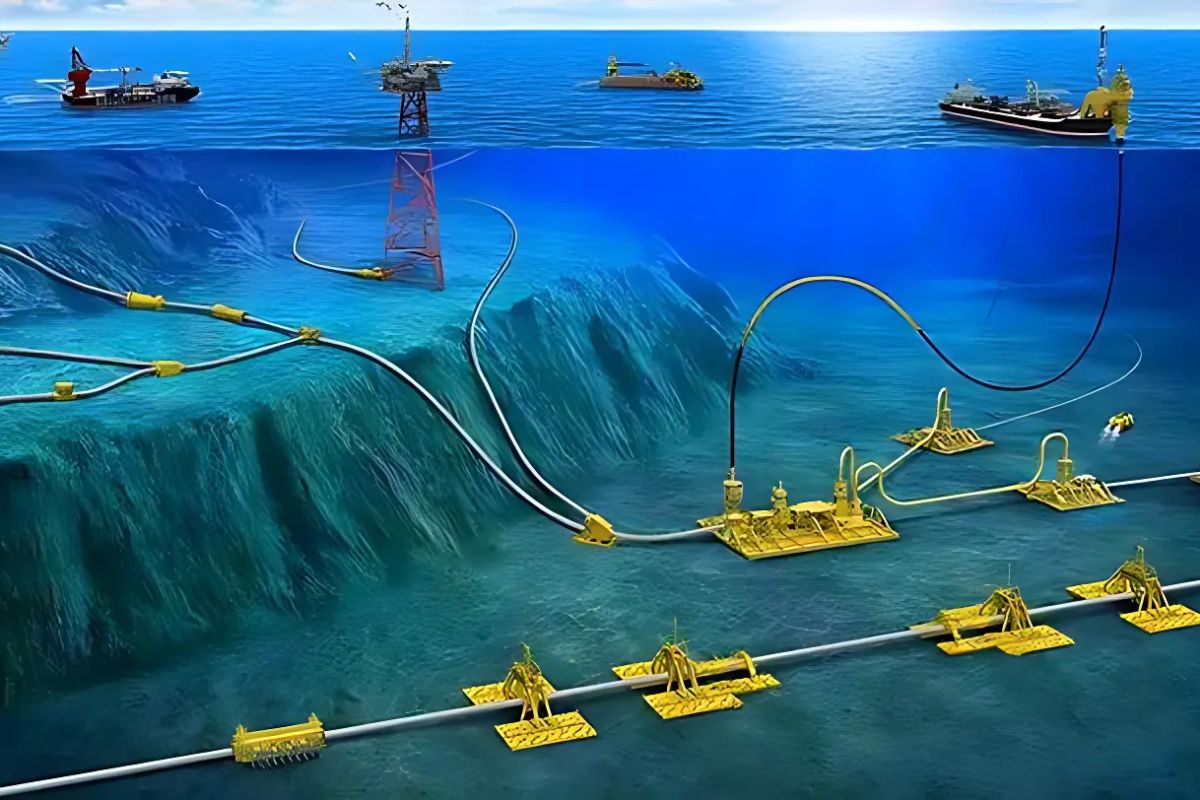
Details of Petrobras’ Ambitious Submarine Interconnection Projects, Focusing on the Búzios 11 Megaproject. We Analyze the State-Owned Company’s US$ 111 Billion Investment Plan and Its Crucial Impact on the Supply Chain and the Brazilian Naval Industry.
Petrobras is driving a new and significant era in oil and gas exploration in deep waters with its grand submarine interconnection projects. The Búzios 11 megaproject, located in the prolific pre-salt layer of the Santos Basin, is an emblematic example of this technological and investment offensive.
This article thoroughly analyzes these strategic ventures. We will discuss the billion-dollar contract for the submarine system of the FPSO P-83 in Búzios 11, the robust US$ 111 billion investment plan from the state-owned company for the coming years, and how these initiatives are shaping the future of the naval industry and offshore services in Brazil.
Búzios 11: A Deep Dive into Brazil’s Pre-Salt Megaproject
The Búzios field, discovered in 2010, is a central piece in Petrobras’ strategy. Currently the second-largest field in Brazil, the company’s projection is that Búzios will become the country’s largest oil producer by 2030, potentially reaching up to 2 million barrels per day, according to information from Petrobras itself.
-
Offshore industrial demand in Macaé skyrockets with the recovery of oil and gas and could grow by up to 396% by 2026 in the Campos Basin.
-
Offshore industrial demand in Macaé surges with the recovery of oil and gas and could grow by up to 396% by 2026 in the Campos Basin.
-
Brazilian giant expands borders in the Southeast: Petrobras confirms new oil discovery in ultra-deep waters in the pre-salt of the Campos Basin.

-
Alert in the global energy market: Severe tropical cyclone hits the coast and disrupts gas production at major plants in Australia, threatening global supply.


For the development of Búzios 11, Petrobras awarded Subsea7 a “super-major” contract for Submarine Collection and Flow Assurance Systems (SSCE), also known as SURF, worth R$ 8.4 billion (approximately US$ 1.5 billion). This contract provides for the interconnection of 15 wells (eight producers and seven WAG injectors) to the FPSO P-83, through 112 km of rigid risers and flowlines, in a water depth of 2,000 meters, as reported by Subsea7 and Petrobras. The offshore campaign is scheduled to begin in October 2027.
The FPSO P-83 will be the heart of Búzios 11. It is a unit from Petrobras’ “New Generation,” with the capacity to produce up to 225 thousand barrels of oil per day and 12 million m³ of natural gas. Built by Seatrium (formerly Keppel), with an Engineering, Procurement, and Construction (EPC) cost of US$ 2.8 billion, according to documents from the constructor, the P-83 incorporates advanced technologies such as Carbon Capture, Utilization, and Storage (CCUS), Digital Twins, and a closed flare system. Its start of production is expected in 2027, according to Petrobras.
Petrobras’ US$ 111 Billion Plan: Fuel for the Offshore Chain
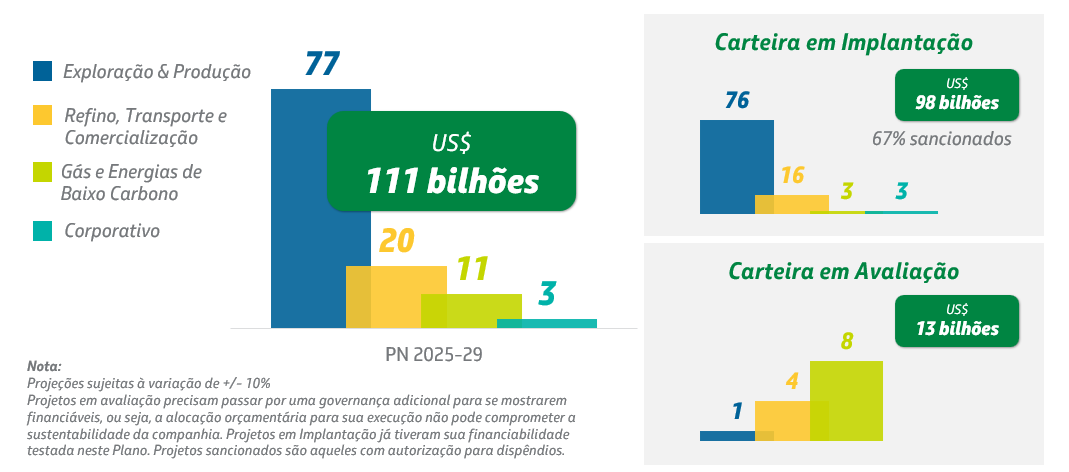
Petrobras’ Business Plan for the five-year period 2025-2029, as disclosed by the company, establishes a total investment of US$ 111 billion, an increase of nearly 9% compared to the previous plan. Of this amount, US$ 77 billion (69% of the total) is allocated for Exploration and Production (E&P), with a majority share of 61% (approximately US$ 47 billion) directed toward pre-salt assets. This substantial investment aims to expand Petrobras’ production capacity, achieve long-term production goals, and ensure Brazil’s energy security, reinforcing the pre-salt layer’s strategic role in the company’s operations.
Revitalizing the National Industry: Shipbuilding and Services on the Rise
The submarine interconnection projects of Petrobras and its overall investment plan serve as a strong stimulus for the national industry. The company plans to contract 11 new FPSO units and approximately 90 support vessels in the coming years, with a significant share of the module manufacturing for the FPSOs (estimated at 200,000 tons) to be carried out at Brazilian shipyards, according to information from Petrobras itself.
Recently, contracts totaling R$ 16.5 billion were formalized for 12 platform supply vessels (PSVs) with hybrid propulsion, with construction to be carried out by Bram Offshore and Starnav Serviços Marítimos in Santa Catarina. Transpetro, Petrobras’ logistics subsidiary, has also launched a bidding notice for eight new gas carriers, according to industry news. In the subsea services sector, major global players such as Subsea7, TechnipFMC, Saipem, Allseas, and Baker Hughes have secured substantial contracts for the pre-salt fields.
Local Content and the “New Industry Brazil”: Petrobras’ Strategy for Development
The Local Content (LC) policy is a key instrument in Petrobras’ strategy, although applied in a nuanced and targeted manner. For the FPSO P-83, for example, the minimum local content requirement is 25%, while for the SURF system of Búzios 11, the minimum target is 40%, with an expectation to exceed 50% national participation, according to the company’s management. This differentiation reflects the capabilities of the local industry in each segment.
New regulations from the National Agency for Petroleum, Natural Gas, and Biofuels (ANP), based on Law No. 15.075/2024, aim to increase the competitiveness of the Brazilian industry and ensure greater regulatory transparency concerning local content, as announced by the agency. Petrobras also demonstrates alignment with the “New Industry Brazil” policy, seeking to promote the national production chain and collaborating with the Brazilian Agency for Industrial Development (ABDI) in technology acquisition and innovation processes, as reported by these entities.
Innovation on the Seafloor: Petrobras’ Cutting-Edge Submarine Technologies
Petrobras has stood out for its pioneering in the adoption and development of advanced submarine technologies. An example is the HISEP® (High-Pressure Separation) system, a patented technology by Petrobras that allows the separation of CO2-rich gas from oil directly on the seabed. The first commercial implementation is planned for the Mero 3 project, in partnership with TechnipFMC, as announced by the companies. This innovation aims to increase production efficiency and reduce emissions.
The state-owned company is also advancing towards fully electric submarine systems, crucial for enabling production in fields far from the coast. A technological cooperation agreement with Curtiss-Wright Corporation for a submarine pumping system with an encapsulated motor, expected to be operational in 2027, is a step in this direction. Additionally, in collaboration with TechnipFMC, Petrobras is working on the development of Hybrid Flexible Pipelines (HFP), more resistant to CO2 corrosion, a challenge in the aggressive pre-salt environment.
New Strategies and the Future of the Submarine Market in Brazil
Alongside technological advancements, Petrobras is reevaluating its contracting strategies for SURF systems. There are indications, according to industry sources, that the company is exploring an alternative model that could involve the direct contracting of large pipe-laying vessels (PLVs), instead of awarding complete EPFI (Engineering, Procurement, Fabrication, and Installation) contracts to a single supplier. This change, if realized, could alter the dynamics of the supplier market.
Delays in important bidding for SURF systems, such as the Atapu-2 and Sepia-2 projects, estimated at over US$ 3 billion, may be related to this strategic review or challenges in the supply chain’s capacity and global inflationary pressures, as reported. The scenario requires industry stakeholders, from large SURF contractors to Brazilian shipbuilding companies, to diversify their offerings, focus on technology, and prepare for potentially more fragmented and competitive contract models.








-

Uma pessoa reagiu a isso.