





 Portuguese
  English
  Spanish
  4 min of reading
  0 comments


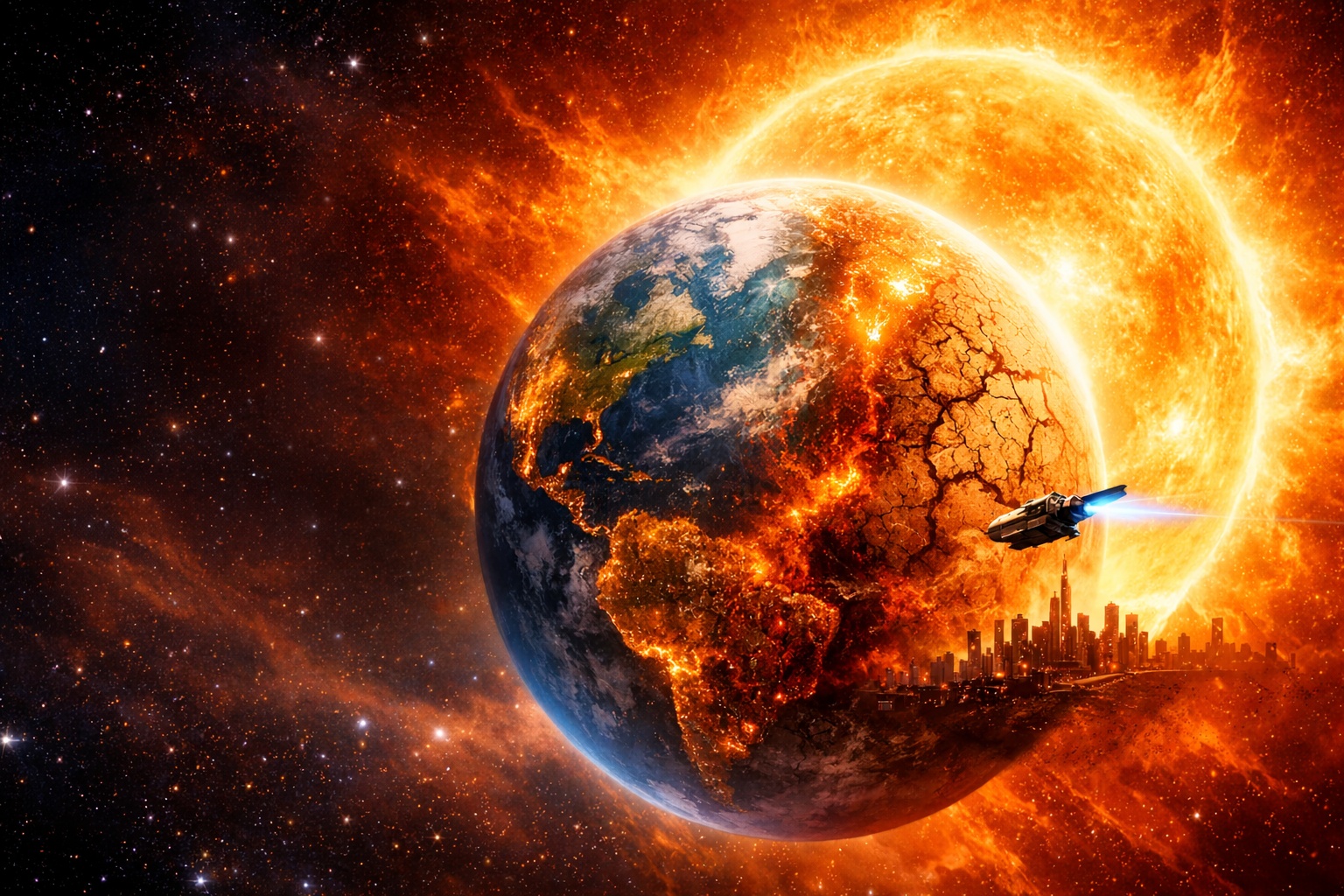
Studies Indicate That Earth Could Become Uninhabitable In About 1 Billion Years Due To Increased Solar Luminosity, Long Before The Red Giant Phase.
The Question Seems Out Of Science Fiction: How much time would humanity have before Earth ceases to be habitable? However, this question has been taken seriously by astrophysicists and climatologists studying stellar evolution and the limits of the habitable zone around the Sun. Solar evolution models indicate that the Sun — a G-class star — gradually increases its luminosity over time. This process is natural and occurs because, as hydrogen is converted into helium in the core, structural changes make the star progressively brighter.
The Consequence Is Clear: More energy reaches Earth. And this could have irreversible impacts long before the Sun transforms into a red giant.
The Sun Is Getting Brighter Every Billion Years
Studies published in astrophysics journals and analyses conducted by researchers affiliated with NASA indicate that the Sun increases its luminosity by about 10% every billion years.
-
Motorola launched the Signature with a gold seal from DxOMark, tying with the iPhone 17 Pro in camera performance, Snapdragon 8 Gen 5 that surpassed 3 million in benchmarks, and a zoom that impresses even at night.

-
Satellites reveal beneath the Sahara a giant river buried for thousands of kilometers: study shows that the largest hot desert on the planet was once traversed by a river system comparable to the largest on Earth.

-
Scientists have captured something never seen in space: newly born stars are creating gigantic rings of light a thousand times larger than the distance between the Earth and the Sun, and this changes everything we knew about stellar birth.

-
Geologists find traces of a continent that disappeared 155 million years ago after separating from Australia and reveal that it did not sink, but broke into fragments scattered across Southeast Asia.



This increase may seem small, but it is sufficient to profoundly alter Earth’s climatic balance.
Earth has already undergone dramatic changes in its geological past. However, the continuous increase in solar radiation may exceed the planet’s capacity to maintain stable liquid oceans.
Earth May Lose Oceans Before The Red Giant Phase
Long-term climate models suggest that, within approximately 1 billion years, solar luminosity may be high enough to trigger an uncontrollable greenhouse effect.
In this scenario, ocean evaporation intensifies. Water vapor — a potent greenhouse gas — further amplifies warming.
The result could be similar to what happened on Venus, which has a dense atmosphere and extreme temperatures.
Even before the Sun reaches the red giant phase, Earth may already be completely unlivable.
The Habitable Zone Is Gradually Shifting
The so-called “habitable zone” is the region around a star where liquid water can exist on the surface of a planet.
As the Sun becomes more luminous, this zone shifts outward.
Today, Earth is positioned within the habitable zone. However, in billions of years, this region could move beyond Earth’s orbit, making Mars potentially more favorable than Earth itself, although Mars also has structural and atmospheric limitations.
How Much Time Would Humanity Really Have?
If we consider the limit of 1 billion years as a critical point for complex habitability, that would be the theoretical maximum timeframe.
However, complex life may face difficulties long before that.

Gradual changes in global average temperature, atmospheric chemistry, and the availability of freshwater may begin to impact ecosystems long before the total collapse of oceans.
On a human scale, 1 billion years is an almost incomprehensible period. Modern civilization has existed for only a few thousand years.
Solar Evolution: What Will Happen Next?
In about 5 billion years, the Sun is expected to deplete the hydrogen in its core and enter the red giant phase.
During this stage, the star could expand its radius hundreds of times. Mercury and Venus will surely be consumed. Earth may be destroyed or, at the very least, completely sterilized.
But the central point of current studies is that habitability could end long before this dramatic event.
Could Advanced Civilizations Escape?
Theoretically, a technologically advanced civilization would have multiple possibilities:
- Colonization of other planets.
- Habitation on moons or artificial space stations.
- Migration to other stellar systems.
Projects such as Mars exploration, exoplanet studies, and research on interstellar travel are frequently discussed in the long-term context of species survival.
However, such possibilities depend on technological advances that are still in early stages.
Exoplanets Show That Habitable Worlds Are Temporary
Observations made by space telescopes have revealed thousands of exoplanets at different stages of evolution.
This data confirms that habitable planets are temporary phenomena on a cosmic scale.
As stars evolve, their habitable zones change, making previously stable worlds uninhabitable. Earth is not an exception to the universal rule.
The Scale of Cosmic Time
It is important to provide context. Earth is about 4.5 billion years old. Complex life emerged relatively late in its history.
If the planet becomes uninhabitable within 1 billion years, that still represents a significant period compared to the total time of multicellular life existence.
From a cosmic perspective, habitability is a limited window.
Does Humanity Need To Worry Now?
No. The gradual increase in solar luminosity does not pose a threat to the next generations or for thousands or millions of years to come.
The current climate changes are much more immediate phenomena and are linked to human activity. The solar fate is a matter of astronomical scale.
The Distant Future of Earth
Studies on solar evolution and the fate of Earth’s habitability are not exercises in pessimism but in scientific understanding.
They show that planetary stability depends on stellar factors that evolve slowly, yet inevitably.
In about 1 billion years, Earth may no longer sustain liquid oceans. In 5 billion years, it may not even exist as a habitable planet.
The question of how much time humanity would have to leave Earth has no practical answer today — but reveals something essential: even seemingly stable planets have a cosmic expiration date.
And on the scale of the Universe, our world is merely a temporary stage in the history of stars.








-

-

-

-

-

-

22 pessoas reagiram a isso.