





 English
  Francês
  Alemão
  Italiano
  Japonês
  Norueguês
  Portuguese
  Spanish
  5 min of reading
  0 comments


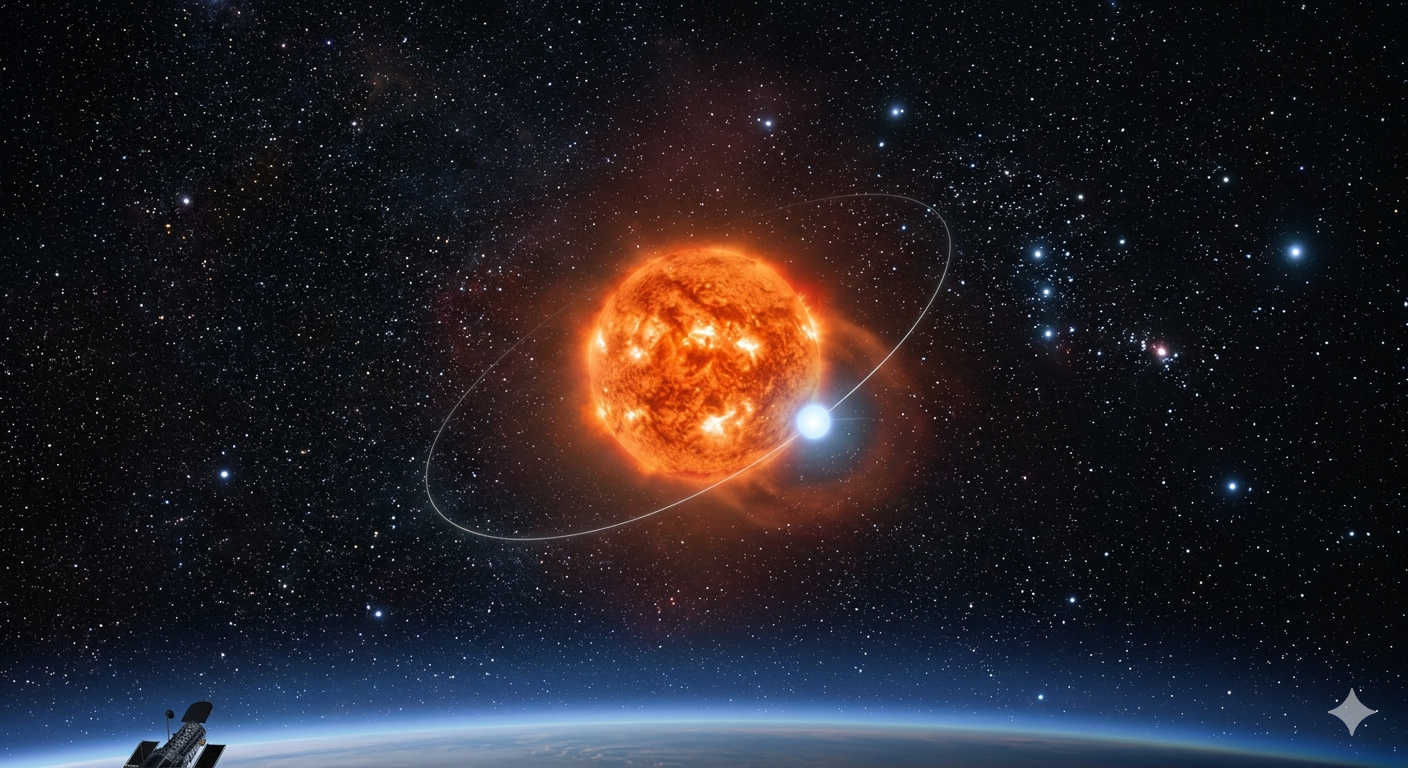
Betelgeuse may have a companion star discovered in 2025 by Gemini North, orbiting every ~6 years and helping to explain its brightness variations.
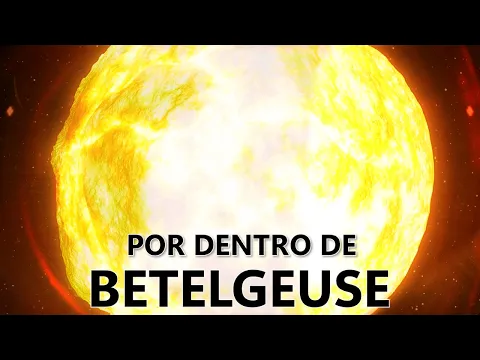
In 2025, observations made with the Gemini North telescope, operated by NOIRLab and associated with NASA, provided one of the most intriguing pieces of evidence ever recorded about the star Betelgeuse, located approximately 640 light-years from Earth. According to a official statement from NOIRLab and a study led by NASA researchers published in the Astrophysical Journal Letters, the data indicate the presence of a possible companion star, observed using high-resolution imaging techniques at Gemini North.
The analysis suggests that this companion may have a mass close to that of the Sun and orbit the supergiant over a period of about 2,100 days, equivalent to approximately 6 years — a cycle that coincides with the brightness variations observed in the star for decades.
This discovery does not represent a definitive confirmation, but marks the first time there is consistent direct observational evidence supporting a theoretical model discussed for decades. If confirmed, this companion could explain part of the brightness variations that have made Betelgeuse one of the most studied stars in the sky.
-
Archaeologists open a sealed Roman coffin that has been closed for 1,700 years and find a young woman surrounded by 140 coins, intact vases, and luxury items.

-
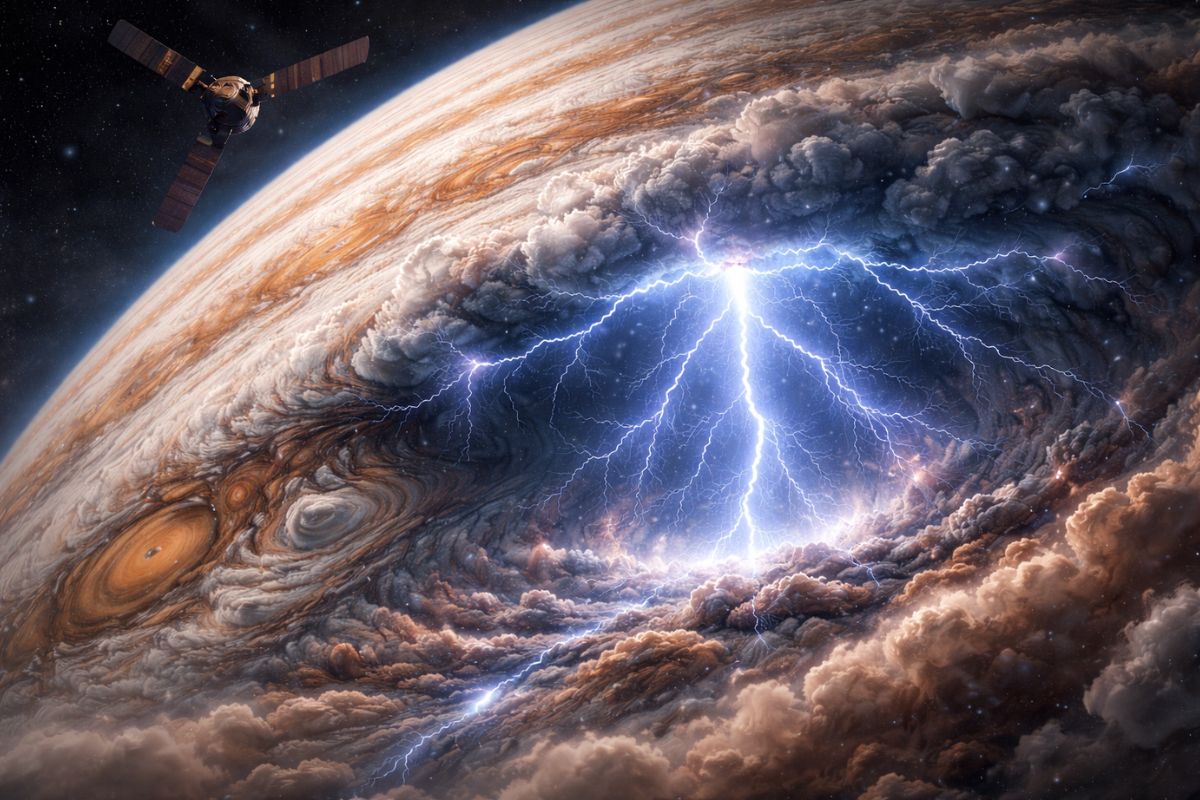
Storms on Jupiter generate lightning up to 100 times stronger than that on Earth, and data from the Juno spacecraft reveal extreme discharges in the planet’s superstorms.
-
Brazilian discovery leads cancer cells to collapse, reverses the logic of treatment, and may pave the way for therapies with less resistance and less damage to healthy body cells.

-
In the depths of the African forest, these rare and terrifying native species dominate rivers, swamps, and treetops with venom, brute strength, lethal teeth, and behaviors that seem impossible in the heart of the wild.


What changed in 2025: the first consistent observational evidence
For decades, astronomers suspected that Betelgeuse might have a companion. This hypothesis arose because the star exhibits a brightness variation cycle with a period of about 6 years, something difficult to explain solely with internal processes.

The observations made in 2025 utilized advanced interferometry and high-resolution imaging techniques, allowing the detection of a signal consistent with a secondary object extremely close to the main star.
This type of detection is extremely challenging, as Betelgeuse is a red supergiant with an extensive and turbulent atmosphere, which can obscure nearby objects and generate noise in the observations.
An extreme orbit: possibly within the star’s atmosphere
One of the most impressive aspects of the proposed model is the proximity of the possible companion star.
Estimates indicate that it may orbit at about 4 astronomical units (AU) from Betelgeuse — a distance equivalent to the region between the Sun and the asteroid belt.

However, Betelgeuse is a gigantic star, with a radius that can exceed 700 times that of the Sun. This means its outer atmosphere extends over a vast region of space.
In practice, the companion may be orbiting within the outer layers of the star, directly interacting with the gas and ejected material.
How this star may affect the brightness of Betelgeuse
The presence of a companion in such a close orbit may generate significant effects. Among the main mechanisms studied are:
- gravitational disturbance of the supergiant’s atmosphere
- compression and displacement of gas
- formation of dense dust regions
- creation of “trails” of material along the orbit
These effects may partially block the light from the star, causing variations observed from Earth. This model helps explain the long-term brightness variation cycle, which was already known but not fully understood.
The “Great Dimming” was not caused by the companion
Despite the excitement surrounding the discovery, it is important to separate the phenomena. The most famous event involving Betelgeuse occurred between 2019 and 2020, when the star experienced a dramatic dimming known as “Great Dimming”.
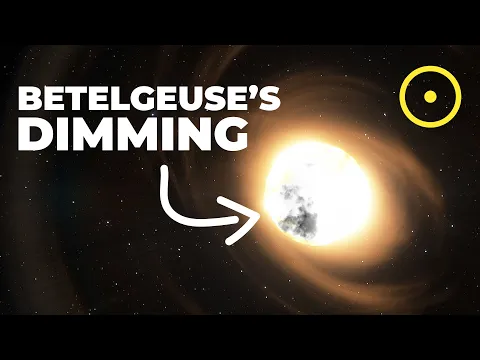
Initially, this generated speculation about a possible imminent supernova. However, subsequent studies showed that the event was caused by:
- ejection of material from the star itself
- formation of a dust cloud
- temporary blockage of light
The companion star is not considered the direct cause of this specific event, although it may influence other variation patterns.
Why Betelgeuse is one of the most important stars in the sky
Betelgeuse is a red supergiant located in the constellation of Orion and is among the brightest stars visible to the naked eye.
It is considered a candidate for supernova because:
- it is in an advanced stage of evolution
- it has a large mass
- it already exhibits structural instability
However, there is no evidence that an explosion is about to happen on a human time scale. The discovery of the possible companion reinforces this view by offering alternative explanations for its brightness variations.
The next step: confirm the existence of the companion
Despite the evidence from 2025, the scientific community still treats the discovery as provisional. The detection has a limited statistical level, which means new observations are necessary for definitive confirmation.
The next important observation window is expected in 2027, when the estimated orbital position of the companion will allow new detection attempts. If confirmed, this will be one of the most important discoveries about supergiant stars in recent decades.
A system more complex than previously imagined
The possible existence of a companion star significantly changes the way Betelgeuse is understood.
Instead of an isolated system, it may be part of a dynamic binary system, where gravitational interactions and matter flows play a central role in the evolution of the star.
This opens new possibilities for understanding how massive stars lose mass, evolve, and eventually explode as supernovae.
A mystery that began decades ago and is still ongoing
For decades, the brightness variations of Betelgeuse have been interpreted as signs of extreme internal instability, fueling theories about an imminent explosion.
The discovery in 2025 does not resolve the mystery but offers an important piece of the puzzle. It shows that the star’s behavior may be influenced by external factors, not just by internal processes.
And, as often happens in science, each answer opens new questions — transforming Betelgeuse into one of the most fascinating natural laboratories in the visible universe.








Seja o primeiro a reagir!