





 Portuguese
  English
  Spanish
  7 min of reading
  0 comments


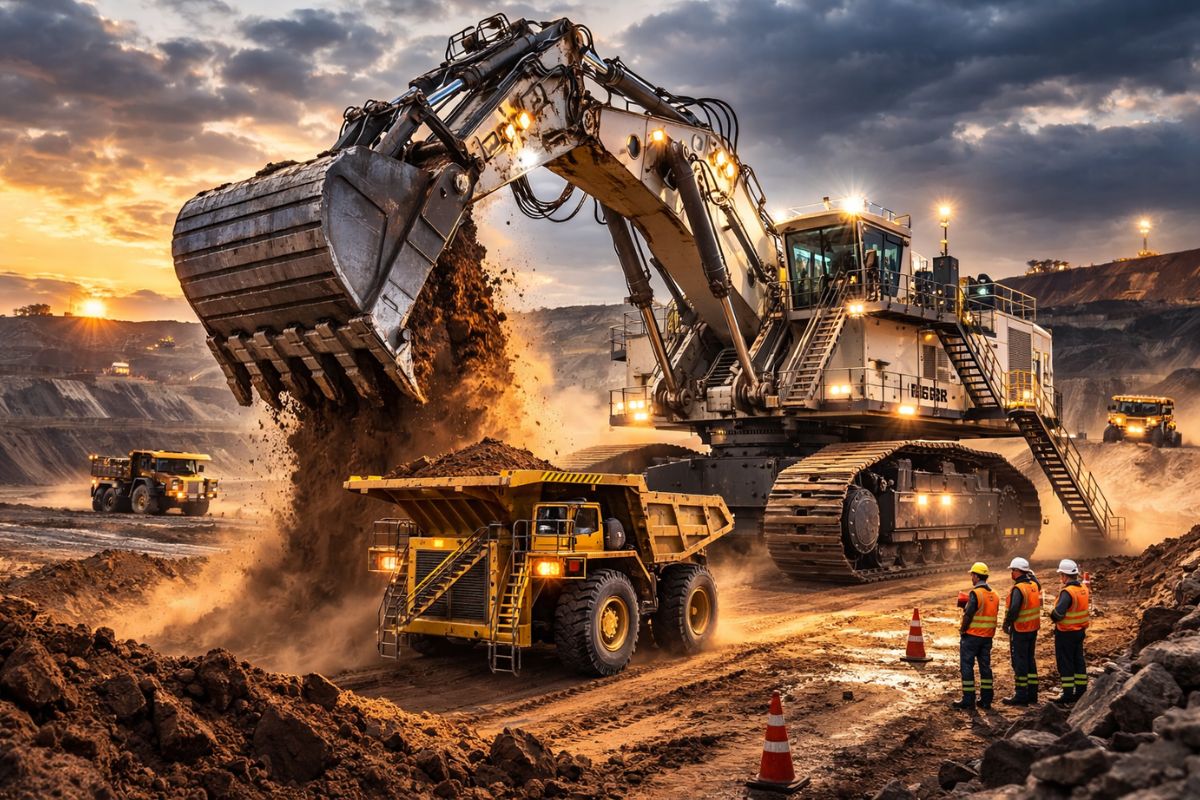
In New South Wales, the Liebherr R9800 became operational with a unique bucket of 56 m³ and 57 tons, built in over 2,000 hours to move mineral sands 24 hours a day, reduce interaction between machines, sustain high productivity and explain why mining demands gigantism.
The Liebherr R9800 became operational in Australia with a feature that sets it apart even within the realm of large mining excavators: the largest bucket ever manufactured by the brand itself. With 56 m³ of capacity, 57 tons of weight, and potential to reach around 90 tons per scoop, the setup was put to work in a mineral sand mine in New South Wales.
The size was not chosen for mechanical show-off. It responds to the density of the material being moved, the narrow and long shape of the pit, and the operational decision to use fewer large equipment to maintain high production. In practice, the scale of the Liebherr R9800 became a tool for efficiency, not just a symbol of power.
The operation occurs 24 hours a day, seven days a week, in an environment where there is no drilling, blasting, or hard rock dominating the mining front. What exists is a different logic of mining: removal of sandy and clay overburden until reaching concentrated bands of mineral sands, in a continuous process that requires rhythm, coordination, and control.
-
New CCR concrete paving technology promises roads up to 3x more durable, less maintenance, and cost reduction in Brazil.
-
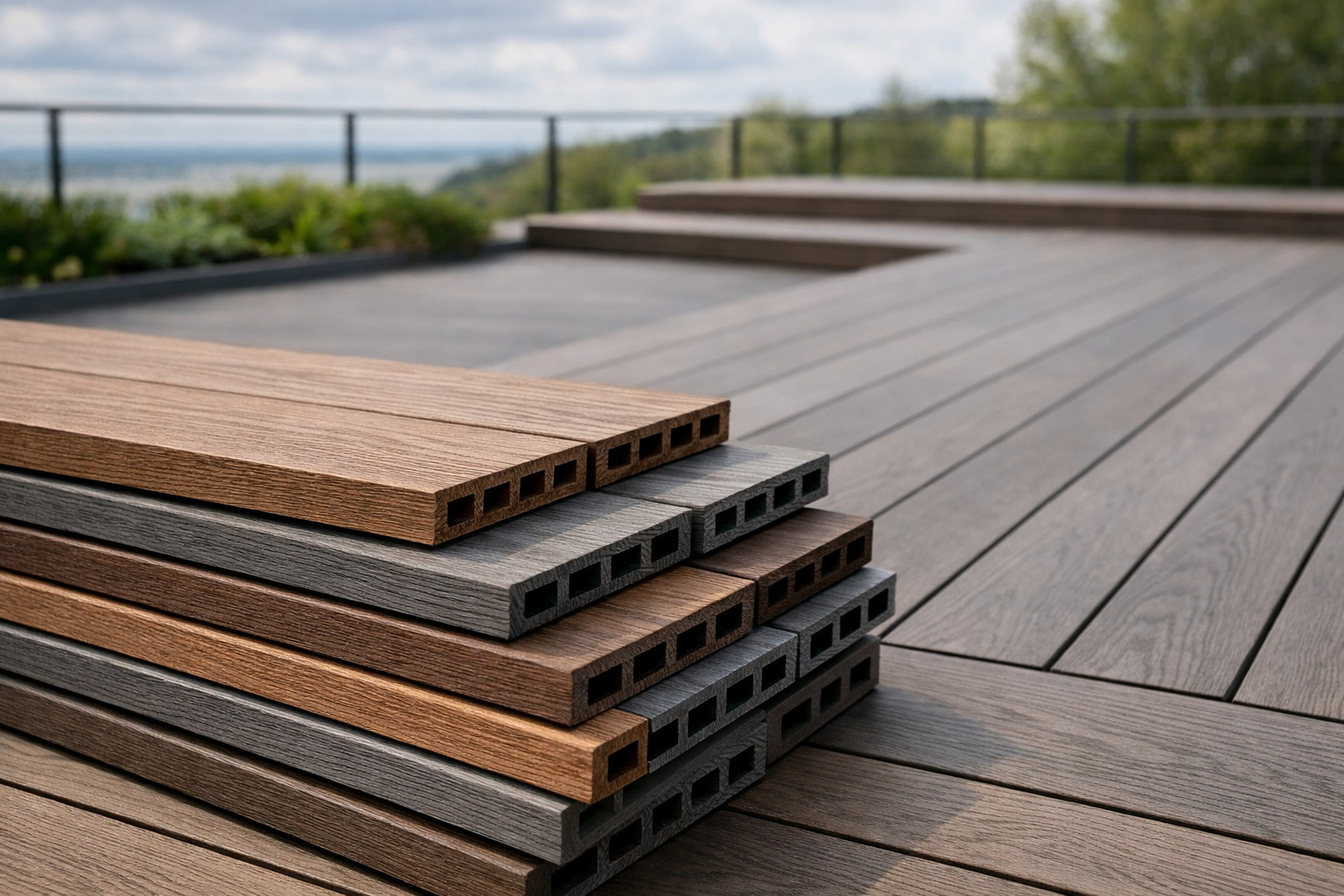
Made from recycled plastic, plastic wood is gaining space in the construction industry because it does not rot, resists moisture, and reduces maintenance costs over the years.
-
Florianópolis will receive a million-dollar BRT that will begin construction in 2026 with nearly 400 million in funding from the federal government and the Inter-American Development Bank, and the map already shows the routes for the exclusive bus corridors.

-
Without a blueprint, without an engineer, and using scrap from the dump, a father spends 15 years building an 18-room castle for his daughter, featuring tram tracks, 13 fireplaces, and over 700 m², which may now be demolished.

It is precisely here that the machine gains relevance. The combination of an unprecedented bucket, large trucks, and a mine designed for constant flow transforms the Liebherr R9800 into the centerpiece of an operation that aims to extract more material with less interaction between equipment.
Why The Liebherr R9800 Received An Out-Of-Standard Bucket

The bucket installed on this Liebherr R9800 is not only larger than the standard version of the model. It was built as a single piece for this specific context.
The structure has 4.22 meters in height, 5.8 meters in width, and 5.7 meters in depth, something comparable to the volume of a garage. Its weight reaches 57 tons, and manufacturing consumed more than 2,000 hours of work and about one ton of welding wire.
There is a technical detail that helps explain this choice. A standard bucket for the R9800 is around 47 m³. In this Australian operation, the bucket advanced to 56 m³, a jump of approximately 18%.
This increase was not designed to confront harder rock, but to take advantage of a lighter and more homogeneous material, the mineral sands and their sandy cover, without overloading the excavator.
The engineering of the component itself needed to deviate from the conventional. Since the width of the steel sheet was not enough to accommodate the increase in dimensions using the usual design, the manufacturer adopted three separate rolling sections. This shows that the project was not a simple scaling up, but a complete structural adaptation around the Liebherr R9800.
Another important detail is the internal coating used to reduce clay adhesion. In wet materials, part of the load can stick to the walls of the bucket and cut efficiency at each cycle.
The smoother plastic coating attempts to minimize this loss. In equipment of this size, small variations per pass can represent a huge difference throughout the shift.
The Geology Of The Mine Explains Gigantism

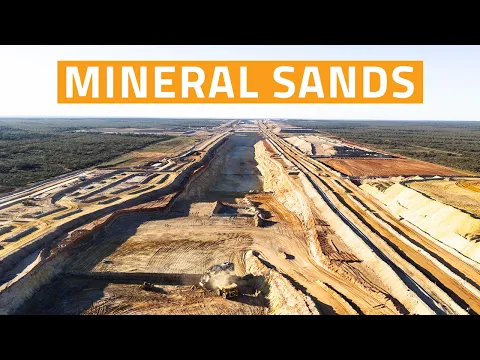
The mine in New South Wales operates over a strip of approximately 150 meters in width by 12 kilometers in length.
The operational description is straightforward: it is an ancient beach, where over millions of years, the heavier minerals have been separated from the lighter ones by the actions of gravity, wind, and water, forming concentrated bands of mineral sands.
This geology creates a unique operation. The overburden removal ratio is about 6 to 1, which means removing six parts of overburden to reach the mineral sand of interest.
There is no drilling, no blasting, and no dominant rock in the excavation. The work consists of removing a mixture of sand and clay which afterwards helps fill already mined areas for recovery.
In this context, the Liebherr R9800 works in benches that descend about 4.5 meters at a time until the desired material is reached. Since the pit is narrow and long, the space for the simultaneous movement of several smaller machines is limited.
It was precisely this physical limitation that pushed the choice for larger equipment with a larger bucket, instead of multiplying smaller units at the mining front.
The decision makes sense within the logic of the site. Theoretically, smaller excavators could fulfill part of the production demand, but the excess of machines in a reduced area would increase interaction, operational risk, and complexity.
The Liebherr R9800, with its extraordinary bucket, allows for maintaining high numbers with a leaner fleet moving around.
Fewer Equipments, More Load Per Cycle

The configuration described in the operation works with the Liebherr R9800 loading trucks in four passes per cycle.
Among the main partners of the excavator are the Caterpillar 794 AC, electric drive trucks, as well as 793 units used depending on the length of the transport corridors.
The operational reasoning is simple: larger trucks mean fewer relative trips for the same volume, and fewer trucks in circulation mean less interaction.
This design reduces the number of assets crossing in the pit and helps maintain fluidity. The excavator operator works with monitoring screens, truck weights, and cameras, aiming to keep production within shift targets.
At a certain point in the described operation, the load per scoop was around 90 tons, a number that helps to gauge the gain brought by the unprecedented bucket.
The company responsible for the use of the machine sought exactly this: fewer, yet larger, equipment to sustain high production with less interference between themselves.
It is not just a choice of size, but a decision for safety and productivity. In a narrow pit, each additional movement, every extra maneuver and each encounter between machines weighs on the final result.
There is also the question of the type of material. Since the overburden is softer and the operation works without blasting rock, excavation can maintain a constant rhythm when floor, moisture and organization are under control.
This allows the Liebherr R9800 to operate with productive aggressiveness without the extreme variability typical of harder mines.
What Keeps The Operation Running 24 Hours A Day
The Liebherr R9800 works in continuous schedule, 24 hours a day and seven days a week, with scheduled maintenance stops at defined cycles.
Aside from that, the machine continues to operate for long periods, changing operators, receiving fuel and grease, but without structural reduction in work rhythm. The shift does not depend solely on the excavator; it depends on an entire chain operating in sync.
Around it, tractors come in for floor management, a Caterpillar 24H grader for maintenance of corridors, water trucks for dust control and dampening the pit’s floor, and additional tractors in the area for material disposal.
This infrastructure exists because the sandy material changes behavior according to moisture. When too dry, the base can become less favorable to the trucks; when dampened, it hardens and improves support.
The operation also requires attention to the front’s design. The excavator traverses the bench from start to finish, returns, and restarts the sequence, preferring a certain advance direction due to the visibility of the cabin for the trucks.
The gigantism of the Liebherr R9800 does not eliminate operational detail; on the contrary, it makes each detail even more crucial.
Performance numbers show this. In a 12-hour shift, reported production reached tens of thousands of cubic meters of overburden, with load per truck in elevated ranges and a clearly collective effort among the excavator operator, truck drivers, ground support, and technical supervision. The machine is the center of the scene, but the result is systemic.
When The Scale Ceases To Be Exaggeration
The Liebherr R9800 in operation in Australia’s mineral sands shows that size alone explains nothing. What explains it is the combination of geology, pit shape, material density, truck selection, the need to reduce interaction, and the pursuit of continuous production.
It is this that transforms a bucket of 56 m³ and 57 tons into a design solution, and not an excess.
By deploying the largest bucket ever manufactured by Liebherr, the Australian operation exposes an important point of modern mining: in certain environments, growing is not luxury, it is method.
And when this method connects to an excavator capable of moving up to around 90 tons per scoop, the gigantism ceases to seem spectacle and starts to function as calculation.
If you had to choose the most impressive element of this operation, what would it be: the 56 m³ bucket, the load of up to 90 tons per scoop, the 24 hours a day regime, or the decision to use fewer larger machines to keep the mine running with more control?










-

-

-

-

8 pessoas reagiram a isso.