





 Portuguese
  English
  Spanish
  3 min of reading
  26 comments





With a Capacity for Up to 174 Passengers and Delivery Promised Already in 2025, China’s C919 Aircraft Promises to Revolutionize the Brazilian Aviation Market, Challenging the Airbus and Boeing Duopoly and Bringing Innovation with Speed and Efficiency.
Total Linhas Aéreas has just signed a contract with Comac to operate China’s C919 aircraft, the newest competitor to giants Airbus and Boeing. Is Brazil ready for this innovation?
The C919, produced by Comac (Commercial Aircraft Corporation of China), is a single-aisle, narrow-body aircraft designed to compete with models like the Airbus A320 and Boeing 737. It has a capacity for up to 174 passengers and has already accumulated over 10,000 flight hours since it entered operation in 2023.
Technical Sheet of China’s Aircraft and Operational Capacity and Competition with Airbus and Boeing
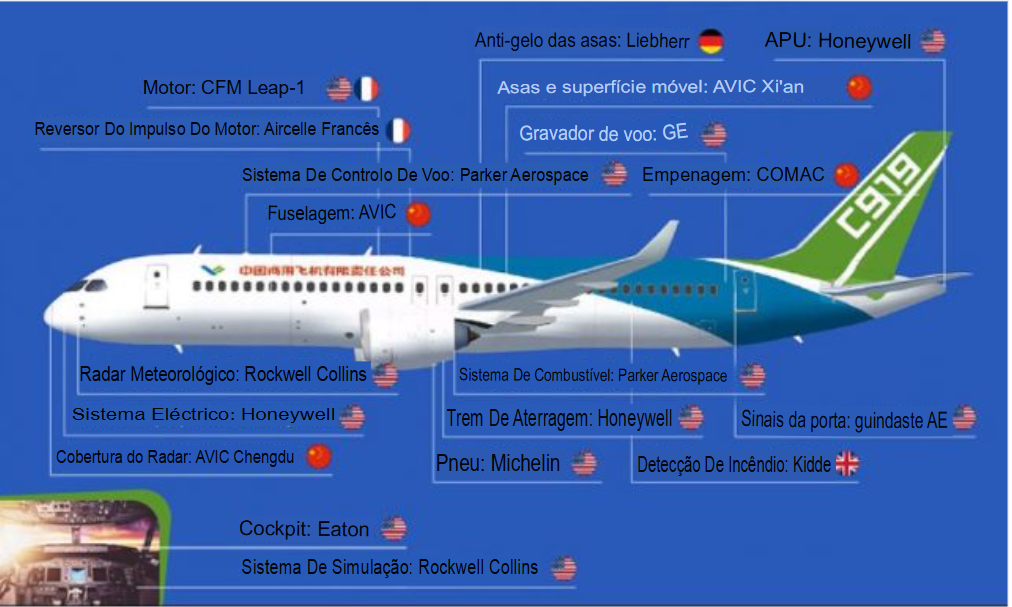
With a range of up to 5,555 km and a cruising speed of 834 km/h, the C919 blends efficiency with cutting-edge technology. Its design prioritizes fuel economy and comfort, characteristics that make it a promising choice for airlines looking to modernize their fleets.
-
50 viaducts, 4 tunnels, 28 bridges, and 40 kilometers of bike paths: BR-262 in Espírito Santo will receive 8.6 billion reais for the largest engineering project in the state’s history, inspired by the Immigrant Highway in São Paulo.

-
Brazil produces too much clean energy and doesn’t know what to do with it: over 20% of solar and wind capacity was wasted in 2025 while investors flee and 509 renewable generation projects were abandoned in the last year.

-
Piauí will produce a new fuel that replaces diesel without needing to change anything in the truck’s engine and reduces pollutant gas emissions by half: truck drivers from all over the Northeast are already celebrating the news that will arrive later this decade.

-
A new Brazilian shopping center worth R$ 400 million will be built in an area equivalent to more than 4 football fields, featuring 90 stores, 5 cinemas, a supermarket, a college, and parking for 1,700 cars, potentially generating 3,000 jobs.


Although the market is dominated by Western manufacturers, the C919 emerges as a viable alternative, especially in times of production bottlenecks at Airbus and Boeing. The Chinese model promises to shorten delivery times, something essential for companies with aggressive expansion plans.
Why Choose the C919?
According to Paulo Almada, controlling partner of Total, the decision was motivated by the immediate availability of the Chinese aircraft. While Airbus and Boeing offer delivery times that can exceed five years, Comac promised to supply a C919 unit as early as 2025.
In addition to charter flights, Total plans to resume regular operations, taking advantage of the moment of low competition and high demand for aircraft. The acquisition of the C919 is seen as a strategic step to consolidate the company’s presence in the Brazilian market.
The Role of Anac in the Process
Before the C919 takes off in Brazil, it will need to be certified by Anac. This is a rigorous process, but Total believes that the procedure will be swift due to the mutual benefits between Brazil and China in the aviation sector.
The partnership with Comac also reflects the strengthening of trade ties between the two countries. According to Almada, the Chinese manufacturer is willing to “jump the queue” to serve the Brazilian market, demonstrating China’s interest in expanding its global influence in the sector.
ACMI Mode: An Innovative Bet
Total plans to use the C919 in the ACMI mode, where the aircraft is leased to other companies along with crew, maintenance, and insurance. This practice is common in Europe and helps airlines meet peak demand without acquiring new planes.
With the flexibility of the ACMI model, Total can explore the potential of the C919 without relying solely on regular routes. The idea is to offer the aircraft as a temporary solution for large companies while Total consolidates itself as a reference in this business model.
The Impact of the C919 on the Brazilian Aviation Sector
The arrival of the C919 could herald a new era for Brazilian aviation. With competitive prices and fast delivery, it has the potential to break the dominance of Airbus and Boeing, diversifying the aircraft options available in the market.
Smaller companies, such as Total, gain a unique opportunity to modernize their fleets without facing the logistical and financial challenges imposed by traditional manufacturers. This could create a ripple effect, stimulating competition and improving services for passengers.
China’s C919 aircraft represents more than a technological alternative for the Brazilian aviation market. It symbolizes a paradigm shift, challenging industry giants and opening new possibilities for local companies. Are we on the brink of a revolution in Brazil’s skies? The future will tell, but with Total at the helm, the winds of change have already begun to blow.










Boa, mas só acredito vendo… O C919 já esta homologado no Brasil???
A matéria ficou devendo comentários sobre como fica esse mercado com a participação da Embraer neste cenário.
A china não é vista com bons olhos referente à qualidade de seus produtos. Será que esse tipo de produto trará credibilidade para ter passageiros ?
Eu mesmo tenho minhas reservas.