





 Portuguese
  English
  Spanish
 4 min of reading
  9 comments


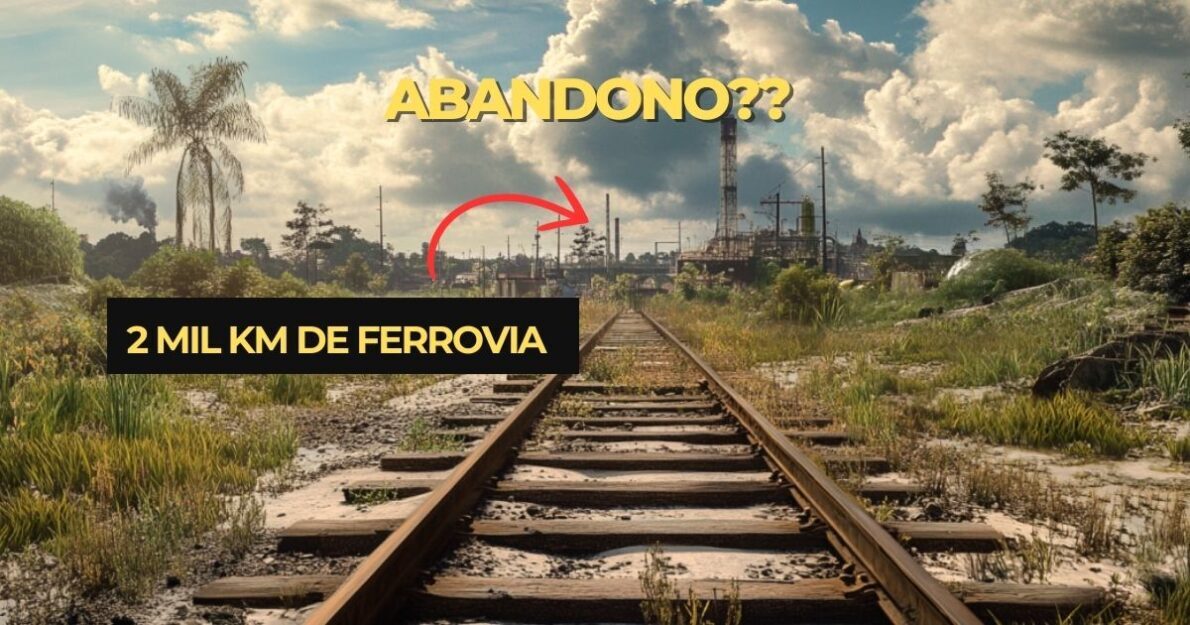


Bahia Is At Risk of Losing 2,000 Km of Railways Due to Lack of Renewal of the Centro Atlântica Railway (FCA) Concession, Operated by VLI. The Public Hearing Revealed Discontent With the Abandonment and Lack of Investments in the Section.
Government and entrepreneurs demand modernization and assess alternatives to save the railway infrastructure and avoid economic losses.
The situation of the Bahia railway network has reached its limit.
With a concession about to expire and an impasse between the concessionaire VLI and the government of Bahia, the state is on the verge of losing 2,000 kilometers of railways.
-
Larger than entire cities in Brazil: BYD is building a 4.6 km² complex in Bahia with a capacity for 600,000 vehicles per year, but the discovery of 163 workers in conditions analogous to slavery has shaken the entire project.

-
With an investment of R$ 612 million, a capacity to process 1.2 million liters of milk per day, Piracanjuba inaugurates a mega cheese factory that increases national production, reduces dependence on imports, and repositions Brazil on the global dairy map.

-
Brazilian city gains industrial hub for 85 companies that is equivalent to 55 football fields.

-
Peugeot and Citroën factory in Argentina cuts production by half and opens a layoff program for more than 2,000 employees after Brazil drastically reduced purchases of Argentine vehicles.


Meanwhile, the future of the Centro Atlântica Railway (FCA), vital for the transportation and flow of goods, remains in limbo, generating intense public debates and strong opposition from various sectors in Bahia.
The public hearing held in Salvador revealed widespread dissatisfaction among Bahianos regarding VLI’s performance, responsible for the FCA concession.
Entrepreneurs, politicians, and experts expressed their discontent, highlighting the neglect with which VLI treats the railway sections that run through Bahia.
According to unanimous opinions, renewing the concession without substantial changes would reward the concessionaire despite its history of neglect and lack of investment in local railway infrastructure.
Challenges and Demands for Modernization
The Federation of Industries of Bahia (Fieb) also spoke out, emphasizing the need to include a modernization project for the railway corridor between Minas Gerais and Bahia.
However, VLI claims that the section does not have enough cargo to justify new investments.
This argument was contested during the hearing, where several companies reported that they could use the railway but hesitate due to the instability in the renewal process, which has been dragging on since 2015.
Studies by the Dom Cabral Foundation show that the potential cargo in the section could make it economically viable, contradicting VLI’s justification.
According to the newspaper Valor Econômico, four alternatives are being considered for the operation of the railway:
- Keep VLI as the operator, following the current format;
- Keep VLI with a modified operational format;
- Bid the section to a new company;
- Conduct a public call to attract new operators.
Despite these options, VLI, controlled by Brookfield and Vale, remains resistant.
The company stated that modernizing the Bahian sections would cost R$ 25 billion, an amount that analysts consider overestimated.
According to independent estimates, modernizing the 795 km stretch between Corinto (MG) and Campo Formoso (BA), including the gauge conversion, would cost around R$ 6 billion, a more realistic figure.
Positions of Bahian Authorities and Experts
The economist and former planning secretary of Bahia, Armando Avena, argues that VLI should be responsible for the modernization and operation of the Corinto-Campo Formoso section.
For him, a new bidding process would cause significant delays and remove Bahia from the railway development map for the Northeast-Southeast axis.
He suggests that continuing with VLI and a contractual renewal requiring improvements in the Bahian section would be the most practical and beneficial solution for the state.
Antônio Carlos Tramm, former president of the Baiana Geological Research Company (CBPM) and responsible for commissioning the Dom Cabral Foundation study, reinforced the criticisms.
Tramm stated that VLI is responsible for the wear and tear of the Bahian railway network and suggested a compensation to the state government of about R$ 10 billion, an amount that could finance a Public-Private Partnership (PPP) for the start of constructing a new railway.
Bahian Government and Economic Impacts
The position of the government of Bahia is also clear.
During the public hearing, the Secretary of the Civil House of Jerônimo Rodrigues’ government, Afonso Florence, highlighted the economic and social damages caused by VLI’s mismanagement of the Minas-Bahia railway corridor.
Florence emphasized that investments in Bahian railway infrastructure are urgent and should be a condition for renewing the concession.
For the secretary, updating and qualifying the railway network are essential measures to compensate for the economic losses that the state has suffered due to the abandonment of railway transport.
Florence believes that Bahia cannot accept a new contract without robust guarantees that the stretch will be modernized and expanded to meet the logistical and economic demands of the region.
The Future of the Railway: Between Resistance and Negotiation
VLI remains firm in its position, and tension between the company and the Bahian government increases as the deadline for the decision on the concession approaches.
The next steps will determine the future of an important railway network that connects states and drives local economies.
If the concession is not renewed or if the government of Bahia does not reach a favorable agreement, the state may lose a vital infrastructure that connects the Northeast to the Southeast of the country, with deep impacts on cargo transportation and economic development.
And you, do you believe that the state should seek new partners to modernize its railway network? Is VLI capable of transforming the Bahian railway? Leave your opinion in the comments.






Eu acho que deve ter um intervenção do governo federal e estadual porque ao tempo a nossa ferrovia bahiana vem sofrendo um grande descaso é mais fácil abrir uma ferrovia ou investir ne uma base que já tá pronta
Tira a VLI e vai ficar sem ferrovia ninguém quer lidar com o trexo, mão de obra complicada e sem garantia de utilização da via e impostos complicado desgoverno do PT ninguém merece
Para de fala ****.
Bolsonaro, ficou quatro anos, o que ele fez, a respeito da ferrovia.
Penso que o Estado não deve se curvar aos caprichos da VLI. E se não houve investimentos ao longo dos anos da concessão a culpa cabe ao Estado que falhou quer nos detalhes da concessão quer na fiscalização do cumprimento do contrato.
Um novo chamamento público PMI só vale se houver demanda atualmente futura que seja atrativo.
Penso que o Estado deva avaliar bem entrategicamente e não ceder!