





 Portuguese
  English
  Spanish
  5 min of reading
  0 comments


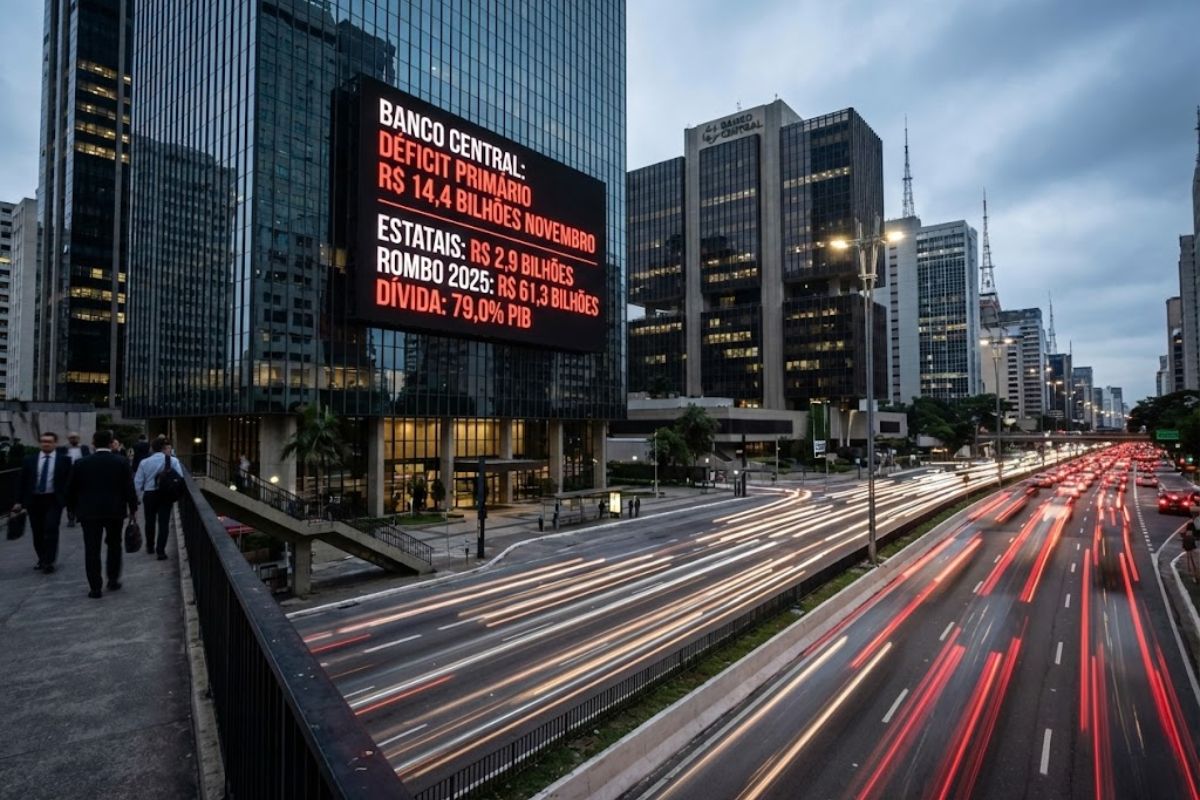
Central Bank Releases Data on December 30, 2025: Public Accounts Closed November with Primary Deficit of R$ 14.4 Billion, with State-Owned Companies Declining. In the Accumulated of 2025, the Deficit is R$ 61.3 Billion and Public Debt Rises to 79.0% of GDP.
On December 30, 2025, the Central Bank reported that the public accounts of the consolidated public sector registered primary deficit of R$ 14.4 billion in November. The official data presented is from the Central Bank, and the result does not include interest from public debt.
In the details released on December 30, 2025, the Central Bank reported that, in November, the federal government had a negative balance of R$ 16.9 billion, states and municipalities totaled a surplus of R$ 5.3 billion, and state-owned companies recorded a deficit of R$ 2.9 billion. In the accumulated of 2025, public accounts remain in the red and the public debt advanced to 79.0% of GDP, not counting interest in the calculation of the primary result.
What Does Primary Deficit Mean in Public Accounts
Primary deficit is the result of public accounts before the payment of interest.
-
Brazil produces too much clean energy and doesn’t know what to do with it: over 20% of solar and wind capacity was wasted in 2025 while investors flee and 509 renewable generation projects were abandoned in the last year.

-
Piauí will produce a new fuel that replaces diesel without needing to change anything in the truck’s engine and reduces pollutant gas emissions by half: truck drivers from all over the Northeast are already celebrating the news that will arrive later this decade.

-
A new Brazilian shopping center worth R$ 400 million will be built in an area equivalent to more than 4 football fields, featuring 90 stores, 5 cinemas, a supermarket, a college, and parking for 1,700 cars, potentially generating 3,000 jobs.

-
Larger than entire cities in Brazil: BYD is building a 4.6 km² complex in Bahia with a capacity for 600,000 vehicles per year, but the discovery of 163 workers in conditions analogous to slavery has shaken the entire project.


When revenues fall short of expenses, the primary deficit arises, an indicator used to measure current fiscal effort without mixing in the financial cost of public debt.
The Central Bank emphasizes that the indicator aggregates the federal government, states, municipalities, and state-owned companies, providing a consolidated view of the public sector.
In public debate, the term Central Bank frequently appears as a shortcut to the fiscal topic, but the number that matters here is the one from the Central Bank on public accounts, primary deficit, and public debt.
November Under the Microscope: Federal Government, States and Municipalities, State-Owned Companies
In November, the primary deficit of R$ 14.4 billion was worse than the shortfall of R$ 6.6 billion observed in the same month the previous year, according to the released comparison.
This movement places public accounts back in the center of the debate, especially because the monthly result can fluctuate with the calendar of revenues and expenses.
The decomposition shows the relative weight of each block.
The federal government accounted for the largest negative balance, with R$ 16.9 billion, while states and municipalities mitigated the result with a surplus of R$ 5.3 billion.
State-owned companies contributed with deficit of R$ 2.9 billion, reinforcing the role of state-owned companies in the short-term picture of the primary deficit and public accounts.
Partial of 2025: Primary Deficit of R$ 61.3 Billion and Historical Comparison
In the accumulated from January to November, the Central Bank reported primary deficit of R$ 61.3 billion in public accounts.
Of this total, state-owned companies accounted for deficit of R$ 10.3 billion, showing that the discussion about state-owned companies is not limited to a single month.
The comparison with previous years changes the reading.
In the same period last year, the public sector had a primary deficit of R$ 63.3 billion, thus 2025 performed better, although still in deficit.
In 2023, from January to November, the primary deficit was R$ 119.5 billion, a significantly higher level, data used by the Central Bank to support that the improvement in 2025 is relevant, even without a surplus.
State-Owned Companies: What Comprises the Shortfall and Where It Concentrates
The shortfall of state-owned companies of R$ 10.3 billion in the accumulated 2025 was mainly driven by federal companies, with a deficit of R$ 6.3 billion.
State-owned companies at the state level also remained in negative territory, with R$ 3.7 billion, and municipal state-owned companies recorded a deficit of R$ 365 million.
In November, the deficit of R$ 2.9 billion from state-owned companies adds to this annual picture.
For those following the topic, including readers drawn to the subject through searches like Central Bank, the relevant data is that state-owned companies can quickly alter their contribution to the primary deficit and, consequently, to public accounts.
Public Debt: 79.0% of GDP and R$ 10 Trillion
The debt of the consolidated public sector advanced 0.6 percentage points in November and reached 79.0% of GDP, equivalent to R$ 10 trillion.
Experts usually use the public debt to GDP ratio to compare countries, and the data is sensitive to growth, inflation, fiscal results, and financial cost.
In the accumulated 2025, public debt increased 2.8 percentage points of GDP.
Although the primary deficit does not include interest, the dynamics of public debt is influenced by both: the primary result and the payment of interest.
That is why fiscal discussion, frequently researched with terms like Central Bank, returns to the same triplet: public accounts, primary deficit, and public debt.
How to Read the Number from November Without Confusing Flow and Stock
The primary deficit of November, in isolation, does not define the year, but signals pressure when compared to the same month of the previous year.
The accumulated R$ 61.3 billion and the level of 79.0% of GDP in public debt place the discussion on two fronts that interact but are not the same thing.
The first front is the flow: month by month, public accounts reveal whether the primary deficit is falling, stabilizing, or rising, and what weight state-owned companies have in this picture.
The second front is the stock: public debt reacts to the fiscal balance, GDP growth, and financial cost. When the flow worsens, the stock tends to press more sooner or later.
The data from November released on December 30, 2025 indicates primary deficit of R$ 14.4 billion in public accounts, with state-owned companies in the red and public debt at 79.0% of GDP.
Even with the improvement of the accumulated 2025 compared to 2024, the picture is still deficit and requires attention to the movements of state-owned companies and the trajectory of public debt.
If you follow fiscal policy, the most useful step is to monitor, with each disclosure, the composition of the primary deficit, the contribution of state-owned companies, and the variation of public debt as a proportion of GDP, without confusing primary result with interest.
Which measure should come first to improve public accounts: reducing the shortfall of state-owned companies or increasing the surplus of the federal government?









Seja o primeiro a reagir!