





 Portuguese
  English
  Spanish
  5 min of reading
  18 comments


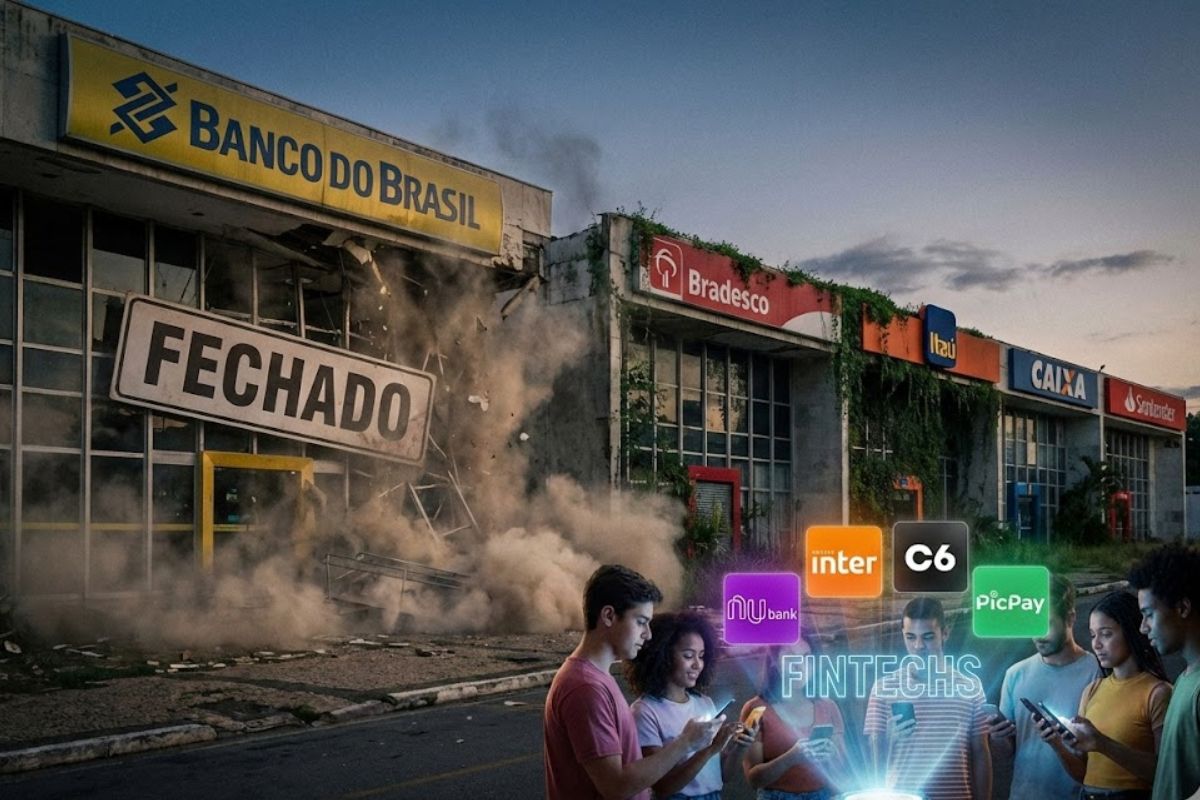


Between 2015 and 2025, Banco do Brasil led the closure of agencies across the national financial system, with 1,557 units closed, while digital banks and fintechs advance over the public and the in-person model shrinks amid the accelerated digitalization of services and the changing habits of customers.
Between March 2015 and 2025, the Brazilian financial system underwent a structural transformation in the network of in-person service. According to data from the Central Bank, the country went from 23,154 to 15,529 agencies, representing a reduction of 32.9 percent and, in practice, the disappearance of approximately one third of the physical points in ten years. In this movement, Banco do Brasil appears simultaneously as a symbol of the contraction of the traditional network and as the bank that still preserves the greatest reach in the country.
On December 7, 2025, the debate returned to the center of the agenda after the confirmation that Banco do Brasil closed 1,557 bank agencies during the period, accompanied by deep cuts at Bradesco, Itaú, Caixa Econômica Federal, and Santander. Although the official discourse relies on accelerated digitalization, changes in customer habits, and gains in efficiency, the shrinking of the physical network raises doubts about service in peripheral regions and in the countryside, where agencies are still the main entry point for basic financial services.
Physical Network Shrinks A Third In A Decade
The snapshot of the agency network in 2015 and 2025 highlights the scale of change.
-
Unemployment rises again to 5.8% at the beginning of 2026, raising alarms about the end of temporary positions and its impact on the Brazilian job market.

-
Document organization can cut invisible costs in small businesses, a simple step that prevents waste, rework, and losses in daily operations.

-
Chinese giant worth nearly R$ 4 billion that manufactures cables for electric cars, solar energy, and robotics wants to open a factory in SC.

-
Many employers do not know, but the law guarantees domestic workers a 25% increase in salary during trips, 50% for overtime, 20% for night shifts, and 17 additional benefits that can lead to labor lawsuits if not paid.


In March 2015, the Central Bank accounted for 23,154 agencies in operation in Brazil. By 2025, this number had dropped to 15,529, a loss of 7,625 units.
The 32.9 percent reduction translates, in practical terms, to the elimination of one third of the physical infrastructure for banking services in ten years.
At the center of this process is the advancement of digital channels, internet banking, and mobile apps, a trend that was already underway and accelerated by the coronavirus pandemic.
With more operations migrating to mobile, large groups argue that maintaining extensive physical structures has become economically unviable.
Yet, the impact is not homogeneous: while large capitals concentrate multiple options, smaller cities see the closure of the only local agency, often of Banco do Brasil or Caixa.
Banco do Brasil And Private Giants Lead The Agency Cuts
The data by institution shows that the reconfiguration of the physical network was led precisely by the largest banks.
Ten years ago, the largest networks were Banco do Brasil, with 5,544 agencies, Bradesco, with 4,654, Itaú, with 3,847, and Caixa, with 3,401 units.
By 2025, the ranking changed: Banco do Brasil remains ahead with 3,987 agencies, followed by Caixa, with 3,212, Santander, with 2,017, Bradesco, with 2,104, and Itaú, with 1,649.
During this period, the most aggressive in closing agencies was Bradesco, with 2,550 units closed, ahead of Itaú, which closed 2,198. Banco do Brasil ranks third, with 1,557 deactivated agencies, followed by Santander, with 624, and Caixa, with 189.
In practice, all large banks significantly reduced their physical presence, repositioning points in more profitable regions and migrating everyday service to the digital environment.
For Banco do Brasil, the challenge is twofold: on one hand, cutting costs and modernizing service; on the other, preserving its role as a public bank with national presence, including in municipalities where the institution is the only banking interface available.
The reduction of agencies, even while maintaining the lead in the number of points, pressures the capacity to maintain in-person service in remote areas without overloading the remaining units.
Digital Banks And Fintechs Occupy Space Since 2018
As the agency map shrinks, digital banks and fintechs have multiplied since 2018, filling part of the gaps left by the closures.
With lean structures, app-based operations, and no physical network, these companies can enter specific market niches, such as no-fee accounts, digital credit cards, and instant payment solutions, directly competing for the customer base of the large banks.
This digital offensive directly impacts the strategy of Banco do Brasil and other giants.
To defend their share, traditional institutions are increasing investments in apps, PIX, remote chat support, and relationship centers.
In practice, the closure of agencies and the expansion of digital platforms are two sides of the same strategy of cost reduction and competitive repositioning, in an environment where physical presence is increasingly seen as a high fixed cost.
At the same time, the entry of dozens of new competitors into the national financial system pressures fees, margins, and relationship models.
Banco do Brasil, which historically combined a large network of agencies with a strong role in credit and services, now needs to balance its role as a public bank with the pace of digitalization imposed by fintechs and exclusively online banks.
Effects For Account Holders And For The National Financial System
The 32.9 percent contraction in agencies and the closure of 1,557 Banco do Brasil units do not only affect the banking geography but also the way the population accesses financial services.
In large urban centers, the migration to digital can be perceived as a gain in convenience. In smaller municipalities and rural areas, the closure of physical agencies can mean more queues, greater travel to another city, and dependence on banking correspondents with a limited scope of operations.
From a systemic perspective, the combination of fewer agencies, consolidation of large groups, and the expansion of fintechs reshapes the national financial system.
Banco do Brasil remains a central piece of this structure but now shares space with exclusively digital actors and with a physical network much smaller than it had in 2015.
The way the country will balance financial inclusion, competition, and operational efficiency in the coming years will depend on regulatory decisions, the speed of digital adoption, and the willingness of banks to maintain a minimum presence in less profitable regions.
In light of the closure of agencies and the expansion of digital banks, do you think Banco do Brasil and the large private banks should still be required to maintain a physical presence in all cities, or can the future of banking be almost entirely digital?










Faz tanto tempo que nem lembro a última vez que precisei entrar numa agência do banco. Aliás, os novos bancos nem têm agência.
Eu acho que vai acabar também no interior ficando o pagamento nas lotérica, já que vários bancos fazem a transação por pix.
Isto ocorre porque os técnicos do Bacen nao conhecem o interior do Brasil e situação nao é pior em pequenas cidades devido as cooperativas de crédito