





 Portuguese
  English
  Spanish
 5 min of reading
  2 comments


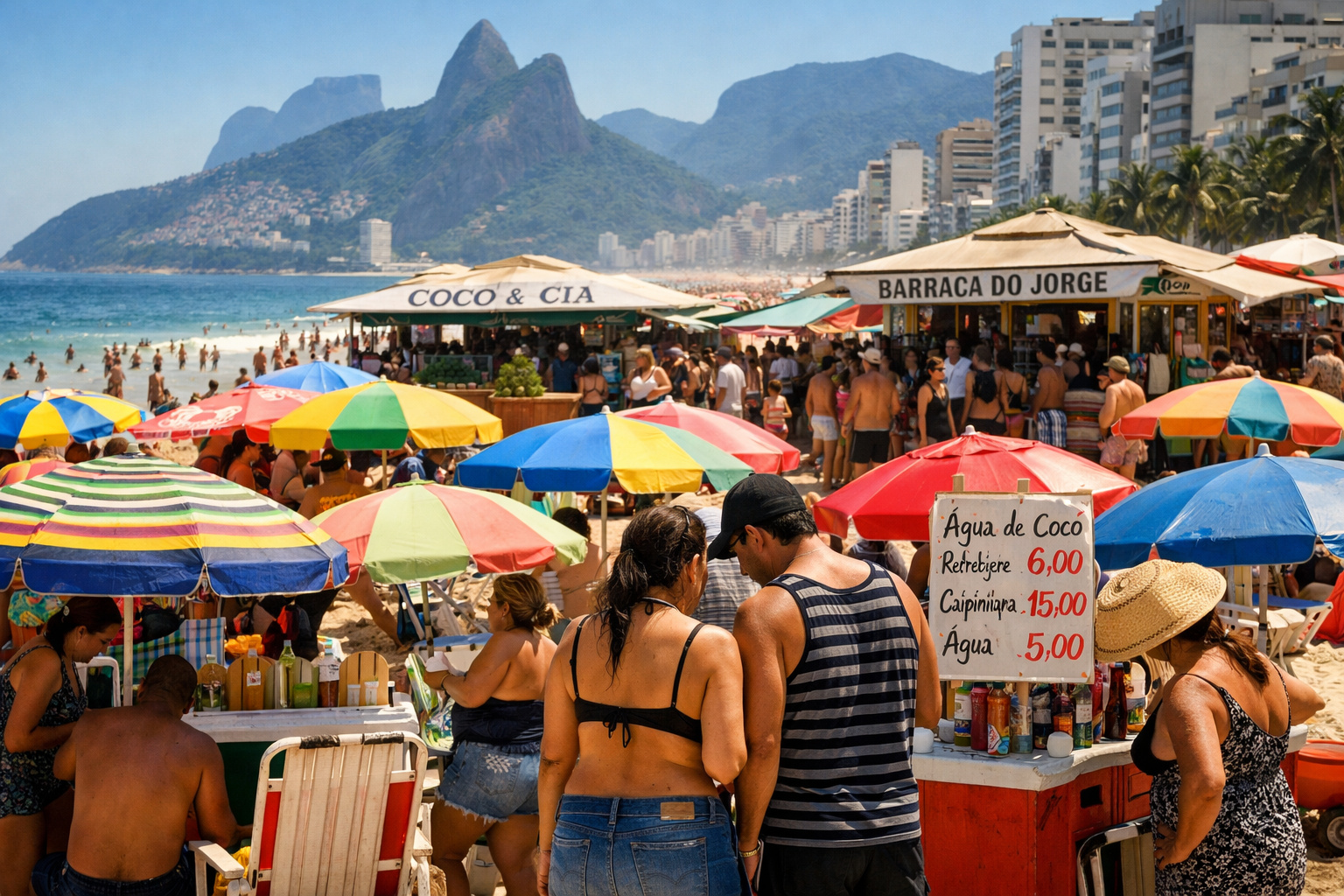


City Proposal Gains Support From Frequenters By Exposing Price Differences In Few Meters Of Sand, While Vendors And Concessionaires Diverge On The Feasibility Of The Measure
The discussion about price regulation on the beaches of Rio de Janeiro gained momentum in recent days after recurring reports from beachgoers who claim to be held hostage by what they consider abusive charges. In the midst of a hot season, with temperatures approaching 40 °C, basic items such as beach umbrellas, chairs, and even coconut water have shown significant price variations at very close points on the same beach, reigniting the debate about the need for clearer rules for beachside commerce.
The information was disclosed by O Globo, which closely followed the experiences of frequenters at beaches such as Copacabana Beach and Arpoador. According to the report, there are cases where renting an umbrella costs R$ 25 at one tent and R$ 50 at another located a few meters away, double the price for the same service.
This scenario, although old for many locals, has surprised tourists and residents of the Metropolitan Region, who claim they cannot predict how much they will spend on a simple day at the beach.
-
The government requests the Federal Revenue Service for a new system to automate the income tax declaration, reducing errors, time, and bureaucracy for millions of Brazilians.

-
Pix in installments, international Pix, and contactless payment without internet: the Central Bank revealed the new features coming to the tool that is already used by almost every adult in Brazil.

-
Mercado Livre has just started selling medications with delivery in up to three hours to your door, and this move could completely change the way Brazilians buy medicines on a daily basis.

-
In Dubai, rising tensions from the war in the Middle East are causing super-rich individuals to leave the Gulf and direct their fortunes to a new financial refuge in Asia.


Price Variation Affects Tourists And Residents Of The Metropolitan Area

On Sunday (11), receptionist Maria Luíza Oliveira, 20 years old, rode from São João de Meriti with her boyfriend, student Carlos Henrique Pires, 22 years old, to enjoy Copacabana Beach. Unable to bring their own umbrella or chairs, the couple ended up exposed to the price variations charged by different vendors.
We’ve seen umbrellas here for R$ 25 and R$ 50, double the price. With regulation, we wouldn’t have to keep searching — reported Maria Luíza, explaining that she tries to pay a maximum of R$ 30 for the rental, knowing that this is the lowest price charged in the area.
This perception is echoed by other beachgoers. Esthetician Thaís Lima, 26 years old, visited Arpoador on Saturday (10) and Sunday (11) and says she practically felt the difference in prices. According to her, the charge of R$ 50 for umbrella rental has become common on extremely hot days, precisely when demand increases.
At 40 °C, who wouldn’t pay for an umbrella? They take advantage of that — she criticized.
Her friend Cássia Agostini, 33 years old, reinforced the complaint, pointing out that the price of a simple chair varied from R$ 12 one day to R$ 20 the next day, at the same beach. For her, the feeling is that prices are set “in the vendor’s head,” making any spending planning difficult.
As a direct consequence of this uncertainty, many beachgoers have started bringing their own chairs, towels, food, and drinks from home, even with the additional effort, just to avoid what they consider excessive costs.
City Hall, Concessionaires, And Vendors Diverge On Standardization
According to the City Hall of Rio, the current rule determines that vendors must display a visible price list for all products sold, specifically to avoid arbitrary charges. Still, the enforcement recognizes that this practice is not always followed, especially in areas with high tourist traffic.
After Mayor Eduardo Paes publicly mentioned the possibility of studying price regulation, the concessionaire Orla Rio, responsible for managing most kiosks, opposed the proposal. According to its president, João Marcello Barreto, the business operates under free market logic and wouldn’t accommodate broad standardization.
He argues that more sophisticated structures, with differentiated services, could not be compared to simpler operations. Still, he acknowledges that abusive charges, such as those reaching R$ 800 for beach infrastructures, typically involve the illegal practice of minimum consumption, which is prohibited by both the Consumer Defense Code and the concession contracts.
— Consumers can contact Procon and report occurrences through our channels. We maintain strict and constant oversight — he affirmed, emphasizing that he is already in dialogue with the mayor on the topic.
On the other hand, Praia S/A, an association representing about 500 vendors from Barra da Tijuca and Recreio, expressed support for regulation, provided the professionals participate in the discussions. For the president of the entity, Eduardo Silva de Andrade, although operating costs at the beach are naturally higher, abusive prices need to be combated to ensure a fairer environment.
Price Differences And New Rules Reinforce The Debate On Ordering
Price variation is not limited to rental equipment. In Copacabana, for example, a cold coconut costs R$ 8 at a shop a block away from the beach, rises to R$ 13 on the promenade, and goes back to R$ 8 a few meters further. In promotions, the discrepancy is even greater: two coconuts for R$ 15 at one booth and the same two for R$ 25 at another.
This difference in such a short space is cited by frequenters as the main argument for supporting price regulation. The proposal gained even more visibility after the report from O Globo reported what is considered abusive charges on the beaches of Rio.
Alongside this debate, the city has implemented new rules for Pedra do Arpoador, which now operates with hours similar to those of a public park. Since January 3rd, the location opens at 4 AM and closes at 9 PM, a measure that has been well-received by beachgoers, even by those who found the entrance closed at night.
— We were surprised at first, but I approve of the measure. The space has become more organized — commented Maria Luíza Oliveira, who had to change her plans after finding Arpoador closed during the early morning.
In the end, both the access control and the potential price regulation reflect a growing demand for more organization, transparency, and predictability in the use of Rio’s beaches, especially during periods of high temperatures and heavy traffic.
Do you consider it fair to pay such different prices for the same product on the same beach or is regulation the only way to prevent abuses and ensure more transparency for beachgoers and tourists?








Toda e qualquer taxa fe conservação ou cobrança é ilegal e assim melhor abandonar o uso que vão rever esse roubo… #AcordaBrasil
Sou contra na minha opinião as Prefeituras de todo território nacional deveriam proibir esses Ambulantes ..Eles é que emporcalham nossas praias.