





 Portuguese
  English
  Spanish
  10 min of reading
  0 comments


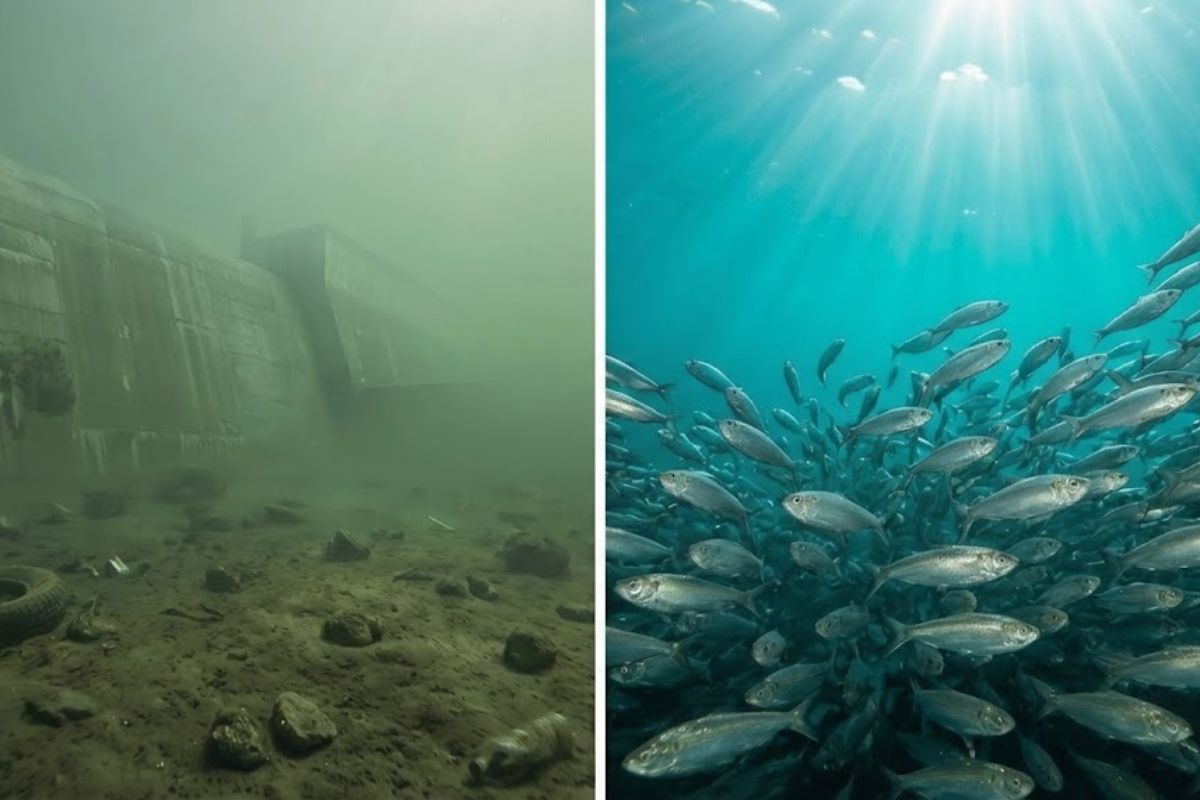
After 162 Years Blocking The KBEC River And Delivering Only 3.5 Megawatts, The Dam Lost Federal License On November 25, 1997, Was Removed On July 1, 1999, Reopened 27.36 Km Of River Life And Boosted More Than 2,000 Removals By 2024 In The US
The dam stood there for 162 years, spanning nearly 300 meters from bank to bank in the heart of Augusta, with its reservoir becoming a daily sight, almost a habit. However, behind the appearance of permanence, the truth was cold and cruel. The dam generated almost no energy, reaching a peak of only 3.5 megawatts in exchange for 27.36 km of blocked habitat, a deep cut into the life of the Kennebec River.
In 1999, when the dam was taken down and the river flowed free again after Augusta for the first time since 1837, the outcome was anything but subtle. It was a wake-up call that became a national reference. The what seemed like a local issue became the catalyst for a movement, with numbers skyrocketing from 78,000 fish to 5.5 million and a domino effect that, by 2024, had already surpassed 2,000 dams removed in the United States.
The Dam That Was Born Promising Progress In 1837

The Edwards Dam emerged in 1837 as a long, imposing wall of wood and stone, stretching across nearly 300 meters from side to side. The scene depicted a growing town with turbines spinning and that constant hum of water seemingly heralding a new era.
-
A couple buys an old chalet, breaks the kitchen floor for renovation, and finds over a thousand coins of gold and silver hidden since the English Civil War over 4 centuries ago.

-
Rigid bags with their days numbered: new trend prioritizes comfort in 2026.

-
YouTuber creates an excavator equipped with a giant 4.5-meter sword to challenge his brother to a rematch, and the invention quickly goes viral on social media.

-
The U.S. Army surprises the world by presenting the UH-60MX Black Hawk helicopter capable of flying without pilots, controlled by a tablet, featuring the MATRIX system, smart sensors, and full autonomy in real combat and rescue missions.


For generations, the dam was treated as a fact of life. The reservoir became a familiar landscape, part of the daily routine. Yet the real story was not in the visuals. It was in the numbers and what the river lost.
The dam was not essential for flood control, it was not for irrigation, it did not store drinking water, and it did not protect towns during spring thaw. Its practical role, throughout its life, was more linked to serving a local paper mill and a few downstream users than to anchoring the state’s power grid.
The Number That Condemned The Dam, 3.5 Megawatts At Peak
The maximum recorded output was 3.5 megawatts. This was less than a tenth of 1 percent of Maine’s electricity. The scale of the contrast becomes even more striking when the state’s total generation in the 1990s reached nearly 14,000 gatt hours per year, while the dam continued to provide such a small fraction that it barely registered in the energy balance.
There was also the operational detail. The workforce was modest, a handful of operators and maintenance staff. The dam could light up a few thousand homes, but it never came close to truly supplying a city.
Meanwhile, the energy world changed. What was once seen as relevant hydropower became almost irrelevant in the face of larger and more distant sources, nuclear, natural gas, wind, and solar. The dam remained stuck in the past, supported by old contracts, with electricity produced at rates above market value until the end.
The Structure Broke, Was Mended, And Kept Going By Inertia
The dam’s history is not one of perfect stability. Over the years, there were ruptures with catastrophic failures in 1839, 1846, and 1855. It was repaired and rebuilt, but never reimagined.
One point summarizes the environmental neglect. The original fish ladder was destroyed long before the Civil War and was never replaced. This meant that for decades the river was without a functioning passageway. The dam continued to exist out of habit and inertia, not because it was indispensable.
And here is where the word that defines this final period appears. Drip. The only real product of the dam was a trickle of electricity while the ecological cost continued to rise, year after year.
27.36 Km Of Blocked Habitat And The Collapse Of A Legendary Migration

Before the dam, the KBEC was a powerful migratory corridor. Every spring, millions of fish made the journey upstream from the Atlantic, following ancient routes to spawning locations scattered throughout the basin.
This migration was more than a natural curiosity. It fed the river’s ecosystem and entire communities on the banks. It was a natural mechanism, almost like clockwork, signaling the start of planting, the arrival of birds like eagles and osprey, and the renewal of forests and fields.
Everything changed in 1837. When the dam closed its gates, the migratory corridor was abruptly interrupted. For the fish, the wall was absolute. The loss was immediate and total. Without a fish ladder, access channel, or even a temporary route.
The numbers became stark and humiliating. Where once runs could reach millions, by the end of the 20th century, only scattered survivors remained, tens of thousands where there had been millions. Salmon, once so abundant they were sold by the barrel, became a thread. The food web broke. Birds and aquatic mammals lost a vital food source. The KBEC’s role as a nursery for the Gulf of Maine dwindled, with effects that extended far beyond Augusta.
The river, which was alive, became a fragment. And the cost was not just ecological. Fishing families saw their nets return nearly empty. Local economies felt the impact. The KBEC below Augusta became a shadow of what it once was.
The Question That Changed Everything, Is It Worth Keeping This Dam
In 1991, the Edward’s Manufacturing Company filed for a new 50-year license to keep the dam operating. This was the start of the decisive confrontation.
A coalition of conservation groups began to build the case with a vast volume of evidence. There were thousands of pages, scientific studies, economic reports, and expert testimonies. The process grew to fill over 7,000 pages in the official record.
The Federal Energy Regulatory Commission, the FERC, had to analyze what had almost never been questioned for decades. Hydroelectric licenses were routinely renewed, but here the law required a different test. Was the public benefit of the dam truly greater than the harm it caused?
November 25, 1997, The License Is Denied And The Country Is In Shock
On November 25, 1997, the FERC issued an order that left the industry astonished. The renewal was denied. The dam would be demolished.
It was the first time in U.S. history that federal regulators refused to allow a dam to be rebuilt and continue operating against the owner’s objections, citing overwhelming ecological and public benefits of a free-flowing river.
The message was clear. The restoration of the KBEC was worth far more than the 3.5 megawatts the dam could provide. Moreover, the era of automatic renewal had ended. Dams could be deemed disposable if public interest pointed to that.
The reaction came with force. There were appeals. Legal arguments claiming that the FERC overstepped, that it was a regulatory taking, threatening the entire hydropower industry. But the decision was upheld. The FERC’s authority to weigh environmental value over private economic interest withstood the challenges. The removal order remained in place.
May 1998, The $7.25 Million Settlement That Unlocked Demolition
A year after the federal order, legal battles gave way to the negotiating table. The question was no longer whether the dam would come down, but how and who would pay for it.
The solution came in a $7.25 million settlement signed in May 1998. It was a financial puzzle bringing together multiple sources.
Most of it came from Bath Iron Works, a shipyard downstream, contributing as mitigation for its own impact on threatened sturgeon habitat. Federal and state agencies added funds for restoration. The dam’s owner agreed to step away in exchange for avoiding an endless legal stalemate and the risk of bearing removal costs alone.
The final piece was the transfer of ownership. The dam and its license were transferred to the state of Maine, which would oversee the removal and long-term restoration of the river.
The state stepped in as the manager of KBEC’s future. Lawyers and engineers worked side by side to transform a legal precedent into demolition and environmental recovery work. The agreement covered not only the demolition but also a decade of restoration and fish monitoring.
July 1, 1999, The Moment When The River Breaks Free

Shortly after sunrise on July 1, 1999, the KBEC reached the breaking point of its long captivity.
On the banks, hundreds of people gathered with cameras and binoculars. Conservationists who had spent years in courts stood side by side with local residents, municipal officials, and schoolchildren on field trips. News crews vied for position.
A yellow excavator climbed the gravel dam and positioned itself at the top. The operator paused and let the bucket bite into the concrete, in a slow, deliberate motion.
At first, nothing. Then, a thin stream of water appeared, dark and cold, sliding through the freshly opened wound. The crowd fell silent. In moments, the trickle grew. The accumulated water from generations began to surge forward. The operator retreated, the breach widened, and the river pressed as if testing its freedom.
Suddenly, a torrent erupted, mixing mud and gravel. The roar of the current drowned out the applause. Bells rang from a nearby church. Someone opened a bottle of champagne.
For the first time since 1837, the KBEC flowed uninterrupted after Augusta. The reservoir began to drop, dramatically reducing in a matter of hours. The paperwork and years of arguments vanished before the raw force of water reclaiming its path.
From 78,000 To 5.5 Million, Nature Reacts With Overwhelming Force
The leap in life was quick and immense.
In the first seasons after the dam’s removal, scientists counted alewives ascending the river in numbers not seen for generations. Where only 78,000 could make the journey, the count began rising to hundreds of thousands and then millions.
By 2019, the annual run reached 5.5 million fish. Field biologists who had spent decades recording empty water were confronted with a dense, glimmering, silver surface full of movement.
The recovery was not limited to alewives. American shad, Atlantic salmon, and even the endangered sturgeon began to regain habitat and old spawning sites. Ospreys and bald eagles began returning in greater numbers, drawn by the abundance.
The river, once silent in spring, began to pulsate with energy. For those who fought for the removal, the speed and scale of recovery challenged cautious predictions.
A Quarter Century Of Monitoring And Consistent Records

After the removal, the KBEC became one of the most monitored stretches of water in New England.
Every spring, teams from the Maine Department of Marine Resources and partners set up monitoring stations along the river and tributaries to account for the pulse of the fish returning.
The described process is methodical. Mechanical lifts, traps, visual surveys. Biologists collecting samples for species identification and health checks. The data feeding into state and federal panels, later becoming reports, management plans, and analyses that have endured over time.
By 2024, the counts year after year confirmed that the explosive increase was not a coincidence. It was sustained recovery. The same protocols that documented the river’s collapse began to record its return, with a history that has withstood scrutiny from independent scientists, skeptics, and supporters.
The Dam That Became A National Catalyst And Helped Take Down More Than 2,000
The removal of the Edwards Dam did not just become a local story. It became a case study. It became evidence. And, most importantly, it became a precedent.
Across the United States, the demolition triggered a chain reaction. Within a decade, more than 100 dams were dismantled from rivers in Maine to California, with national organizations gaining momentum, mobilizing communities, lawmakers, and scientists.
By 2024, the number of removed dams surpassed 2,000 in the country. Each new removal leaned on the legal and scientific foundations that began consolidating there in Augusta, when the FERC said no and upheld the decision.
The reverberation reached the Elwha River in Washington, where two massive dams came down between 2011 and 2014, reopening 113km of salmon habitat and attracting worldwide attention.
In Oregon and California, the Klamath River project, launched in 2024, entered as the largest dam removal in history, promising to reconnect hundreds of kilometers of river in one go.
What started as a local fight on the KBEC turned into a national domino effect. Rivers once thought lost began to be reevaluated. Forgotten barriers were compared to living ecosystems. The decision spread as a signal that an old structure, no matter how large it seems, does not have automatic rights to exist if the public and ecological costs are greater than the benefits.
The Final Portrait, A River Reborn When The Water Flows Again
Twenty years after a historic decision, rivers once deemed dead are pulsating again with millions of fish. Communities are reclaiming their banks. The removal of dams proves that nature responds quickly when we finally let the water flow free again.
The story of this case is a sum of details that fit together like gears. A dam nearly 300 meters in length, built in 1837. A blockage of 27.36 km that erased migrations. A maximum power of 3.5 megawatts, less than 0.1 percent of Maine.
A licensing process started in 1991 that became a dossier of over 7,000 pages. A decision on November 25, 1997, denying renewal. A $7.25 million settlement in May 1998. A historic break on July 1, 1999. A leap from 78,000 to 5.5 million in 2019. A movement that reached over 2,000 removals by 2024.
All of this because of a word that needs to be at the center of the debate: dam. Because when the dam stops being treated as a destination and starts to be treated as a choice, the outcome can reshape entire rivers.
In your opinion, how many dams still exist out of habit and inertia, even when the numbers already show that the river is worth more?










-

-

-

-

15 pessoas reagiram a isso.