





 Portuguese
  English
  Spanish
  12 min of reading
  1 comment


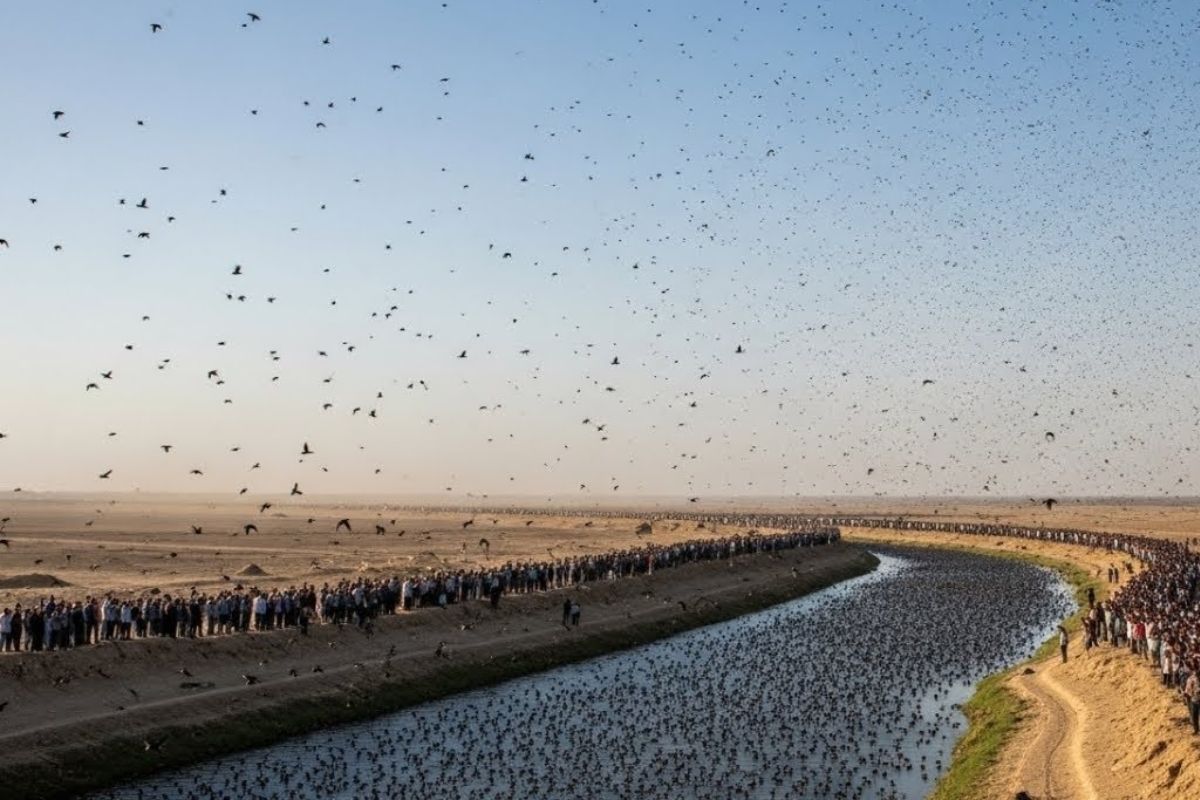


Periodical Cicadas Emerge After 13 Or 17 Years Underground And In 2024, Two Large Broods Emerged Together In 16 States. The Noise Reached 110 dB, With Up To 2.5 Million Per Hectare, Causing Slippery Streets And Intense Cleaning, Without Justifying Extermination Because Protecting Pollinators Maintains The Food Chain
When cicadas appear, summer stops being just hot and becomes deafening. In 16 U.S. states, the mass emergence was so intense that residents reported the ground trembling, and the sound reached 110 dB, a level comparable to being very close to a jet plane during takeoff. Beyond the noise, streets and sidewalks became slippery carpets, with layers of carcasses requiring constant removal.
Despite the discomfort and the impact on daily life, the United States does not treat cicadas as a disaster to be exterminated. In over 200 years of scientific records, there has been no environmental or economic event classified as damage caused by cicadas. They do not destroy crops, do not eat fruits, do not sting people, and do not transmit diseases. The central reason for not “ending” the swarm is simple and harsh: killing billions of individuals would require a level of pesticide capable of destroying pollinators and disrupting the food chain, creating a bigger problem than the phenomenon itself.
Why Cicadas Are Not A Pest Even When They Seem Like An “Invasion”
The loud noise causes many people to see cicadas as an immediate nuisance. Still, the classification changes when the real impact is observed. According to entomologist J Kritky, cicadas are harmless. They are not after yard plants or human food. They want to sing and reproduce.
-
A “silent skill” is allowing Brazilians to earn up to R$ 22,000 per month without a degree and become indispensable for companies that rely on millions of data to survive.

-
Researchers at the Toyota Research Institute found that if a human uses robotic arms to flip a pancake 300 times in an afternoon, the robot learns to do it on its own the next morning, and this is currently the most promising method to solve the biggest bottleneck in modern robotics.

-
Goodbye iron: a common item in households is starting to lose space to technology that smooths clothes in minutes without an ironing board and with less energy consumption.

-
Antarctica reveals an unusual clue high in the Hudson Mountains, and what appeared to be just an isolated rock began to expose a secret hidden under the ice for ages.


This point helps explain why the mass emergence, however chaotic it may seem, does not fall into the same group of events related to agricultural losses or health risks. The phenomenon looks like urban collapse, but has the nature of a biological cycle.
The Invisible Work Of Cicadas In The Soil Before The Chaos On The Surface
Most of the life of cicadas occurs away from human eyes. When they emerge after more than a decade underground, they leave a trail of natural engineering.
By digging millions of small holes, they create a ventilation network that helps the soil breathe and allows rainwater to penetrate deeply to the roots of trees.
When the adult cicadas die, the effect continues. The bodies of billions of individuals become natural fertilizer, rich in nitrogen, phosphorus, and potassium.
This volume is described as equivalent to thousands of tons of organic fertilizer and capable of increasing soil nutrients by up to 160%.
The Base Of The Food Chain In Spring And The Domino Effect In The Ecosystem
The role of cicadas does not stop in the soil. They provide an important source of protein in spring for over 25 species of animals, including birds like cardinals and wild turkeys, as well as squirrels, opossums, turtles, and even fish.
When there are cicadas, predators shift focus. This reduces pressure on other insects and helps maintain the balance of the ecosystem. The effect is so strong that in years of great emergence, the diet of several species shifts almost entirely to this abundant food.
Not All Are The Same: The Rare Group Of Periodical Cicadas
There are about 3,000 species of cicadas in the world, but only seven belong to the group of periodical cicadas, and all live exclusively in the United States. These cicadas are divided into 30 groups, known as broods, and each group has its own emergence schedule, precise to the year, like a biological clock.
What makes the event shocking is the scale. This is not about a few individuals. In certain emergencies, there are billions, sometimes even trillions of cicadas emerging at the same time.
A 13 Or 17-Year Cycle: 95% Of Life Underground
Periodical cicadas spend 95% of their life in the dark underground, about 60 cm deep. In practice, they stay underground for approximately 13 or 17 years and spend only about six weeks on the surface.
Underground, the larvae escape surface predators and feed on the sap of roots, a poor source of nutrients that causes them to take more than a decade to mature. In return, this source is stable and has little competition.
No other insect on Earth has such a strange biological clock, as described in the aforementioned research.
How They “Know” The Time: The Chemical Clock Of Trees
For years buried without light and obvious external references, cicadas keep track of time through the roots of trees. The sap changes every year, varying in sugar, nitrogen, and minerals according to the seasons. Cicadas use these changes as time markers.
As entomologist John Coley said, cicadas do not have a calendar, but they know how to read the chemical clock of trees. When they complete 13 or 17 of these milestones, they wait for the final signal: the soil warming to about 17.8. At that moment, genes that have been inactive for more than a decade are activated and billions emerge on the same night.
In years of significant climate instability, such as 2017, a small portion may emerge early due to incorrect chemical signals from the trees, which opens a chapter of concern for researchers.
The Extraordinary Event Of 2024: Two Broods At The Same Time
Spring 2024 was described as out of the ordinary because two large groups emerged together. Brood 13, after 17 years of silence, and Brood 19, after 13 years underground.
The coincidence is considered extremely rare and was described as something that happens only once every 2001 years, because 13 and 17 are prime numbers and almost never align.
The last mentioned occurrence took place in 180, when Thomas Jefferson witnessed the phenomenon and described cicadas as grasshoppers, probably due to confusion or lack of knowledge at the time. After 2024, the next meeting is pointed for 245.
The Noise At 110 dB And The City That Can’t Converse
In areas of Illinois and Tennessee, the noise of the cicadas reached 110 dB. Many biologists working outdoors needed to use industrial ear protection because they couldn’t hear each other speaking, even from just half a meter away.
The sound is produced by males flexing membranes called tymbals, about 300 to 400 times per second, like a living speaker.
When millions do this at the same time, the noise vibrates car windows, drowns out large vehicles, and turns entire neighborhoods into a sea of sound, robbing families of sleep for weeks. It’s nature at maximum volume.
Density Almost Unimaginable: Millions Per Hectare And Hundreds Of Thousands Per Square Meter
The density described for 2024 reached an almost unimaginable level: about 2.5 million individuals per hectare. A study from Emory University estimated that an area of just 10.4 km² could contain up to 375,000 cicadas per square meter when they completely cover trunks and ground.
To translate the absurd into comparable images, there are two measures that circulate as visual shocks. If we lined up one trillion cicadas one behind the other, the line would be about 25.4 million kilometers, equivalent to 66 times the distance from Earth to the Moon. In terms of area, the cicadas that emerged in 2024 would be enough to cover approximately 4,000 cities the size of New York.
Broken Branches And Streets Turning Into Slippery Carpets
The weight of millions of nymphs concentrated at the same time turned into physical impact. In Indiana, in forested areas near Bloomington, branches appeared broken as if after a hailstorm, not due to wind, but by the weight of nymphs clinging to the branches.
In Louisville, Kentucky, residents reported slippery streets as if they were covered in oil. Bodies of dead cicadas accumulated in thick layers, needing to be removed with shovels and special trucks.
Cleanup crews worked day and night with high-pressure jets to wash playgrounds, parking lots, and even hospital entrances, where carcasses formed compact plates. The biological carpet became an urban task.
The Explosion Of Cicadas Changes The Diet Of Birds And Disrupts Other Insects
The ecological impact was significant. Many birds began to feed almost exclusively on cicadas, an abundant and easy source of protein. As a result, caterpillars, a primary food source for birds in normal years, were ignored.
A 2021 study from the University of Michigan showed that in areas with large cicada emergences, the caterpillar population doubled, as did the consumption of young leaves, causing severe damage to vegetation in a matter of weeks. The excess of one food reorganizes the rest of the plate.
Health Alerts And Everyday Situations That Made Headlines
The season brought notable episodes. The FDA issued an urgent alert: people allergic to shrimp and crab may also react to cicadas, as they belong to the group of arthropods.
In Cincinnati, an outdoor wedding had to be postponed when cicadas invaded food, drinks, and even the bride’s dress.
In Nashville, owners took dogs and cats to the veterinarian after the animals ate so many cicadas that they suffered intestinal obstruction.
The cicadas landed on TV cameras, stuck to microphones, and even fell into reporters’ coffee during live broadcasts. The phenomenon entered the routine from all sides.
Why The U.S. Can’t Exterminate Cicadas: Four Barriers That Block The “Fight”
The question always arises when the noise and slippery carpet dominate the scene. Why not eliminate cicadas?
The first answer is biological and practical: they are harmless. They do not bite, do not sting, do not destroy crops, do not transmit diseases, and do not cause economic damage like mosquitoes or locusts.
Entomologist Chris Simon from the University of Connecticut clearly summarizes: cicadas are not pests, they are an ecological phenomenon.
The second is functional: they are extremely useful. By emerging in the billions, they aerate the soil, facilitate water absorption by plants, and allow rain to reach deeper into the roots, especially during dry periods.
After death, they return large amounts of nitrogen, phosphorus, and potassium to the soil, nutrients that farmers usually need to purchase. And they sustain the spring food chain.
The third is logistical: they cannot be eliminated. A single group can number in the hundreds of billions. In 2024, two groups emerged together, totaling trillions.
The amount of pesticide needed to exterminate them would also kill birds, bees, butterflies, earthworms, and other pollinators, causing an environmental disaster greater than any noise or odor caused by cicadas.
Entomologist Nancy Hinkel sums up the impossibility with a straightforward phrase: you cannot spray insecticide on a biological phenomenon that occupies half of the United States.
The fourth is legal: there are protections and restrictions. States like Maryland, Indiana, and Tennessee prohibit large-scale spraying during cicada season.
National parks and federal forests consider them ecological heritage. The EPA and USDA classify these cicadas as native species of high ecological value, making large-scale extermination attempts restricted or completely prohibited.
If They Are Not Villains, Why Are Some Groups Disappearing
Even without extermination campaigns, there is decline. Some groups have already been completely extinguished, such as Brood 11, and others are rapidly decreasing due to urbanization, deforestation, and soil compaction. Brood 21 is cited as nearly disappeared.
This combination reduces suitable territory, alters the soil where cicadas spend more than a decade, and weakens the cycle that depends on stable underground conditions.
The “Zombie” Enemy: Massospora And The Untreatable Infection
There is a threat described as coming out of a movie: the fungus Massospora, dubbed by scientists as the “zombie of cicadas.” When infected, the lower part of the cicada’s body detaches, exposing a white mass of spores resembling powder.
The fungus directly attacks the nervous system. The cicada loses its ability to fly but becomes hyperactive, attempts to mate repeatedly, and does not realize that part of its body has already disappeared.
Professor Matt Casson directly described how Massospora turns cicadas into machines for spreading the infection.
In West Virginia and Ohio, during the season of 224, residents reported cicadas without the lower part of their bodies still trying to climb trees in search of mates.
With every contact, spores spread. There is no treatment or vaccine. Once infected, they continue singing and trying to reproduce until exhaustion. The song, in this case, becomes a symptom.
The Cicada Killer Wasp: The Giant Wasp That Hunts Like A Projectile
Another cited danger is the cicada killer wasp, a giant wasp that can reach 5 cm in length. It attacks like a projectile, paralyzes the cicada with venom, and drags the prey, often heavier than itself, to an underground nest. There, the immobilized cicada becomes live food for the larvae.
Residents of Maryland and Georgia describe the scene as “death with wings.” It’s another piece of the reality that, as loud as they are, cicadas are also food, targets, and machinery.
When Curiosity Becomes A Dish: 40 Restaurants And A Taste Described As Nutty
The 2024 season also made its way to the table. The Washington Post reported that more than 40 restaurants, chefs, and food creators in Zibainu experimented with cooking cicadas in various ways: sautéed in butter, fried, seasoned, in cookies, and even in cicada sushi.
A chef from Missouri commented that they taste like cashews in butter with a slight flavor resembling cooked crab. The curiosity is not exclusive to the U.S. In several countries, cicadas are considered delicacies.
In Japan, nymphs are fried in a dish called semi. In Thailand, they are stir-fried with kaffir lime leaves in the dish maenque, common at street fairs in Chiangmai and Bangkok.
In China, especially in Shandong and Dianu, they appear as Chanong, prepared with garlic or butter and seen as nutritious.
In Mexico, in Oaxaca, there are roasted cicada chapulines with lime, salt, and dried chili. In the Congo and parts of Central Africa, they are gathered during the rainy season and roasted over charcoal in a dish known as cicada roast.
Cicadas As Memory, Spiritual Symbol, And Art
In many places, cicadas transcend biology and become a cultural language.
In Japan, they are described as the heart of summer. Their song is a trail of collective memory and appears in anime, movies, and books, functioning as an emotional landscape.
The cycle, years underground and a few weeks on the surface, symbolizes impermanence.
In China, the cicada belongs to the spiritual world. Since the Western Han Dynasty, the dead were buried with a small jade cicada in their mouth, called Shanu, a symbol of belief in the ascension of the soul. In poetry, the cicada represents purity for living in the treetops and feeding on sap.
In Greece, the cicada appears as a symbol of art. In mythology, Apollo transformed a poet who died singing into a cicada so he could sing forever. Aristotle described the life cycle in Historia Animalium with such detail that texts are still cited today.
In southern Italy and Sicily, farmers use the song as a living thermometer. If it sings early and loud, the summer will be harsh. If it silences, it may indicate heavy rain.
In Calabria and Puglia, the sound is called “the drum of the Sun,” a traditional sign for olive, grape, and wheat harvest.
Australia, 120 dB And The Tragedy Of 2019
Australia is cited as the place where cicadas can be even more grandiose. The country is home to hundreds of species, including the Double Drummer, described as the largest and loudest in the world, with a song that reaches 120 dB, loud enough to drown out a lawnmower.
But there was also tragedy. In 2019, extreme heat waves killed millions of cicadas due to thermal shock, a rare event that received global attention.
The same heat that accelerates summer can kill the symbol of summer.
The Clock Starting To Fail: Early Emergence And Risk Of Collapse
In recent years, the pattern of precision in cycles is described as less reliable. In the last two decades, scientists have observed several groups emerging one to four and even seven years earlier than expected, something described as never recorded in the history of this species.
In 2017, for instance, about 5% to 10% of Brood Shakes emerged up to four years early. For Professor John Cooley, who has studied periodical cicadas for over 30 years, this is an unnatural and extremely concerning sign.
The pointed cause is underfoot: soil warming. Cicadas do not keep track of time by light or air temperature, but by chemical changes in the sap of tree roots.
With warmer climates, trees alter nutritional cycles earlier, and cicadas interpret this as the passage of an entire year when in fact only a few months have passed. Thus, the evolutionary clock begins to fall out of rhythm.
The problem worsens because, upon emerging at the wrong time, they lose their greatest defense: the safety of numbers.
When a group appears in reduced numbers, birds, rodents, and predatory wasps can eliminate them before they can reproduce. Some smaller groups have already failed to survive.
What Remains After The Noise: It’s Not Villainy, It’s An Ecological Alert
The 2024 season shows that cicadas are not villains causing chaos but a portrait of nature’s fragility in the face of environmental changes.
It took millions of years of evolution to create an almost perfect biological clock, and just a few decades of warming related to human action for the system to begin to crack.
If these cicadas disappear, the loss will not just be the silence of an insect. It will mean less ventilation in the soil, less natural fertilizer, less protein for spring, disruption of food chains, and a less stable forest.
Do you see the explosion of cicadas in 2024 as a temporary nuisance or as one of the first major alerts of environmental imbalance?







O efeito benéfico das cigarras no solo, abrindo canais e galerias é fundamental para a fertilidade do solo e suficiente para considerá-las colaboradoras naturais do Sistema Agroecológico.