





 Portuguese
  English
  Spanish
  5 min of reading
  1 comment


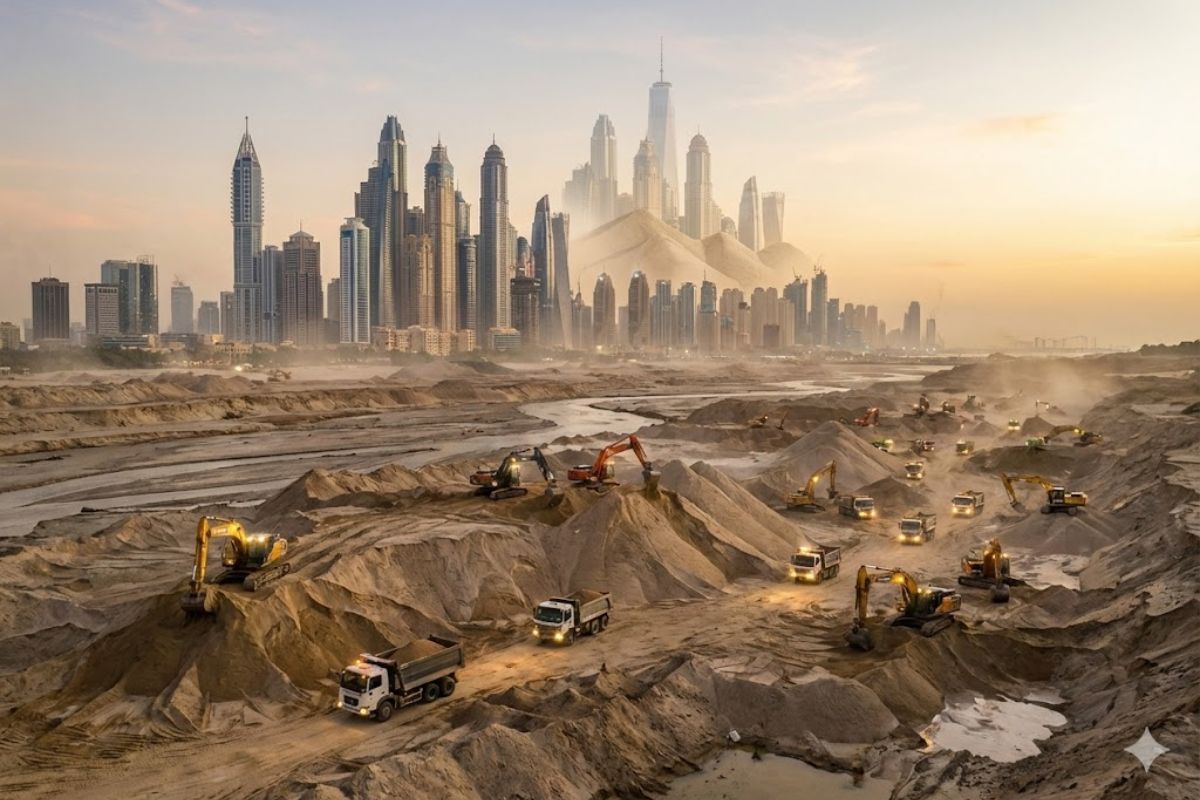


As Global Demand For Concrete Explodes, Illegal Sand Fuels A Shadowy Market Worth 890 Billion Reais, With More Than Half Of The Extraction Illegal, Rivers Destroyed, Communities Threatened, And Cities Built Without Minimal Environmental Traceability In A Silent Context Of Corruption, Diffuse Violence, And Almost Absolute Impunity.
Each year, illegal sand helps to build the equivalent of nine New York City’s worth of concrete, asphalt, and glass, but the real cost of this urban advancement remains hidden beneath excavated rivers, collapsing banks, and intimidated communities. In 2004, the attack on an activist in India exposed how the dispute for this seemingly mundane resource began to involve armed mafias, systemic corruption, and hundreds of deaths linked to illegal extraction.
In recent decades, sand has become the second most exploited natural resource on the planet, only behind water, with about 50 billion tons of sand and gravel consumed annually worldwide. Researchers estimate that in developing countries, more than 50% of this extraction occurs illegally, leaving a trail of environmental destruction and violence rarely associated with the shine of skyscrapers or the comfort of the apartments where this material ends up.
The Invisible Input That Sustains The Modern World

The concrete of cities, the asphalt of highways, the glass of windows, and even the silicon used in advanced technologies depend on sand.
-
50 viaducts, 4 tunnels, 28 bridges, and 40 kilometers of bike paths: BR-262 in Espírito Santo will receive 8.6 billion reais for the largest engineering project in the state’s history, inspired by the Immigrant Highway in São Paulo.

-
Brazil produces too much clean energy and doesn’t know what to do with it: over 20% of solar and wind capacity was wasted in 2025 while investors flee and 509 renewable generation projects were abandoned in the last year.

-
Piauí will produce a new fuel that replaces diesel without needing to change anything in the truck’s engine and reduces pollutant gas emissions by half: truck drivers from all over the Northeast are already celebrating the news that will arrive later this decade.

-
A new Brazilian shopping center worth R$ 400 million will be built in an area equivalent to more than 4 football fields, featuring 90 stores, 5 cinemas, a supermarket, a college, and parking for 1,700 cars, potentially generating 3,000 jobs.


Approximately 90% of all extracted sand is destined for the construction industry, feeding a continuous cycle of urban expansion in rich and poor countries.
The scale is colossal: 50 billion tons per year would be enough to cover the entire territory of Argentina with a one-centimeter layer.
In parallel, the planet builds, year after year, the equivalent of nine cities the size of New York, a result of mass migrations from rural areas to urban ones, especially in developing countries.
However, not all sand is suitable for erecting buildings and overpasses.
Desert sand, eroded by the wind, has grains that are too rounded to form strong concrete.
The most valued is river and bank sand, with irregularly shaped grains, better able to fit into the mix.
It is precisely this rarer and more valuable sand that is targeted by illegal sand.
How Illegal Sand Fuels A Billion-Dollar And Opaque Market


The global sand market is estimated at around 890 billion reais, but the lack of traceability makes it almost impossible to determine which portion of this volume comes from regular operations and which part comes from illegal sand.
In many countries, the clandestine cycle starts simply, with small extractors removing material from rivers, beaches, and banks without a license or in prohibited areas.
From there, the machinery becomes sophisticated.
Illegal sand is mixed with sand from regular sources, enters depots, crosses roads, arrives at construction sites, or is loaded onto cargo ships without anyone technically able to distinguish one grain from another.
In practice, few buyers ask where the material came from, and there are rarely control systems capable of tracing the origin back to the extraction point.
This context creates a low-risk and high-reward business.
Sand is considered a free resource, available in rivers and beaches.
Those with political strength, economic power, or territorial control over extraction areas can turn this resource into quick profit.
It is at this point that illegal sand connects with criminal networks, corruption schemes, and organized violence.
Sand Mafia, Corruption, And Overlooked Deaths
In various countries, the so-called “sand mafia” has come to control entire stretches of rivers and coastal areas, charging tolls, exploiting workers, and intimidating local communities.
The phenomenon affects everything from small properties, where residents extract sand to build their own houses, to large schemes with excavators, barges, and dredges operating without a license.
Researchers and activists report hundreds of murders linked to illegal sand in recent years, with documented cases in countries such as India, Mexico, Ghana, and Indonesia.
Corruption allegations in local and regional governments are frequent, with authorities tolerating or covering up clandestine extraction in exchange for bribes or political support.
The very experience of activists highlights the risk.
Sumaira’s campaign against illegal sand extraction gained momentum after the attack she suffered in 2004, when her work began to confront economic interests directly, solidifying illegal sand as a violent business.
Since then, confronting the sand mafia has come to mean, in many regions, assuming real physical risk.
Excavated Rivers, More Severe Flooding, And Destroyed Ecosystems
The environmental impact of illegal sand is deep and cumulative.
When extraction exceeds the natural replenishment capacity of rivers, the riverbed deepens, banks lose support, and erosion accelerates.
This increases the risk of landslides, slope collapses, and more intense flooding during rainy periods.
Large-scale dredging removes sediments, plants, fish eggs, and tiny organisms from the riverbed, annihilating entire habitats, altering water quality and affecting food chains.
In coastal areas, the removal of sand from beaches and dunes reduces natural protection against storms and rising sea levels, leaving communities more vulnerable.
In many cases, riverine populations and fishermen are the first to notice the changes: banks collapsing, steep declines in fish stocks, and instability of structures near the water.
But these signs rarely reach the center of economic decisions, while the concrete resulting from illegal sand continues to feed urban projects far from the extraction areas.
Technologies, Alternatives, And The Challenge Of Oversight
There are technological pathways to reduce pressure on rivers and beaches.
It is possible to recycle concrete, repurposing fragments from demolished buildings, and also to produce sand artificially by crushing rocks in controlled quarries.
These solutions, however, are still more expensive and energy-intensive than directly extracting sediments from rivers.
In practice, as long as it is cheaper to extract sand from natural beds, illegal sand will continue to be attractive.
Combating this problem depends on a complex combination: strengthening oversight bodies, closing legal loopholes, confronting local corruption, involving communities in monitoring, and creating minimum traceability systems that can follow the trail of the material back to its source.
Experts point out that awareness campaigns are also essential, as most people are unaware that the building they live in or the avenue they walk on may have been erected at the cost of more severe floods, biodiversity loss, and violence in regions far from major urban centers.
Without public attention, the devastation tends to continue silently, grain by grain.
In the end, one question remains open: in the face of a billion-dollar market, with 50 billion tons per year and more than 50% of extraction in irregular situations, how much responsibility rests on governments, companies, and consumers in the choice between regular sand and illegal sand?
And you, do you think the issue of illegal sand should be treated with the same climate and political urgency as other global environmental issues?









Matéria boa mas muito triste o desfeixo.Tudo isto em nome do progresso e do enriquecimento ilícito de muita gente. Gosto de ler matérias do tipo, mas confesso que me trás tanta revolta em saber que, vários países do mundo está acontecendo esses tragédias, pois é o que considero. Vamos ficar nus pelados e desprovidos de tudo sem a natureza. Vai acontecer em breve.