





 Portuguese
  English
  Spanish
  5 min of reading
  0 comments



Bill Gates defends that great achievements come from small improvements repeated over years, not from genius leaps, and data from the International Energy Agency confirm this logic by showing that accumulated gains in energy efficiency since 2000 have reduced household energy bills by up to 20% and prevented global emissions from being 20% higher than they are today
Bill Gates wrote that the secret to changing the world is not in great leaps, but in small improvements repeated over the years. The phrase sounds like motivational advice until you look at the numbers. The International Energy Agency (IEA) shows that without the accumulated efficiency gains since 2010, global greenhouse gas emissions would be 20% higher today. It was not a single technological breakthrough that produced this result. It was thousands of small adjustments, repeated in millions of homes, factories, and offices over more than a decade.
According to the IEA report (International Energy Agency), Bill Gates acknowledges that individual choices matter, but makes it clear that the most impactful measures need to be taken at the governmental level. Still, the IEA confirms that the efficiency actions implemented since 2000 have reduced energy bills for households in advanced economies by up to 20%. The logic of small improvements that Bill Gates advocates is not theory: it is a measurable pattern that works both in the career of the person who built Microsoft and in the fight against climate change.
What Bill Gates means by small repeated improvements
The central idea of Bill Gates is that great achievements do not happen in a dramatic moment, but accumulate over years of constant adjustments. In the climate context, this means that changing an incandescent bulb to LED, sealing a draft in the window, or reducing food waste in the kitchen may seem like insignificant gestures.
-
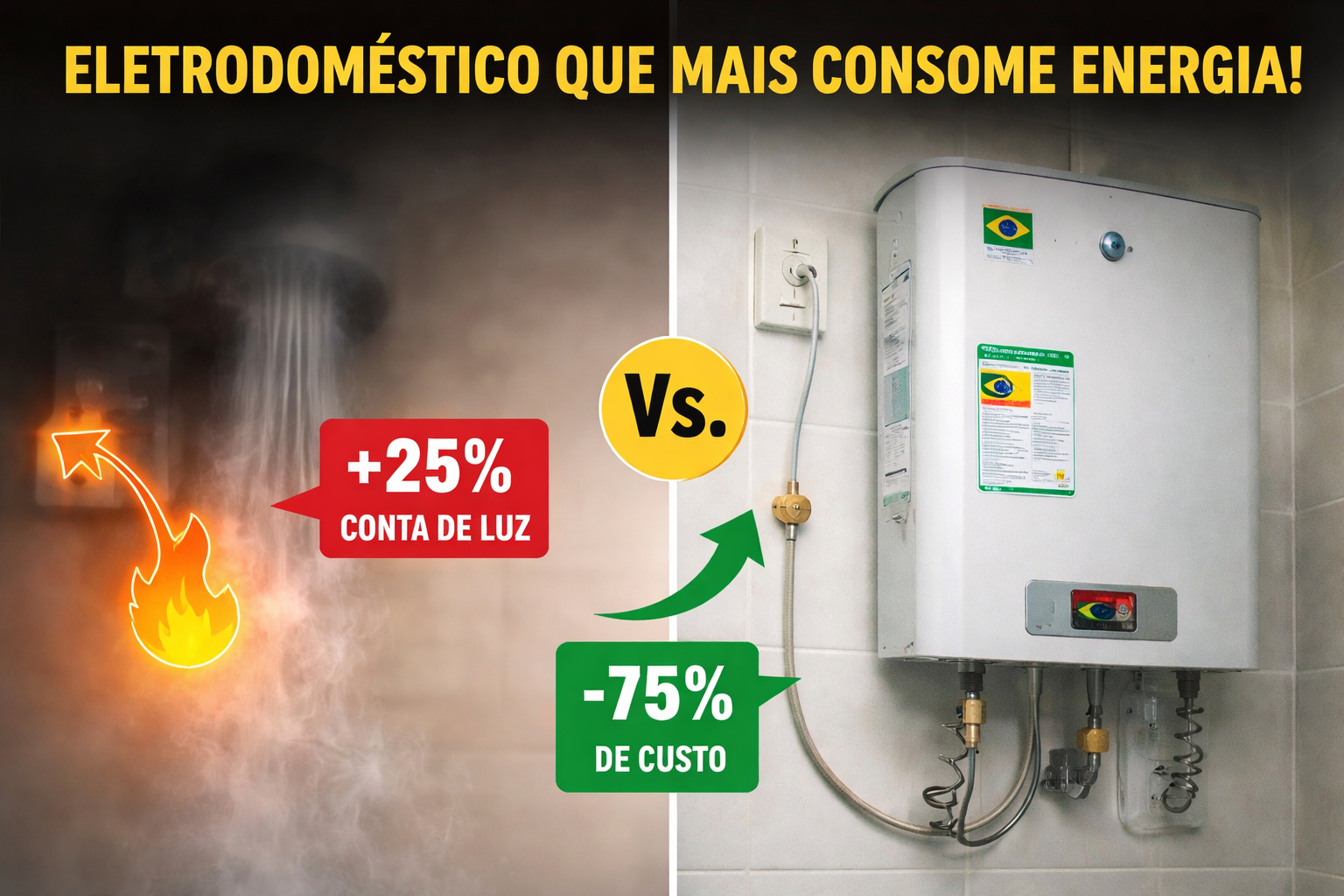
The household appliance that consumes the most energy in Brazilian homes is not the air conditioner; it is located in the smallest room of the house, is used daily, and can account for up to 25% of the electricity bill, while an alternative in the same outlet can reduce this cost by up to 75%.
-
Son of a seamstress from the rural area of Ceará who did not speak English wins a scholarship of over 2 million reais at Williams College, one of the top 10 universities in the United States, covering everything including dormitory, meals, and annual trips to Brazil.

-
With 22 thousand tons of steel, a height nearly three times greater than the Eiffel Tower, and a cost of R$ 1.6 billion, China is building the highest bridge on the planet over a colossal canyon, reducing a crossing time of over 2 hours to just over 2 minutes.

-
With more than 635,000 doctors, Brazil sees competition increasing in large cities, and recent graduates are competing for shifts at an accelerated pace while the countryside still faces shortages.


But when millions of families make these same changes, the accumulated effect becomes measurable in avoided emissions and money saved.
Bill Gates applied the same logic in building Microsoft. The Windows operating system did not come ready-made: it took decades of incremental versions, each correcting errors and adding features, until the product became ubiquitous.
The pattern is repeated in Breakthrough Energy, Bill Gates’ foundation focused on investing in climate technologies that need years of development before reaching scale. The philosophy is the same: do not wait for the genius leap; build constant progress.
The numbers that prove Bill Gates’ philosophy works in combating climate change
The IEA released data that accurately illustrates what Bill Gates advocates. Global progress in energy efficiency averaged 1.3% per year since 2019, down from 2% recorded between 2010 and 2019 and far below the 4% annual target agreed upon by governments at COP28.
Even so, this slow progress accumulated over years has already been enough to prevent global emissions from being 20% higher than they are today.
At the domestic level, the results are also concrete. The U.S. Department of Energy points out that reducing the thermostat temperature by 7 to 10 degrees for eight hours can save up to 10% per year on heating and cooling.
LED bulbs consume at least 75% less energy than incandescent ones and last up to 25 times longer. Sealing drafts and improving insulation generates an average savings of 15% on heating and cooling costs.
These are small improvements, exactly as Bill Gates describes, that when added together produce a huge impact.
The food waste that Bill Gates and EPA data expose
The logic of small improvements by Bill Gates applies beyond energy. The EPA (Environmental Protection Agency of the United States) estimates that one-third of all food produced in the country is not consumed.
In 2019, about 96% of the food wasted by households ended up in landfills or incinerators. Food waste is responsible for 58% of methane emissions from U.S. landfills, an impressive number for something that most people consider just a trash problem.
The EPA estimates that an average family of four spends nearly $3,000 a year on food that is not consumed. Planning meals, better storing food, and using leftovers are simple gestures that reduce methane, cut waste, and save money.
It is exactly the type of small repeated improvement that Bill Gates advocates: individually it seems little, but multiplied by millions of families the impact is measurable.
Why Bill Gates insists that small improvements are not enough without public policies
Bill Gates has been clear in separating what individuals can do from what governments need to do. He wrote that there are things everyone can do, but that the most impactful measures must be taken at the governmental level.
The IEA confirms that energy efficiency policies remain one of the most effective tools for reducing emissions on a large scale, but warns that these policies are lagging behind available technology.
An example cited by the IEA illustrates the problem: high-performance bulbs have doubled their efficiency in the last 15 years, but the minimum standards required by law have only increased by 30%.
The demand for cooling grows as warmer weather pushes more people to air conditioning, and regulation is not keeping pace with the need.
For Bill Gates, it is at this point that the philosophy of small improvements finds its limit: without larger systems functioning, individual gestures do not scale.
What Bill Gates’ career teaches about constant progress
Bill Gates’ trajectory is the most visible demonstration of the philosophy he preaches. Microsoft did not start big: it began in a garage, grew version by version, and took decades to become the company it is.
Each Windows update, each bug fix, each feature improvement was a small improvement that, accumulated over the years, built one of the largest technology empires in history.
Today, Bill Gates applies the same logic to combating climate change through Breakthrough Energy.
The foundation invests in technologies that are not yet commercially viable, with the conviction that years of incremental improvements will transform promising solutions into products that work on a global scale.
For Bill Gates, the most common mistake is waiting for the moment of genius instead of investing in the daily work of improving a little each day.
Great results start with changes that seem too small to matter
Bill Gates sums up in one sentence what the data confirms: small improvements repeated over the years produce results that genius leaps rarely achieve.
The numbers from the IEA, the Department of Energy, and the EPA show that changing bulbs, sealing windows, reducing waste, and adjusting thermostats have already avoided billions of tons of emissions and saved billions of dollars.
It is not motivational theory. It is mathematics applied to real life.
Do you agree with Bill Gates that small improvements are more powerful than great leaps? Have you made any simple changes in your home that generated real savings? Or do you think that without public policies none of this makes a difference? Leave your comments and share this article with those who need a push to get started.









Seja o primeiro a reagir!