





 Portuguese
  English
  Spanish
  4 min of reading
  1 comment


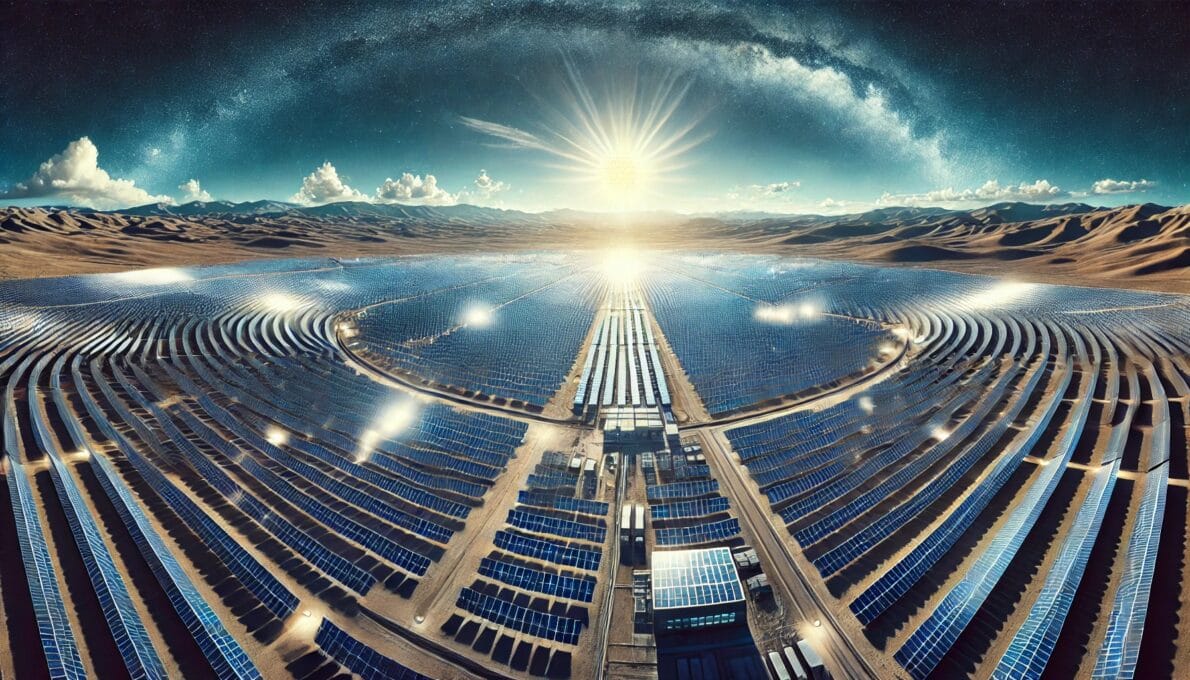

With Million-Dollar Support from BNDES, Brazil Prepares to Inaugurate the Largest Solar Power Complex in Latin America, Capable of Generating Enough Energy to Supply 1.9 Million Residences.
Solar energy is one of Brazil’s major bets to ensure a more sustainable and cleaner future. With massive support from BNDES, Brazil is about to inaugurate another major renewable energy project that promises to be a game changer: the Irapuru Solar Complex. This project, which will be the largest solar power complex in Latin America, is already 70% complete and will completely change the way we view energy generation in the country.
What is the Irapuru Solar Complex?
Located in Janaúba, Minas Gerais, the Irapuru Solar Complex is a gigantic project that will join the already existing Janaúba Solar Complex. Together, these two complexes will have an installed capacity of 1.6 GWp, enough energy to supply around 1.9 million residences. The new complex will feature seven solar parks, spread over an area of 800 hectares, and will have 750,000 bifacial solar modules, which ensure even greater efficiency in energy generation.
To bring this project to fruition, BNDES approved financing of R$ 600 million, which corresponds to around 50% of the total investment. This support is fundamental for Brazil to continue advancing in the energy transition and reducing CO2 emissions, something that is a priority for the government.
-
Renewable energy advances over protected areas in Brazil, and a survey by the Energy Transition Observatory reveals silent impacts that challenge environmental conservation and pressure sensitive traditional territories.

-
Rio Grande do Sul accelerates energy transition: State invests in renewable technologies and consolidates decarbonization strategies and pathways to attract billions in new industrial investments.

-
With 160,000 m² of collectors, an area larger than 20 football fields, Silkeborg, in Denmark, hosts a solar thermal plant that heats 19,500 homes and could become the largest solar heating plant in the world.

-
A study reveals the expansion of renewable energy procurement in Brazil and shows how companies are taking advantage of opportunities to reduce expenses, ensure energy efficiency, and strengthen strategic environmental commitments.


BNDES: The Engine of Renewable Energy in Brazil
It is not new that BNDES has stood out as the main financier of renewable energy in Brazil. The bank, which also supported the construction of the Janaúba Solar Complex, has already invested around R$ 1.5 billion in solar energy in the country, reaffirming its commitment to sustainability and Brazil’s green future.
Through programs like the Climate Fund and the FINEM, BNDES has ensured that large projects, like the Irapuru Solar Complex, become reality. With these incentives, the bank not only helps boost solar energy generation but also contributes to job creation and economic development in the regions where these complexes are installed.
How the Irapuru Solar Complex Will Impact Brazil?
Besides being a significant victory for the environment, the Irapuru Solar Complex will also generate important social and economic impacts for Brazil. With the expectation of creating 1,000 direct jobs and 4,000 indirect jobs during its construction, the project will directly benefit the local population in the Janaúba region, boosting local income and creating new job opportunities.
The project will also play a crucial role in reducing carbon emissions. It is estimated that, once operational, the largest solar power complex in Latin America will prevent the emission of 38,391 tons of CO2 per year, significantly contributing to Brazil’s efforts in the fight against climate change.
Additionally, solar energy has a positive impact on consumers’ wallets. With the increased capacity for solar energy generation in Brazil, production costs are likely to decrease, which may result in lower electricity bills in the future.
The Role of Brazil in the Global Energy Transition
Brazil has enormous potential when it comes to renewable energy, and solar energy is one of the pillars of this revolution. According to consulting firm McKinsey, the country is poised to become one of the global leaders in the energy transition, not only decarbonizing its own energy matrix but also helping the world adopt cleaner energy sources.
Currently, about 20% of Brazil’s electrical matrix is already composed of solar energy, and this number is expected to grow in the coming years. With the support of institutions like BNDES, Brazil is positioning itself as a global powerhouse in renewable energy, not only in the solar sector but also in sources such as wind, hydropower, and biomass.
Cutting-Edge Technology for a Sustainable Future
The Irapuru Solar Complex stands out not only for its size but also for the cutting-edge technology used in its construction. With the installation of bifacial solar modules, the complex will be able to generate more energy than traditional models, harnessing both direct sunlight and light reflected by the ground surface.
Furthermore, the project also includes the construction of a transformer that will be integrated into the dedicated and shared transmission system of the Janaúba Solar Complex, ensuring that the energy generated is transmitted efficiently to consumption centers.
This advanced technology places Brazil in a prominent position in the global renewable energy landscape, demonstrating that the country is prepared to face the challenges of the energy transition and continue growing sustainably.
The Future of Electric Generation in Brazil
Solar energy is already a reality in Brazil, and projects like the largest solar power complex in Latin America show that this energy source will play an increasingly important role in the country’s future. The constant reduction in the costs of solar panels, combined with Brazil’s high solar irradiation potential, makes solar energy one of the most viable options for ensuring the country’s electric supply in a clean and renewable way.
Besides being a sustainable solution, solar energy also represents a significant economic development opportunity. With the creation of direct and indirect jobs, and the increase in income in the regions where solar complexes are installed, solar energy has the potential to transform not only the electricity sector but also people’s lives.









As “fazendas” de produção de energia solar consomem espaços imensos no meio rural. Espaços que poderiam ser usados para a produção de alimentos e outras atividades… Tá na hora dos grandes investidores pensarem na produção a nível urbano. Seria o caso de usar todos os telhados com ideal incidência de raios solares, onde, numa casa onde bastam umas 3 placas solares para “zerar” a conta de energia dessa casa. Mas, se esse telhado cabe 50 placas, a empresa instalaria as 50; o morador teria sua conta zerada com 3 placas das 50 instaladas e a empresa usaria o excedente de 47 placas…
Isso, replicado em um grande número de telhados poderia gerar para o empreendedor a nível urbano, uma imensurável produção de energia limpa…. E, um grande número de moradores seriam beneficiados… Evidentemente que a empresa faria um contrato com cada morador. O morador passaria a economizar energia e o empreendedor usaria a produção energética excedente…
Um caso a pensar e a calcular…