





 Portuguese
  English
  Spanish
 4 min of reading
  1 comment


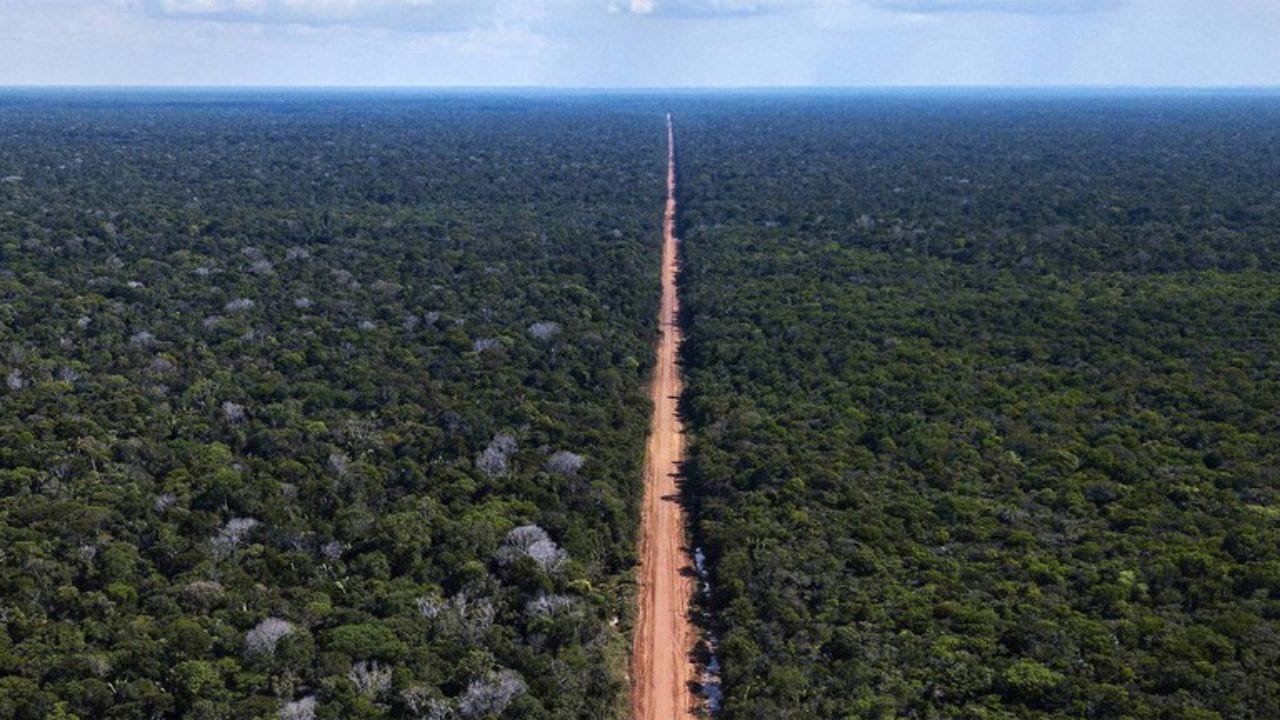

Understand The Political, Environmental And Financial Challenges That Have Prevented The Completion Of The Highway Connecting Manaus To The Rest Of The Country For Decades, A True Amazon Saga.
In the heart of the Amazon, a vital road for national integration remains a symbol of unfulfilled promises. BR-319, the only land link between Manaus and the rest of Brazil, has been challenging progress for over 40 years. Amidst stretches of mud and environmental controversies, the question persists: why has this important highway in Brazil never been fully paved?
What Is BR-319 And Its Strategic Importance As A Highway In Brazil?

BR-319 is a federal highway with approximately 885 km in length. It connects Manaus, in Amazonas, to Porto Velho, in Rondônia. In theory, it would be a crucial route for transporting cargo, people, food, and medicines. In practice, the road is in a precarious state. Long stretches simply do not function as a highway.
The route of the highway in Brazil crosses remote areas of the Amazon rainforest. It cuts through regions of high environmental sensitivity, including extractive reserves and indigenous lands. It is a corridor that, while it could connect, isolates millions due to lack of basic infrastructure. The most critical point is the “middle section,” which is about 405 km long. This segment lacks paving and signage. It features makeshift wooden bridges and impassable mud pits during the Amazonian winter. Drivers face days stuck and constant risks. The Canal Construction Time reports that trips that should take 12 hours can extend to four or five days.
-
A megaproject worth R$ 89 billion is advancing in Iraq and promises to change the game in global trade by creating a new corridor between Asia and Europe, reducing traditional routes and repositioning the country as a logistics powerhouse.
-
Goodbye bedside table: floating shelves become a trend in 2026 by freeing up space in the bedroom, improving circulation, bringing visual lightness, and integrating technology without taking up floor space.

-
Israel, Greece, and Cyprus signed an agreement in 2020 to transport gas from the Mediterranean to Europe via a 1,872 km pipeline, but Turkey claimed sovereignty over part of the maritime route, and the project never materialized.
-
Israel, Greece, and Cyprus signed an agreement in 2020 to transport gas from the Mediterranean to Europe via a 1,872 km pipeline, but Turkey claimed sovereignty over part of the maritime route, and the project never materialized.

The Current Situation Of The Highway: A Segmented Portrait

Currently, BR-319 is far from being a continuous and functional route. Less than half of the road has regular paving.
- Km 0 to 198 (Manaus – Careiro da Várzea): This stretch is fully paved. It is considered in good condition for travel.
- Km 198 to 250 (Lot C): Paving works began in 2021. Progress is slow, with obstacles hindering advancement.
- Km 250 to 655 (Middle Section): Here lies the greatest challenge. There are approximately 405 km without continuous asphalt, with dirt and mud. Traffic conditions are terrible, especially during the rains.
- Km 655 to 885 (to Porto Velho): The last 230 km are paved. The quality is variable, and some points require maintenance, but it is a passable stretch. This discontinuity in the asphalt fuels the nickname “ghost highway.”
History Of BR-319: Promises, Abandonment And Attempts To Resume

BR-319 was born in the context of the Brazilian military regime, constructed between 1968 and 1973. It was inaugurated in 1976 by President Ernesto Geisel. Its mission was to connect Manaus to Porto Velho by land, ensuring national sovereignty in the Amazon. It also aimed to boost settlement and facilitate the flow of production.
In the early years, BR-319 was fully paved. However, it succumbed to lack of maintenance, heavy rains, and unstable soil. By the 1980s, the middle section became practically impassable. The road was abandoned. Several governments attempted to reactivate the highway. In 1996, it was included in the Brazil in Action plan (FHC government), without advancements. In 2007, during Lula’s government, it was included in the PAC, with recovery of sections at the ends. In 2021, the Bolsonaro government began paving Lot C. However, the project faced environmental criticism and legal disputes, resulting in work suspension in 2024 due to licensing failures and lack of consultation with indigenous peoples.
Today, the discussion resurfaces with force. The federal government included the highway in the New PAC. An unprecedented model of environmental oversight was proposed. The main barrier remains environmental licensing, due to conservation units and indigenous lands. Environmentalists fear an increase in deforestation and environmental crimes. Nevertheless, its reactivation could reduce transport costs to Manaus and integrate the north with the country.
This Is Not An Isolated Case, Other BRs In Brazil Are In Precarious Conditions

BR-319 is not alone in its precariousness. Brazil has other highways in similar or worse condition. BR-156, in Amapá, connects Macapá to Oiapoque. Of its approximately 800 km, around 60% are paved. The rest turns to mud, isolating cities.

Another example is BR-242, which connects western Bahia to Mato Grosso. With over 2,300 km, it is essential for the agribusiness of the Matopiba region. Even with its economic importance, entire stretches remain unpaved, causing losses. Like BR-319, BR-242 lives on unfulfilled promises. While BR-319, a strategic highway in Brazil, faces complex environmental issues, BR-242 suffers from apparent political abandonment, despite being vital for the economy.
These comparisons illustrate a bigger problem: a road infrastructure marked by abandonment and lack of planning. What connects BR-319, BR-156, and BR-242 is the scenario of having been designed to integrate the country but ending up left behind.







Porque será?
Talvez pela incapacidade de políticos?
Cadê o porta voz do povo?