





 Portuguese
  English
  Spanish
  5 min of reading
  179 comments


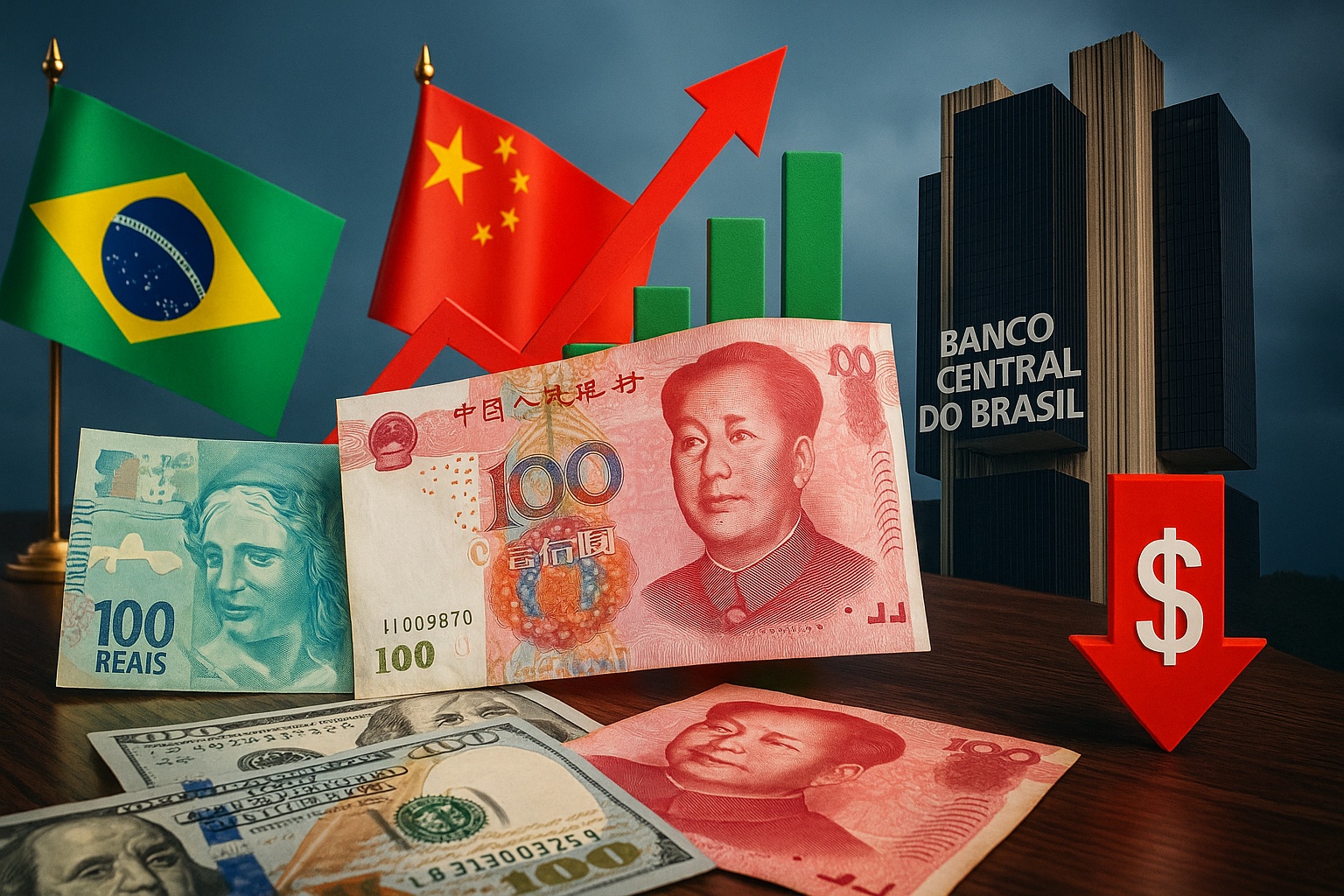


Brazil And China Close Currency Swap Of R$ 157 Billion, Expand Use Of Yuan And Put Unprecedented Pressure On The Global Supremacy Of The Dollar.
In May 2025, the Central Bank of Brazil announced a historic agreement with the People’s Bank of China: a currency swap equivalent to R$ 157 billion (US$ 27.7 billion), valid for five years. At first glance, the operation is technical, but it is actually a geopolitical milestone. More than just ensuring liquidity in times of crisis, the swap accelerates the use of yuan in bilateral trade and signals to the world that Brazil is willing to diversify its dependence on the dollar.
This move places the country at the center of the dispute between two powers: on one side, the United States, which still dominates 80% of global transactions with its currency; on the other, China, which seeks to establish the yuan as an international reference in energy, commodities, and technology contracts.
What Is A Currency Swap — And Why Does It Matter So Much


A currency swap is an agreement between two central banks that allows for the exchange of currencies at a predetermined value, acting as a “liquidity cushion.”
-
Brazilian city gains industrial hub for 85 companies that is equivalent to 55 football fields.

-
Peugeot and Citroën factory in Argentina cuts production by half and opens a layoff program for more than 2,000 employees after Brazil drastically reduced purchases of Argentine vehicles.

-
A Brazilian city gains a factory worth R$ 300 million with the capacity to process 200 thousand tons of wheat per year, a mill of 660 tons/day, silos for 42 thousand tons, and an industrial area of 276 thousand m².
-
Havan will leave the shopping mall in Blumenau to inaugurate something that the chain has never done before: a megastore in half-timbered style in the Historic Center of the city, which is expected to be completed in May and change the landscape of local retail.

If a currency crisis were to hit Brazil, for instance, the Central Bank could turn directly to the yuan, without relying on intermediary dollars.
However, the 2025 agreement is not just a line of defense against crises. It reflects China’s strategy to expand the use of its currency in global trade and create alternatives to the financial system dominated by Washington. For Brazil, it opens up the opportunity to reduce transaction costs, enhance competitiveness in agribusiness and mining, and increase resilience in times of currency instability.
The Weight Of China In Brazilian Trade
The relevance of the yuan is growing because China has already been the main trading partner of Brazil for more than a decade. In 2024, bilateral trade totaled US$ 157 billion, with a record surplus for Brazil.
Products such as soybeans, iron ore, oil, and meat accounted for most of the exports, while Brazil mainly imported industrial inputs and technology.
The most symbolic data is that, in the first quarter of 2025, 41% of the trade between Brazil and China was already settled in yuan, a historic index. This means Brazilian companies are paying and receiving directly in the Chinese currency, without needing to go through the dollar — something unthinkable just a few years ago.
The Alert From Washington
In the United States, the advance of the yuan is seen as a direct challenge to the supremacy of the dollar. The American currency still dominates international reserves and is used in about 80% of currency exchange transactions.
However, each agreement that strengthens the yuan in strategic countries — such as Brazil, Russia, Saudi Arabia, and the United Arab Emirates — is interpreted as a step in the slow, yet consistent erosion of American hegemony.
Authorities in Washington have already expressed concern. The fear is that, by reducing dependence on the dollar, countries like Brazil also diminish their vulnerability to sanctions and financial pressures from the U.S., creating a parallel network of global transactions.
Europe On Hold
While the U.S. sounds the alarm, the European Union watches cautiously. Brussels fears that by strengthening financial agreements with China, Brazil will stop prioritizing negotiations with the European bloc — which is already strained in talks over the Mercosur–EU agreement.
Additionally, the transition to alternative currencies in global trade threatens the competitiveness of European companies, which operate under stricter and less flexible rules than their Chinese counterparts.
Connection With The BRICS And De-Dollarization
The swap cannot be analyzed in isolation. It is part of a broader BRICS strategy, which has been discussing alternatives to the dollar for years.
In 2024, the group announced its expansion to include Saudi Arabia, Egypt, and Iran, and reinforced the debate about BRICS Pay, a payment system that would allow multilateral transactions in local currencies.
Although the creation of a “BRICS common currency” still seems distant, the accumulation of bilateral agreements, like the Brazil–China swap, practically builds a multipolar payment system, where the dollar gradually loses ground.
The Direct Impacts On Brazil
For Brazil, the immediate effects of the swap are clear:
- Agribusiness: soybean, meat, and sugar exporters will find it easier to close contracts in yuan, reducing costs and volatility.
- Mining: iron ore and nickel, sold on a large scale to China, can be settled in Chinese currency, facilitating long-term operations.
- Energy: with new oil and green hydrogen projects, the yuan could become a reference in energy contracts.
- Financial System: Brazilian banks gain direct access to reserves in yuan, strengthening currency stability in times of turbulence.
The Risk Of New Dependence
But not all is victory. Economists warn that trading dependence on the dollar for a dependence on the yuan could generate new problems.
The Chinese currency is still not fully convertible, and the country’s financial market remains under strong state control. This means that, in crisis scenarios, access to the yuan may depend more on political decisions from Beijing than on automatic market mechanisms.
In other words: the swap increases autonomy from the U.S., but it may increase vulnerability to China.
Experts disagree on how far the yuan can advance. Some believe that without a full opening of the Chinese financial system, it will hardly replace the dollar. Others, however, point out that it is not necessary to replace in order to challenge: it is enough to capture increasing shares of global trade.
With Brazil as a strategic partner, China shows it is willing to use diplomacy, investments, and finance to strengthen its currency. Each contract signed in yuan is a symbolic and practical victory in the dispute for the future of the international monetary system.
Yuan, Dollar, And Real
The agreement of R$ 157 billion places Brazil at the epicenter of a monetary battle that will define the coming decades. While expanding its options and reducing costs, the country also draws closer to Beijing’s orbit.
The big question is: Will Brazil be able to use the swap as a strategic trump card, diversifying its partnerships without becoming tied to a single power pole? Or will it merely be exchanging a historic dependency for the risk of a new financial trap?
In any case, one thing is certain: in 2025, Brazil ceased to be merely an observer to become the protagonist in the global dispute between the dollar and the yuan.









Trazer Yuan pra ser referencia por mim e muito bom, por que se depender da nossa moeda ja era. O Yuan ira alavancar os valores do agronegócio, de certa forma pra mim e dependencia do Brasil com a China sim, mais tem seus motivos e vantagens por isso espero que continuem.
República popular do Brazil
Os EUA estão provando o que eles mesmos inventaram , o Livre Comércio entre as nações, o que eles mesmos inventaram e consta na Declaração de Independência de 1776, o que eles não querem ( aliás mr.Trump) que seja colocado em prática, quando afeta a desvalorização do dólar.