





 English
  Francês
  Alemão
  Italiano
  Japonês
  Norueguês
  Portuguese
  Spanish
  3 min of reading
  0 comments


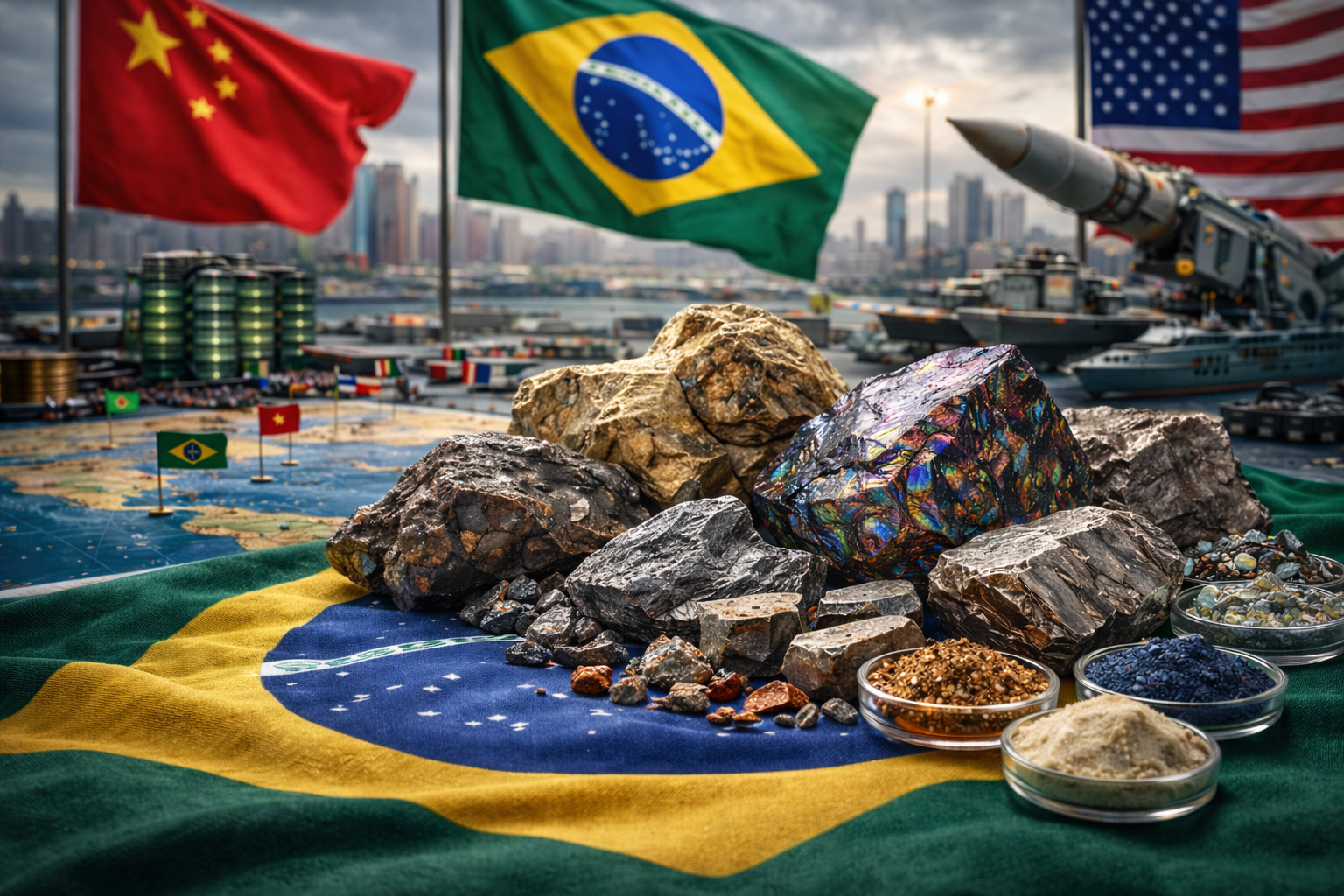
Rare Earths Support Screens, Turbines, and Powerful Engines and Help Understand Debates About China, Electric Cars, and the Amazon
A mineral discussion with a strong technological impact has gained prominence in recent years, especially in debates about technology, China, electric cars, and Amazônia. Additionally, although the topic may still seem distant for some of the public, the so-called rare earths support strategic sectors of the modern economy.
In practice, this group of discreet minerals is behind colorful screens, wind turbines, high-precision missiles, and high-performance engines. Consequently, over the last few decades, a silent dispute among global powers has consolidated around these chemical elements.
What Rare Earths Really Are
First of all, it is essential to clarify that rare earths are not secret locations or hidden mines. In fact, the term designates a set of 17 chemical elements from the lanthanide family.
-
If the USA were to go to war with Brazil, Washington’s greatest fear would not be the attack itself, but facing a vast territory, prolonged resistance, and a costly, chaotic, and unpredictable occupation.

-
In 2013, Nicaragua sold the concession for a canal to rival Panama to a Chinese billionaire who lost 85% of his fortune, disappeared, and was declared bankrupt. Now the project resurfaces with a new route, a new Chinese partner, and a cost of $64.5 billion.
-
The USA announces a mysterious billion-dollar vault project to store critical minerals, but what intrigues experts is not just the plan itself, but why Latin America, including Brazil, has entered the center of this global dispute against China.

-
Trump Announces Bombing of U.S. Military Targets on Iranian Island Responsible for About 90% of Iran’s Oil Exports, Warns of Further Attacks if Navigation in Strategic Strait of Hormuz Is Threatened


Historically, the expression emerged in the 19th century when these elements were found in small quantities and mixed in hard-to-process rocks. During that time, according to scientific records of the period, they were believed to be extremely scarce.
However, it is now known that these elements are not so rare in the Earth’s crust. Nevertheless, the great challenge remains in the extraction, separation, and transformation of the ore into a high-value-added product.


Strategic Elements for Modern Technology
Among the main names are lanthanum, cerium, neodymium, terbium, europium, and gadolinium, all with specific functions in modern technologies. Furthermore, while some ensure vivid colors in screens, others enable more powerful and efficient engines.
Thus, these minerals support the invisible foundation of electronic devices, industrial systems, and energy solutions. At the same time, rare earths appear in the manufacturing of wind turbines, reinforcing their link to the energy transition.
Similarly, they are used in high-precision missiles, enhancing their strategic relevance on the international stage. Consequently, their importance extends beyond the electronic sector and reaches sensitive areas of the global economy.
Public Interest and Digital Debate
In recent years, the topic has increasingly occupied space in digital and scientific discussions. In this context, the channel CanalTop10, which has 9.7 million subscribers, explores precisely this universe considered little known by the general public.
According to the channel itself, it is now known that these elements are not as scarce as was previously believed. Consequently, the focus of the debate has shifted from absolute rarity to the complexity of industrial processing and the technological dominance involved.
Industrial Challenge and Productive Chain
Despite the wide presence of these elements in the Earth’s crust, industrial processing remains complex and technically demanding. First, the ore must be extracted using appropriate techniques.
Then, it must undergo specific chemical processes for separation. Subsequently, it transforms into a high-tech material, ready for industrial application.
Thus, the technical and productive costs rise significantly. Consequently, countries that dominate this productive chain consolidate a strategic advantage over the decades.
Rare Earths in the Global Scenario
Currently, rare earths remain associated with discussions about industrial sovereignty, technological innovation, and geopolitical positioning. However, it is essential to highlight that these elements have been known for over a century and studied since the 19th century.
Therefore, understanding their technical function allows for an analysis of the topic with precision, transparency, and a scientific basis. Additionally, this understanding reduces exaggerated interpretations and strengthens a more qualified public debate.
Thus, when observing modern screens, turbines, and powerful engines, it becomes possible to recognize the silent presence of lanthanum, neodymium, and terbium, elements that support essential technologies in daily life and the global industry.
Given this strategic and technological scenario, should Brazil prioritize industrial mastery of rare earths or enhance public debate about their global importance?









Seja o primeiro a reagir!