





 Portuguese
  English
  Spanish
  6 min of reading
  0 comments


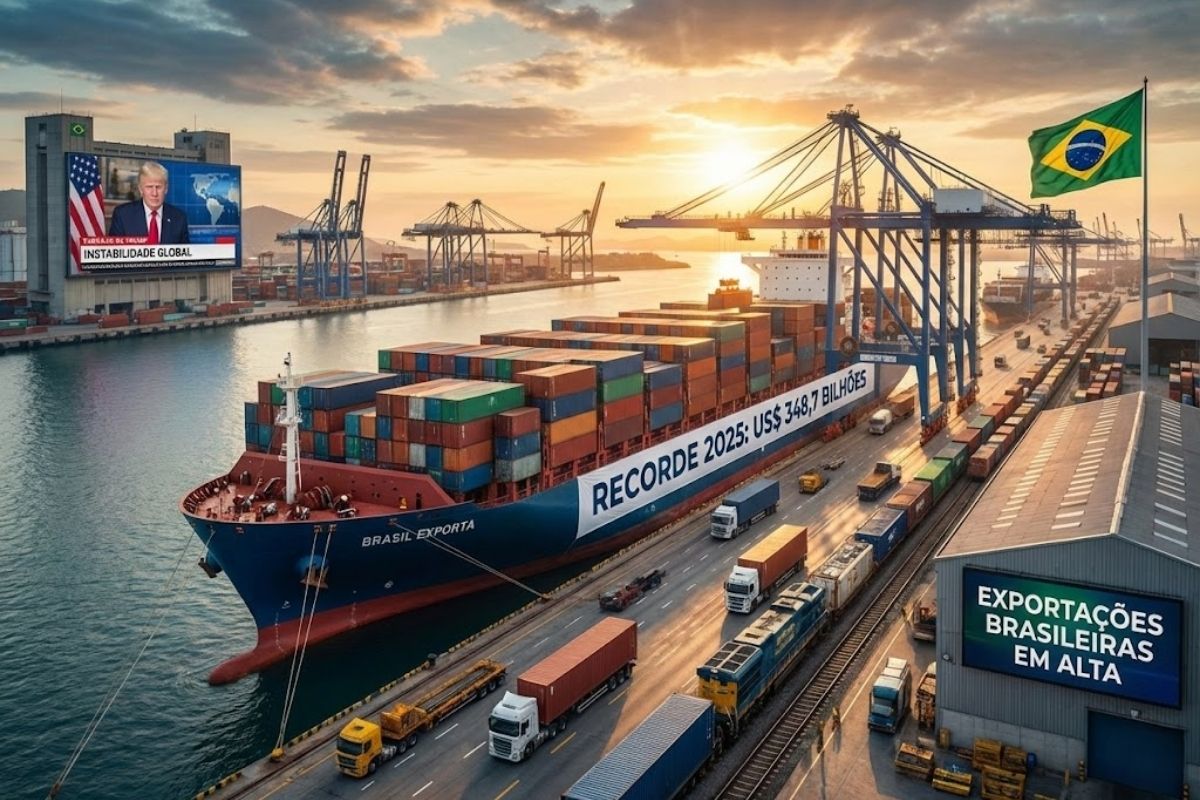
The Record Export of Brazil in 2025 Summed US$ 348.7 Billion, Up 3.5% Over 2024 and a New Historical Maximum. China Surpassed US$ 100 Billion and Responded for 28% of the Total. Meanwhile, the US Fell 6.6%, the Surplus Fell and Imports Set a Record in Total Trade Flow.
The record export of Brazil in 2025 was achieved even with the tariff hike by the government of Donald Trump and with geopolitical instability on the radar. The country exported US$ 348.7 billion, an increase of 3.5% compared to US$ 337.0 billion in 2024, establishing a new historical maximum.
The result also exceeded the previous record, registered in 2023, by US$ 9 billion, and came accompanied by important changes in the commercial balance design: while China expanded its leadership and surpassed US$ 100 billion, sales to the United States fell, the surplus shrank, and imports reached a new record.
What Sustains the Record Exports in 2025
The final number of US$ 348.7 billion consolidates the record for exports in a year where international trade had to deal with tariff pressures and described an unstable external environment.
-
Larger than entire cities in Brazil: BYD is building a 4.6 km² complex in Bahia with a capacity for 600,000 vehicles per year, but the discovery of 163 workers in conditions analogous to slavery has shaken the entire project.

-
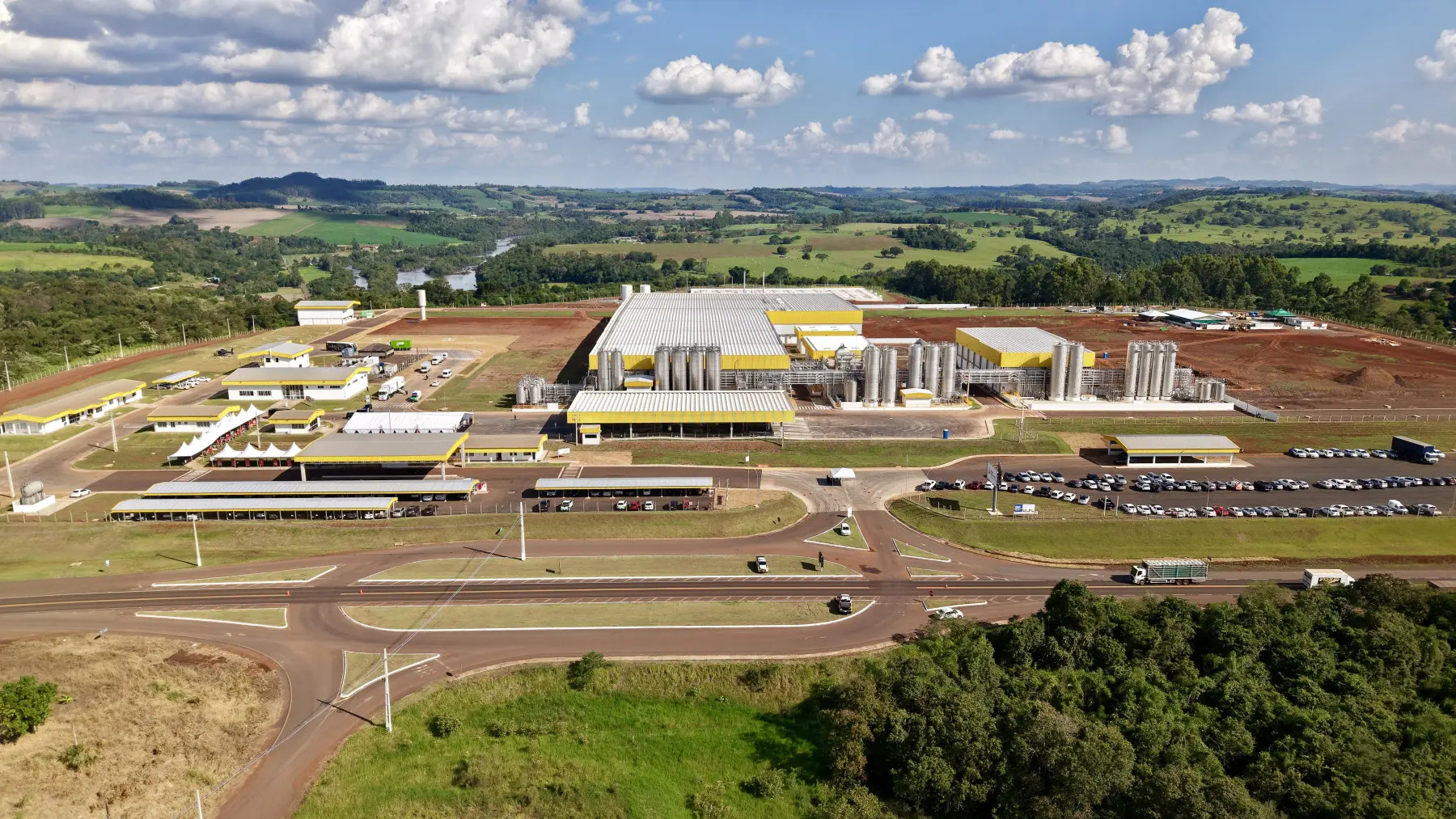
With an investment of R$ 612 million, a capacity to process 1.2 million liters of milk per day, Piracanjuba inaugurates a mega cheese factory that increases national production, reduces dependence on imports, and repositions Brazil on the global dairy map.
-
Brazilian city gains industrial hub for 85 companies that is equivalent to 55 football fields.

-
Peugeot and Citroën factory in Argentina cuts production by half and opens a layoff program for more than 2,000 employees after Brazil drastically reduced purchases of Argentine vehicles.


In absolute terms, the increase of 3.5% over 2024 represents a significant increment in the exported value, in addition to marking the symbolic turning point over the previous best performance.
Another point that helps to gauge the strength of the result is the breaking of the 2023 record by US$ 9 billion, a leap that reinforces the reading that 2025 combined growth with expansion of the reach of external sales, even with losses in specific markets.
China Expands Advantage and Surpasses US$ 100 Billion
China was the main destination and surpassed the US$ 100 billion mark in purchases, with about 28% participation in the total exported value. In practice, this means that more than a quarter of everything Brazil sold abroad in 2025 had China as the destination, consolidating the Asian country as the central axis of the performance.
After China, the United States appeared with US$ 37.71 billion and 10.8% participation, Argentina with US$ 18.10 billion and 5.2%, and Mexico with US$ 7.73 billion and 2.2%. This design shows an international trade with relevant destinations, but with a clear concentration on the main buyer.
USA Fell 6.6% and October Marked the Most Critical Moment
Even with the record exports for the year, sales to the United States ended 2025 with a decline of 6.6%, in a movement associated with the tariff barriers imposed by the government of Donald Trump.
The performance was especially pressured in the second half, with a well-defined turning point.
The most critical moment occurred in October, when sales to the US recorded a drop of 35.4%. By December, data indicated a recovery trajectory, with the decline limited to 7.2% compared to the same month in the previous year.
In other words, there was a strong shock in October and then signs of improvement at the turn of the year, although without returning to positive territory.
Surplus Falls 7.9% Because Imports Accelerate Faster Than Exports
The final balance of the commercial balance was US$ 68.3 billion, which represents a decline of 7.9% compared to the US$ 74.2 billion of 2024. The decline occurred despite the record exports for a direct reason: imports grew at a faster pace than exports.
This detail is crucial to understand the full picture of 2025. Exporting more does not guarantee a larger surplus when the country also purchases more from abroad, and that was exactly the layout of the year: advances in exports, but accompanied by an even stronger leap in imports.
Imports Set Record and Take the Trade Flow to US$ 629.1 Billion
The total imported in 2025 summed US$ 280.4 billion, an increase of 6.7% compared to the US$ 262.9 billion of the previous year.
This amount exceeded the previous import record by US$ 8 billion, registered in 2022, and confirms that 2025 was a year of peaks both on the sales and purchases side.
With this simultaneous movement, the total flow of Brazilian international trade, the sum between imports and exports, reached US$ 629.1 billion in 2025, growing by 4.9% compared to 2024.
The number highlights a more active economy in foreign trade, but also explains why the surplus fell: the flow’s growth was driven by both sides, with emphasis on the acceleration of imports.
Agriculture Leads Growth and Coffee Soars with Price Increase
Among the sectors, agriculture was the one that presented the highest growth in annual exports, with a 7.1% increase, totaling US$ 77.6 billion.
Within this performance, the individual highlight was unroasted coffee, which had a 31.1% leap in value, driven by a 60% increase in prices in the international market.
Soybeans also appear as a key component of the result: the product reached historic volume marks for China, surpassing 80 million tons.
This data helps explain why China not only led but also surpassed the US$ 100 billion mark during the year, reinforcing the role of agriculture in the record exports.
Opening New Markets Mitigates Losses in the USA
In addition to performance in major destinations, there was a relevant dispersion factor: the opening of new markets.
Brazil registered record purchases from more than 40 countries, including Canada, Switzerland, Norway, India, and Turkey, which helped mitigate losses in the United States.
In practice, this movement indicates that 2025 was not only a year of selling more but also of selling to more places, reducing part of the impact of a specific market in retraction.
In a scenario of tariff barriers, diversification of destinations becomes a strategic component to sustain the aggregate performance.
Government Attributes Result to Competitiveness Actions
In the government’s view, the performance is related to policies aimed at increasing productivity and competitiveness.
Vice President Geraldo Alckmin, Minister of Development, Industry, Commerce and Services, stated: “The result also reflects the set of programs and actions by President Lula’s government to enhance the productivity and competitiveness of our companies abroad.”
The declaration is set in a context where the country combined record exports with an external environment described as more challenging, especially due to tariff measures and geopolitical instability.
Oil: Volume Rises 10.1%, But Revenue Falls with Price Decrease
Another important aspect of the 2025 picture was the behavior of crude oil. The total revenue from the product fell 0.7% over the year.
This data stands out because, at the same time, the volume exported grew 10.1%, showing that Brazil shipped more, but earned less.
The explanation lies in the price: there was a 9.8% drop in average barrel prices in the global market. Thus, the increase in volume was not enough to offset the drop in price, pressuring revenue even with more shipments.
The Final Balance of 2025: More Exports, More Imports and Smaller Surplus
At the close of the year, 2025 leaves a clear set of signals. The record exports reached US$ 348.7 billion and were driven by China above US$ 100 billion, by a strongly growing agriculture sector, and by significant gains in products like coffee and soybeans.
At the same time, tariff barriers weighed on the US, with an annual drop of 6.6% and a shock in October of 35.4%, although December showed improvement.
On the internal balance side, the expansion of 6.7% in imports up to US$ 280.4 billion elevated the trade flow to US$ 629.1 billion, but reduced the surplus to US$ 68.3 billion, a drop of 7.9%.








Seja o primeiro a reagir!