





 Portuguese
  English
  Spanish
  4 min of reading
  0 comments


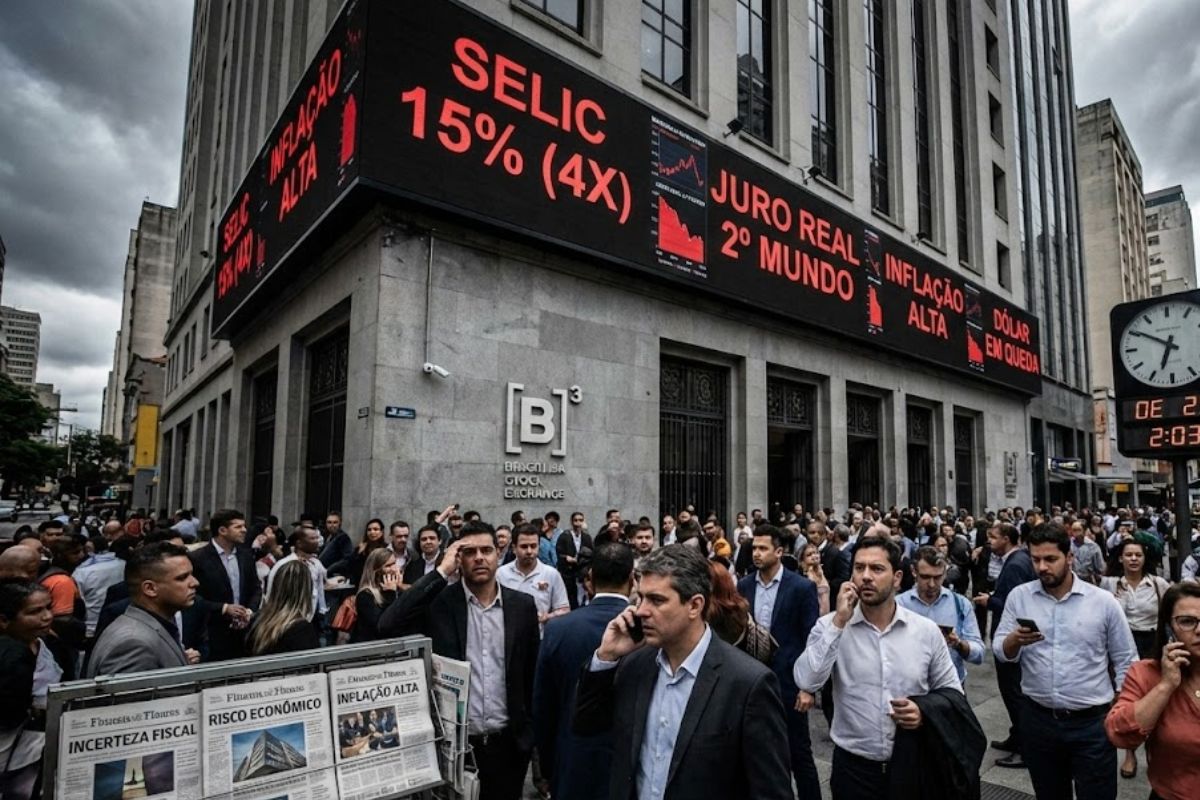
With Real Interest Rate of 9.44%, Brazil Maintains 2nd Global Position, Just Behind Turkey and Ahead of Russia and Argentina, While the Copom Holds the Selic at 15% and MoneYou Warns of Inflationary Uncertainty, Public Spending and Lower Momentum of Economic Activity, with Dollar Falling.
On Wednesday, December 10, 2025, Brazil decided to maintain the basic interest rate at 15% per year, following a meeting of the Central Bank’s Monetary Policy Committee. The decision solidified the country in the position of 2nd highest real interest rate in the world, only behind Turkey, in a scenario where the elevated rate continues to influence inflation, consumption, and economic activity.
On the same day, December 10, a survey by MoneYou showed that Brazil’s real interest rate is at 9.44%, calculated from the nominal rate minus the expected inflation for the next 12 months. The report emphasized that, even with the global dollar decline and a lower momentum of economic activity, the inflationary uncertainties remain significant, especially in light of concerns over government spending.
Brazil Maintains 2nd Highest Real Interest Rate in the World
The study by MoneYou confirms that Brazil remains in 2nd place among the highest real interest rates in the world, at 9.44%, a result directly linked to the maintenance of the Selic at 15% per year.
-
Larger than entire cities in Brazil: BYD is building a 4.6 km² complex in Bahia with a capacity for 600,000 vehicles per year, but the discovery of 163 workers in conditions analogous to slavery has shaken the entire project.

-
With an investment of R$ 612 million, a capacity to process 1.2 million liters of milk per day, Piracanjuba inaugurates a mega cheese factory that increases national production, reduces dependence on imports, and repositions Brazil on the global dairy map.

-
Brazilian city gains industrial hub for 85 companies that is equivalent to 55 football fields.

-
Peugeot and Citroën factory in Argentina cuts production by half and opens a layoff program for more than 2,000 employees after Brazil drastically reduced purchases of Argentine vehicles.


Turkey leads the ranking, with a real interest rate of 10.33%, followed by Russia, in 3rd place, with 7.89%.
The Argentina, which in the previous measurement by MoneYou was in 4th place with a real interest rate of 5.16%, maintained the same position in December, but now with a real rate of 7.14%, approaching the Brazilian level.
These numbers show that Brazil still offers one of the highest returns in the world, when considering the yield above projected inflation.
How the Real Interest Rate is Calculated in Brazil
MoneYou reminds that the real interest rate is formed, among other points, by the nominal interest rate minus the expected inflation for the next 12 months.
In Brazil’s case, the combination of Selic at 15% and inflation expectations helps keep the country at the top of the international ranking.
This elevated real interest rate directly impacts the daily life of the Brazilian economy: it makes credit more expensive, discourages productive investments and slows down household consumption, while making fixed income securities more attractive to domestic and foreign investors.
Selic at 15% for the Fourth Consecutive Time
In this Wednesday’s decision, the Copom opted to maintain the Selic at 15% per year for the fourth consecutive meeting, reinforcing the cautious stance in light of the inflationary and fiscal scenario.
As a result, the basic rate remains at its highest level in nearly 20 years; in July 2006, during the first term of President Luiz Inácio Lula da Silva, the Selic was at 15.25% per year.
The repetition of the same rate for four consecutive meetings indicates that Brazil still faces strong inflationary uncertainty, despite recent dollar depreciation and slowing activity.
For MoneYou, the behavior of prices remains closely tied to concerns over government spending, which reduces the space for a rapid easing of monetary policy.
Inflationary Uncertainty, Government Spending and Weaker Activity
In the report released also on December 10, MoneYou highlighted that Brazil still faces significant inflationary uncertainties, largely associated with the management of public accounts.
Government spending remains a sensitive point, putting pressure on inflation expectations and limiting the potential for cuts in the Selic in the short term.
At the same time, the institution noted that the price index has been showing some relief, aided by the global dollar decline and the lower momentum of economic activity, both effects of the elevated interest rate itself.
In other words, the more restrictive monetary policy has helped contain inflation but comes at a cost in terms of economic growth in Brazil.
Brazil in 4th Place in Nominal Interest Rates
When only looking at nominal interest rates, without discounting inflation, Brazil ranks 4th in the global ranking, behind Turkey, Argentina, and Russia.
The list by MoneYou, which considers 40 countries, shows the following picture of disclosed basic rates:
Turkey: 39.50%
Argentina: 29.00%
Russia: 16.50%
Brazil: 15.00%
Colombia: 9.25%
Mexico: 7.25%
South Africa: 6.75%
Hungary: 6.50%
India: 5.25%
Indonesia: 4.75%
Philippines: 4.75%
Chile: 4.75%
Israel: 4.25%
Hong Kong: 4.25%
Poland: 4.00%
United Kingdom: 4.00%
United States: 3.75%
Australia: 3.60%
Czech Republic: 3.50%
China: 3.00%
Malaysia: 2.75%
South Korea: 2.50%
New Zealand: 2.25%
Canada: 2.25%
Germany: 2.15%
Austria: 2.15%
Spain: 2.15%
Greece: 2.15%
Netherlands: 2.15%
Portugal: 2.15%
Belgium: 2.15%
France: 2.15%
Italy: 2.15%
Taiwan: 2.00%
Sweden: 1.75%
Denmark: 1.60%
Thailand: 1.50%
Singapore: 1.15%
Japan: 0.50%
Switzerland: 0.00%
This set of data reinforces that Brazil remains among the economies with the highest interest rates in the world, both in nominal and real comparison, which influences investment, currency and fiscal policy decisions.
What the Interest Rate Scenario Says About Brazil Today
With a real interest rate of 9.44% and Selic at 15% for the fourth consecutive time, Brazil remains an attractive destination for fixed income investors, but coexists with a monetary policy that still serves as an important brake on consumption and production.
At the same time, the combination of inflationary uncertainty, concerns over public spending, and the dollar’s decline creates a delicate environment for the Central Bank, which needs to balance price control with the effects on economic activity.
In your opinion, should Brazil start reducing Selic in the next Copom meeting, or is it still too early to cut interest rates?








Seja o primeiro a reagir!