





 English
  Francês
  Alemão
  Italiano
  Japonês
  Norueguês
  Portuguese
  Spanish
  3 min of reading


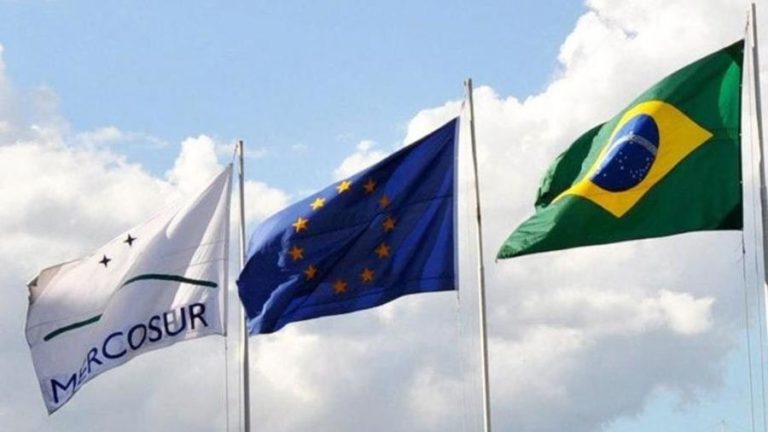
Mercosur and European Union Agreement Expected to Impact Brazil’s Economy Over the Next 15 Years with a Billion-Dollar Investment According to CNC
Brazil’s economy could be impacted by US$ 79 billion by 2035 due to a trade agreement between the Southern Common Market (Mercosur) and the European Union (EU), finalized at the end of June. Government decides to resume uranium mining to expand the nuclear program in the country.
The assessment comes from the National Confederation of Trade in Goods, Services and Tourism (CNC), which released a study on the matter on Friday, October 11, at the entity’s headquarters in Rio de Janeiro, during the 2nd International Trade and Services Conference of Mercosur (CI19).
-
Government unlocks R$ 554 million for a highway that has been requested for decades and accelerates the duplication of BR.
-
Without bricks, without cement, and without endless construction: the cardboard house that is assembled in modules and can be moved.

-
Billions of barrels on the equatorial margin could lead Amapá to double its oil production in Brazil — the state aims to enter the route of companies in the Campos Basin, attract investments, and boost jobs and businesses in the oil and gas sector.
-
Without bricks, without cement, and without endless construction: the cardboard house that is assembled in modules and can be moved.

Considering the reduction of non-tariff barriers, the impact could reach US$ 112 billion over the period, according to CNC. The figures are slightly lower than those released by the Brazilian government, which are US$ 87.5 billion and US$ 125 billion including non-tariff barriers over 15 years.
Brazil is currently holding the pro tempore presidency of the Mercosur Chamber of Commerce Council (CCCM), thus leading the discussions on the alliance, explained CNC President José Roberto Tadros.
Roberto Tadros stated, “Foreign market is trade, so we are positioned within this context. Not only in terms of exchanges but also regarding tourism and services, so this is the place to address these matters and international relations.”
One of the study’s contributors, CNC economist Fábio Bentes, clarifies that the figure was calculated by adding the commercial balance surplus, estimated at US$ 66 billion, with the aggregated investment of US$ 13 billion, plus US$ 33 billion from the reduction of barriers such as phytosanitary ones, to reach US$ 112 billion.
“We considered Brazil’s expected growth for the coming years, around 2%, 2.5%, and Europe’s growth, which is slightly lower at 1.2%, but given the size of the continent’s economy, this also helps to amplify the positive impact of the agreement. Another premise is the exchange rate, between R$ 3.80 and R$ 4 until 2024, according to the Focus Bulletin from the Central Bank, and then adjusted for inflation,” he argued.
For him, the agreement is historic and will benefit exporters, importers, and consumers. “From the perspective of our exports, the tendency is to benefit the agro-export sector. Brazil is the second largest exporter of agricultural products to Europe and will surpass the United States in about two or three years.
From the perspective of imports, we, from trade and services, if we have access to quality products without high tariff barriers, will import goods or services at a lower price, and the population will have more competitive prices,” the economist explained.
The 32 countries that make up the two blocs need to authenticate the Mercosur-EU agreement for it to take effect. Relations began in 1999.
- Ibama Will Demand Clarifications from Shell About Oil Barrels on Sergipe Beaches
- Brazil Will Receive a US$ 79 Billion Investment from the Mercosur-EU Agreement
- Imetame Acquires Petrobras Fields in Espírito Santo for US$9.4 Million






Seja o primeiro a reagir!