





 Portuguese
  English
  Spanish
 6 min of reading
  32 comments


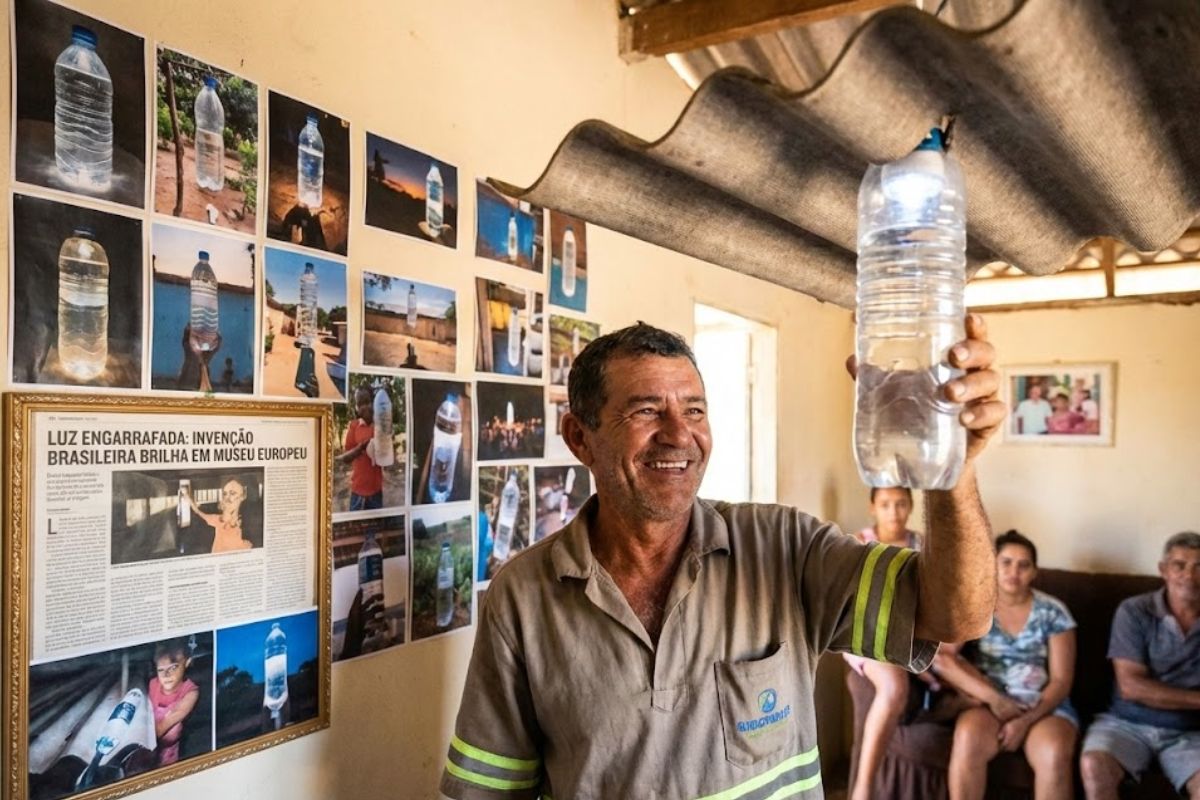


Bottle PET Lamp Created by Alfredo Moser in Uberaba Reuses PET Bottle and Sunlight to Replace Part of the Electric Energy, Lower Utility Bills in Windowless Homes, Inspire Social Projects in Various Countries and Reach a European Museum as a Symbol of Accessible Technology
In 1990, still a mechanic in Uberaba, in the interior of Minas Gerais, Alfredo Moser left home on his bicycle and heard from Chico Xavier that he would have a “light” in his life, which would not be just his, but “of the people.” Eleven years later, in 2001, this prediction took shape on the roof of the old workshop, when he installed the first bottle PET lamp filled with water in the tile, transforming the midday sun into diffuse brightness inside the house.
Since then, the invention has spread silently. In just over two decades, the bottle PET lamp left the rooftops of Uberaba for social projects in over 15 countries, was reproduced in about 140,000 homes in the Philippines, reached India, Bangladesh, and Tanzania, became a piece in a museum in Amsterdam, and took the Brazilian to speak at an international innovation conference in South Korea, always with the same principle: to illuminate those who cannot pay for electric light during the day.
Prophecy, Workshop in Uberaba, and the Birth of the Bottle PET Lamp

The story begins in a simple neighborhood of Uberaba, where Alfredo Moser pushed the door of a mechanical workshop daily that exists now only in memory.
-
Scientists from an international project drill 1,800 meters of ice in Antarctica using hot water and discover details about one of the most intriguing places on planet Earth.

-
Seen from space, a colossal volcano nearly 5,000 meters high in Russia has released 1,600 km of smoke over the Pacific, forming “devil’s horns” of lava and revealing the brutal force of the Ring of Fire.

-
Expedition 501: Scientists drill into the ocean floor and discover a giant reserve of fresh water hidden beneath the sea, extracting nearly 50,000 liters and revealing an invisible system that could reshape the map of water scarcity.

-
Archaeologists find an intact tomb over 2,500 years old, with more than 100 preserved objects, weapons, jewelry, and human remains never touched.

It was there, years after the meeting with Chico Xavier in 1990, that he decided to test an improvised solution for the constant dimness of the workshop.
In 2001, Moser drilled the roof, fitted a bottle PET lamp filled with water into the tile, and realized that sunlight was refracted into the environment with intensity equivalent to a 40-watt bulb.
That bottle hung between beams and tiles began to be cited by the inventor as proof that an extremely simple solution could have an immediate effect on the lives of families without access to proper lighting.
“You have your own sunlight with water, which are priorities of our life together,” Moser sums up when explaining the concept.
For him, the invention is not just a decoration on the roof, but a survival technology for dark houses, without windows and without money for electric energy during the day.
How the Bottle PET Lamp Works

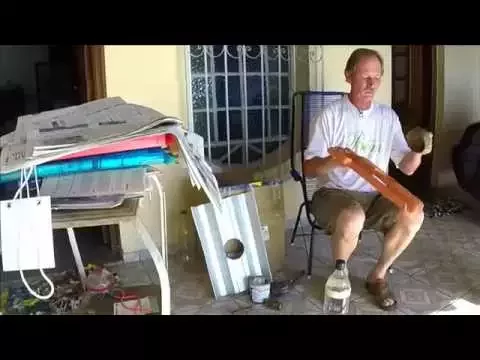
The assembly of the bottle PET lamp follows a standardized procedure that Alfredo Moser has been teaching “for 15 years” to anyone interested, in home workshops and demonstrations.
The step-by-step process begins with a transparent PET bottle, filled with drinking water and two capfuls of bleach, which prevents algae growth and keeps the water clear for longer.
On the outside of the cap, the inventor adds a small pot or simple cover to protect the bottle from direct sunlight, reducing plastic wear.
On the roof, the installer uses a hole saw attached to an electric tool to open the hole in the tile and secures the bottle PET lamp with plastic putty on both sides, sealing the entrance of rainwater.
On the outside, half the bottle remains exposed to the sun. On the inside, the part filled with water diffuses the light, illuminating the environment uniformly.
During the day, it is not necessary to turn on the electric lamp, which results in direct savings on the energy bill, especially in houses where the use of artificial light would be continuous due to lack of windows or natural ventilation.
From Uberaba to More Than 15 Countries and a Museum in Europe

The simple formula of the bottle PET lamp found fertile ground in regions with a high index of energy poverty.
A young Filipino saw the system online, replicated the model, and coordinated the installation of about 140,000 bottle lamps on rooftops in the Philippines, in communities where electricity is intermittent or too expensive for daily use.
The solution was also taken to India, Bangladesh, Tanzania, and other African countries, integrating housing programs and projects from social organizations.
In several of these locations, houses have only one door, no windows, and rely on kerosene or oil to light rooms at night.
By installing the bottle PET lamp, these families began to have strong natural light during the day, reducing fuel costs and improving basic conditions for reading, studying, and domestic work.
The impact attracted attention outside the NGO universe. A Dutch designer turned the concept into an exhibition work, and Moser’s solution ended up in a museum in Amsterdam, as an example of socially-oriented and environmentally responsible design.
The Brazilian was also invited to speak at an international innovation conference in South Korea, explaining how a reused bottle and drinking water can change the economy of a household with minimal income.
30% Lower Utility Bills and Impact at Home
The strength of the bottle PET lamp is not limited to statistics on rooftops around the world.
Inside the Moser family’s home, in Uberaba, the effect was measured with the energy bill.
Wife Carmelinda reports that the first test was in the bathroom: an environment where the electric light was turned on every time someone entered, even during the day.
As soon as the bottle PET lamp was installed on the bathroom roof, the family monitored the bill the following month.
According to Carmelinda, the result was immediate: the energy bill registered a reduction of about 30%, thanks to the fact that artificial lighting was no longer necessary during various periods of the day.
For a couple with a modest income, the difference in the bill meant real relief in the household budget.
In another experience reported to the inventor, a couple from a country that uses kerosene and oil to illuminate windowless homes managed, in just a few months of using the bottle PET lamp, to save enough to buy the layette for their first child.
This case is often recalled by Moser as a concrete example of how technology directly influences consumption decisions of poor families.
Register in Guest Books, Visitors, and the Pedagogy of the Bottle PET Lamp
The simple house in Uberaba became a point of technical pilgrimage.
Carmelinda and Alfredo keep a notebook with notes of everyone who visits their home to learn about the bottle PET lamp, from curious neighbors to television teams and foreign visitors affiliated with universities, NGOs, and design institutions.
The pages can hardly accommodate new signatures.
For about 15 years, the inventor has repeated the same script: explaining the origin of the idea, showing the first bottles still fixed on the roof of the old workshop, demonstrating the step-by-step assembly, and reinforcing that the goal is to allow each family to build their own bottle PET lamp using accessible materials.
The proposal is that technology remains open, without a patent that prevents mass reproduction.
At the same time, Moser insists on combating aesthetic prejudice.
Many people, he says, see the bottle on the roof as something “ugly” or too improvised.
For the inventor, those who criticize usually have never experienced the real value of the solution inside the house, in terms of savings and abundant light where there was once dimness.
Legacy, European Museum, and the Idea of Light as a Basic Right
The presence of the bottle PET lamp in a European museum, alongside high-cost design pieces, places Alfredo Moser’s invention in a larger debate about technology, sustainability, and inequality.
By reusing PET bottles and reducing the use of kerosene and electric lights during the day, the system helps to decrease waste and emissions, but above all, serves as a shortcut to access lighting in communities that cannot wait for ideal electrical networks or complete renovations.
For Moser, the main legacy is not in the international recognition or the speeches at conferences, but in the silent multiplication of rooftops drilled by a hole saw and filled with transparent bottles.
In each successful installation, he sees a practical confirmation of the phrase he often repeats: “It is not a decoration for the house, it is a saving and immense value within a home”.
Given such a simple, cheap, and replicable solution as the bottle PET lamp, would you install such a system on your roof to reduce the use of electric light during the day and test, in practice, how much you could save on the next energy bill?








Ele NÃO inventou. Existe Há mais de 100 anos no estado do Rio de janeiro. Tenho setenta anos de idade e vejo desde criança nos ramais de trem Nova Iguaçu, Santa Cruz e Leopoldina Nao era pet era garrafa de vidro de água mineral. Esse senhor aprendeu com os mais velhos. É muito **** apropriar-se do folclore brasileiro.
Ele NÃO inventou isto existe há mais de 100 anos no estado do Rio de janeiro. Tenho 70 anos e vejo desde criança nas casas pobres e oficinas nos subúrbios nos ramais das linhas de trem de Nova Iguaçu, Santa Cruz e Leopoldina..Não usavam pet nessa época e sim garrafas de vidro de água mineral. Existia garrafa de 2l. Usavam cimento para segurar a garrafa na telha de amianto .Esse senhor sabe disso ele aprendeu com os mais velhos. Quem é da minha idade sabe disso.
Eu já fiz a alguns anos atrás a invenção dele na minha garagem e funcionou