





 Portuguese
  English
  Spanish
  5 min of reading
  0 comments


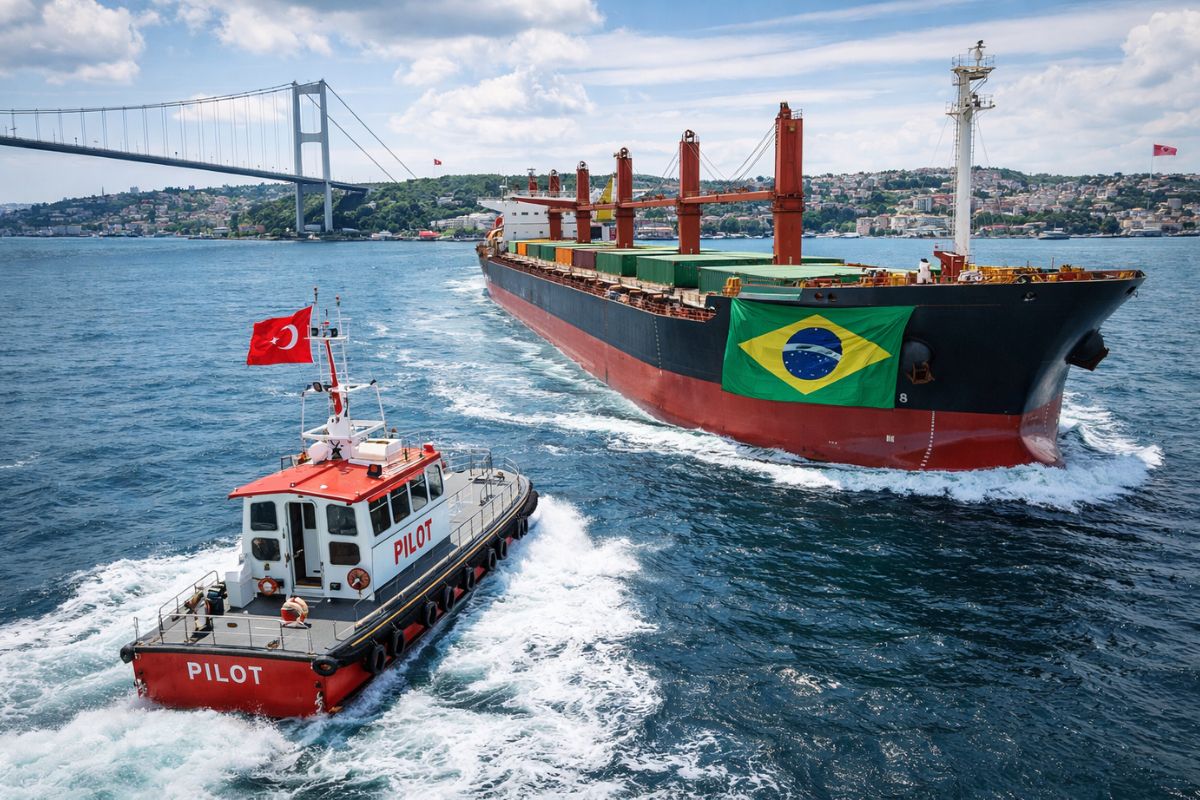
The Ministry of Agriculture has concluded negotiations with Turkish authorities to maintain an alternative route that allows Brazilian agribusiness to export products bypassing the Strait of Hormuz, closed due to conflicts in the Middle East, using Turkey as a logistical support point for markets in Central Asia and the Middle East
The Brazilian agribusiness has just secured a solution to a problem that threatened billions of dollars in exports. The Ministry of Agriculture and Livestock (Mapa) announced that negotiations with Turkish authorities have been concluded to maintain an alternative route for the flow of Brazilian agricultural products. This measure is a direct response to the closure of the Strait of Hormuz, blocked amid tensions and confrontations in the Middle East, which interrupted routes used by ships transporting loads from Brazilian agribusiness.
The solution found uses Turkey as a logistical support point. Goods from Brazilian agribusiness will be transported by sea to Turkish ports and then can proceed overland within Turkish territory before returning to maritime transport towards the final destination. The route bypasses the Persian Gulf and allows exports to continue reaching markets in the Middle East and Central Asia without relying on crossing the Strait of Hormuz.
Why the closure of the Strait of Hormuz threatens Brazilian agribusiness
The Strait of Hormuz is one of the most important maritime corridors for global trade. The passage connects the Persian Gulf to the Gulf of Oman and the Arabian Sea, and vessels transporting oil from major exporters like Saudi Arabia, Iran, Iraq, and the United Arab Emirates transit through it.
-
JBS, founded by the Batista brothers, continues to conquer the world: the entrepreneurs built a ‘factory in the desert’ with 3,000 jobs.

-
With only 1% of Brazilian territory, Santa Catarina has built one of the most competitive industrial parks in the country with 64,000 companies, nearly 1 million jobs, and a growth of 5.3% while the national industry is practically stagnant.
-
China banned the export of 22 tons of meat from Argentina.
-
While Russia dominates the global wheat market, Brazil emerges as an unexpected competitor in the Cerrado, offering grain available in July and August when stocks in the Northern Hemisphere are at their lowest point of the year.


The same route is used to send fertilizers and other products from the region to international markets, and to transport loads from Brazilian agribusiness in the opposite direction.
With the blockade caused by confrontations in the Middle East, vessels involved in commercial operations linked to Brazil had to alter their routes. This resulted in an immediate increase in freight costs and uncertainty about the continuity of deliveries.
For agribusiness, which depends on tight deadlines and international contracts with fixed dates, any interruption in the route represents a real financial risk and can compromise Brazil’s credibility as a reliable supplier.
How the route through Turkey works in practice
The logistical model negotiated by the Ministry of Agriculture combines maritime and land transport, with support in Turkish territory.
Loads from Brazilian agribusiness arrive at Turkish ports by sea and can be temporarily stored or proceed overland to another shipping point, returning to maritime transport towards the final destination.
The Turkish port infrastructure had already been used by Brazilian exporters before the closure of the Strait of Hormuz.
Although it enables the continuity of agribusiness exports, the model is expected to significantly increase logistical costs. Combining maritime transport with a land segment in foreign territory adds steps, time, and expenses that did not exist in the direct route through the Strait of Hormuz.
Still, the alternative is preferable to a total halt of deliveries, which would cost Brazilian agribusiness much more than the increase in freight.
The sanitary certificate that unlocked the passage through Turkey
For Brazilian agribusiness loads to transit through Turkish territory, Turkish authorities began to require new sanitary conditions for animal products subject to veterinary control.
In response, the Veterinary Sanitary Certificate for Products Subject to Veterinary Controls in Direct Transit through the Republic of Turkey or for Temporary Storage was established.
This document authorizes agribusiness goods to cross Turkish territory or remain temporarily stored in ports and logistics centers before continuing their journey.
The measure covers products that are under official veterinary inspection and are only in transit, meaning they do not have Turkey as a final destination and can proceed to another country or to loading onto ships.
Without this certificate, the alternative route would be unfeasible for animal products, which represent a significant share of Brazilian agribusiness exports.
What the Ministry of Agriculture says about the safety of the new route
In a statement, the Ministry of Agriculture stated that the measure provides more security and predictability to Brazilian exporters at a time of instability in international routes.
The ministry emphasized that the continuity of the route is part of the strategy to keep Brazilian agribusiness trade functioning even in scenarios of logistical restrictions.
The maintenance of access through Turkey is seen as a way to preserve the flow of foreign trade of agribusiness in an unstable environment that may persist.
If the confrontations in the Middle East extend or intensify, the Turkish route may cease to be an alternative and become the main outlet for markets in the region, which would require additional investments in logistical infrastructure and more robust agreements between the two countries.
The impact on costs and what changes for agribusiness from now on
The alternative route solves the flow problem but does not eliminate the cost. Combining maritime transport with a land segment in Turkish territory increases the operation’s cost, and this increase will be passed along the chain.
For Brazilian agribusiness, which operates with variable margins depending on the commodity, any increase in international freight can compromise price competitiveness in destination markets.
At the same time, the existence of a functional alternative route demonstrates Brazil’s ability to respond to international logistical crises.
Agribusiness is the sector that contributes the most to Brazil’s trade balance, and ensuring that exports are not interrupted by conflicts in other regions of the world is a matter of economic sovereignty.
The route through Turkey is a pragmatic solution that keeps trade functioning while instability in the Strait of Hormuz persists.
When a conflict on the other side of the world forces Brazil to redesign routes
The closure of the Strait of Hormuz exposed the vulnerability of the routes that Brazilian agribusiness uses to supply markets in the Middle East and Central Asia.
The alternative route through Turkey solves the immediate problem, but at a higher cost and with a logistical complexity that did not exist before.
For agribusiness, the lesson is that relying on a single maritime route in a geopolitically unstable region is a risk that can materialize at any moment.
Do you think Brazil should have permanent alternative routes for agribusiness or is this an emergency measure that will last little? Will the increase in freight affect food prices in the domestic market? Leave your comments and share this article with those who follow foreign trade and agribusiness.







Seja o primeiro a reagir!