





 English
  Francês
  Alemão
  Italiano
  Japonês
  Norueguês
  Portuguese
  Spanish
  5 min of reading
  0 comments


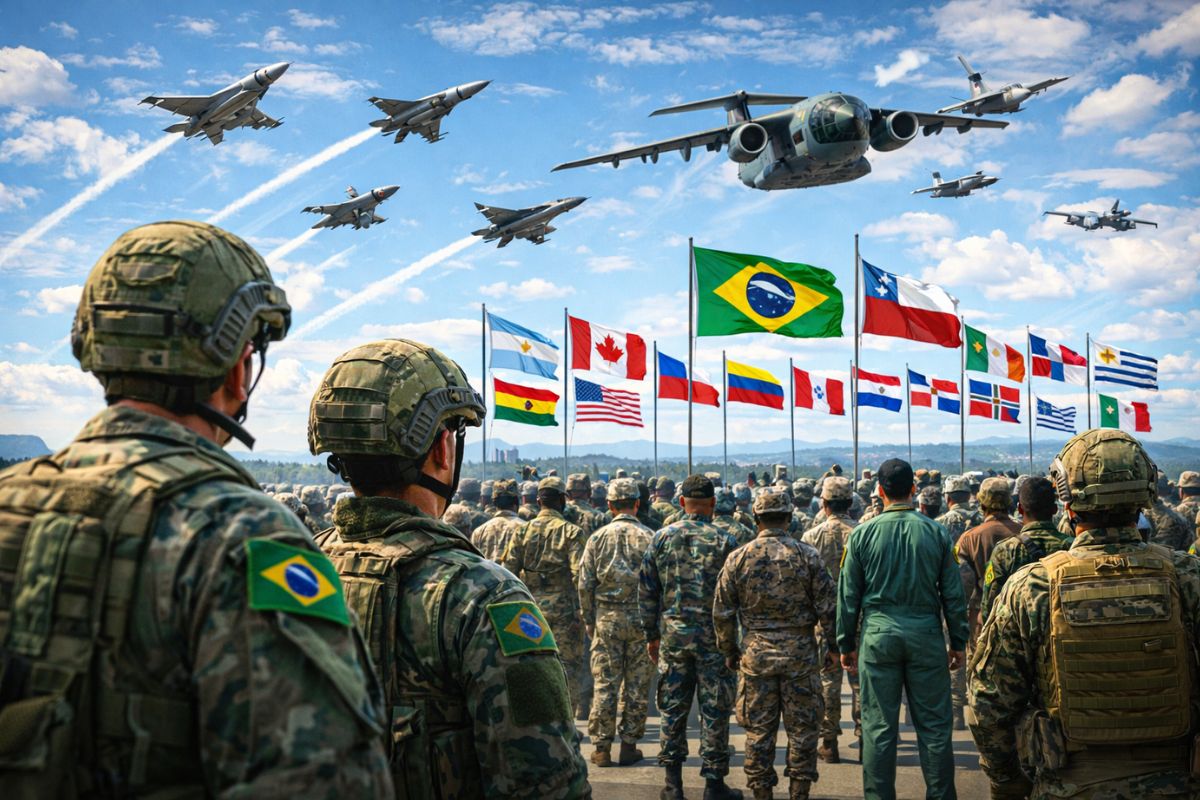
Cooperation XI brings together forces from 14 nations at Campo Grande Air Base for the largest multinational air exercise ever held on the continent, focusing on firefighting, search and rescue, and response to natural disasters.
Brazil made history by hosting, for the first time, the largest multinational air exercise in the Americas aimed at responding to natural disasters. Held from March 16 to 27, 2026, Cooperation XI transformed Campo Grande Air Base in Mato Grosso do Sul into the epicenter of an international operation mobilizing over 1,200 military personnel from 14 countries and approximately 18 aircraft of different categories.
Coordinated by the Aerospace Operations Command of the Brazilian Air Force, the training simulates critical scenarios that require immediate response and coordination among nations. The missions range from aerial firefighting to aeromedical evacuation and search and rescue in remote areas, reflecting increasingly frequent situations in light of the rise of extreme weather events across South America.
What is Cooperation XI and why is it considered the largest multinational air exercise in the Americas?

Cooperation XI is the 11th edition of a training program created under the American Air Forces Cooperation System, an organization founded in 1961 that currently includes 23 countries. For the first time in the program’s history, Brazil was chosen as the host, solidifying the 2026 edition as the largest ever held in terms of personnel, number of aircraft, and diversity of participating nations.
-
Brazil presents the first national F-39 Gripen fighter and redefines air defense with technological advancement, job creation, and strengthening of the defense industry on the global stage.
-
The construction of the Polar Ship Almirante Saldanha is progressing ahead of schedule and strengthens Brazil’s presence in Antarctica; the vessel will be 93 meters long, have a two-month autonomy, and technology to face ice.

-
The United States Army has an armored vehicle that reaches speeds of up to 100 km/h, capable of operating normally on different types of terrain and also on asphalt without causing damage; equipped with a 350 hp engine, it can transport up to 9 soldiers — meet the Stryker.
-
Gepard 1A2: the armored vehicle that fires 1,100 rounds per minute and became a shield against drones in Brazil.

The largest multinational air exercise on the continent includes forces from Argentina, Bolivia, Canada, Chile, Colombia, the United States, Honduras, Mexico, Panama, Paraguay, Peru, the Dominican Republic, and Uruguay, in addition to personnel from the Brazilian Air Force, Brazilian Navy, and Brazilian Army. The joint effort reinforces interoperability among different armed forces and standardizes procedures for real emergency situations.
The aircraft participating in the exercise in Campo Grande

image: Claudio Capucho
Among the assets used in the largest multinational air exercise in the Americas are approximately 18 aircraft of different categories, including tactical transport, surveillance, drones, and helicopters. The highlight is the KC-390 Millennium, considered one of the most modern cargo aircraft in the world, capable of performing missions ranging from logistics to aeromedical evacuation and aerial firefighting with the onboard MAFFS system.
The Brazilian Air Force also employs the C-105 Amazonas for tactical transport, the SC-105 for search and rescue, the C-98 Caravan for logistical support, RQ-900 drones for reconnaissance, and H-60 Black Hawk helicopters for rescue.
Other nations brought aircraft such as the C-130 Hercules from Argentina and Canada, the C-295 from Colombia, the C-27J Spartan from Peru, and Bell 412 and UH-1H Huey helicopters. Uruguay also contributed DJI M300 and M350 RTK drones for advanced monitoring.
KC-390 and the MAFFS system in combating wildfires
One of the technological highlights of the exercise is the use of the MAFFS system integrated with the KC-390 Millennium. The MAFFS, which stands for Modular Airborne Fire Fighting System, is a deployable module that quickly transforms the aircraft into a platform for combating wildfires, capable of dropping large volumes of water or fire retardant over affected areas.
The system can be installed without permanent modifications to the aircraft, preserving the KC-390’s multimission versatility. In the Brazilian context, this solution significantly enhances the capacity to respond to natural disasters such as large-scale wildfires, a recurring problem in various regions of the country and South America.
The use of MAFFS during Cooperation XI allows for the validation of doctrines, training of crews, and integration of procedures with nations that already operate similar systems.
Simulated missions that prepare forces for real natural disasters
For two weeks, the largest multinational air exercise in the Americas tests the response capability of the participating forces through highly challenging simulated scenarios.
The missions include aerial firefighting, search and rescue in remote areas, transportation of humanitarian aid, and aeromedical evacuation, always in coordination with local civil authorities.
The initiative gains relevance in light of the increasing frequency and intensity of natural disasters worldwide. Recent episodes in South America, including severe flooding and large-scale wildfires, have highlighted the need for rapid and coordinated responses among different countries.
Exercises like Cooperation XI help reduce reaction time in real situations and strengthen international cooperation.
The strategic role of Brazil as the host of the exercise
In addition to the operational aspect, hosting the largest multinational air exercise represents a diplomatic and strategic advancement for Brazil. The country establishes itself as a reference in combined air operations and humanitarian aid actions on the American continent. The exchange of experiences among the participating nations enhances the capacity for joint action and strengthens ties that can be decisive in future crises.
The training also reinforces the role of the American Air Forces Cooperation System as an essential platform for the exchange of doctrine, operational experiences, and technologies.
With Cooperation XI, Brazil demonstrates not only leadership capacity but also a commitment to international cooperation in a global scenario where responding to natural disasters increasingly requires integration, speed, and efficiency.
Cooperation XI marks an important chapter in the history of defense and humanitarian cooperation in the Americas. By bringing together 14 countries in Campo Grande for the largest multinational air exercise ever held on the continent, Brazil shows that joint preparation is the most effective way to save lives when the next disaster strikes.
With information from the portal cavok.
What do you think about Brazil’s participation as the host of this exercise? Do you believe that training like Cooperation XI makes a real difference in responding to natural disasters? Leave your opinion in the comments and share with those who follow defense and military aviation topics.









Seja o primeiro a reagir!