





 Portuguese
  English
  Spanish
  5 min of reading
  0 comments


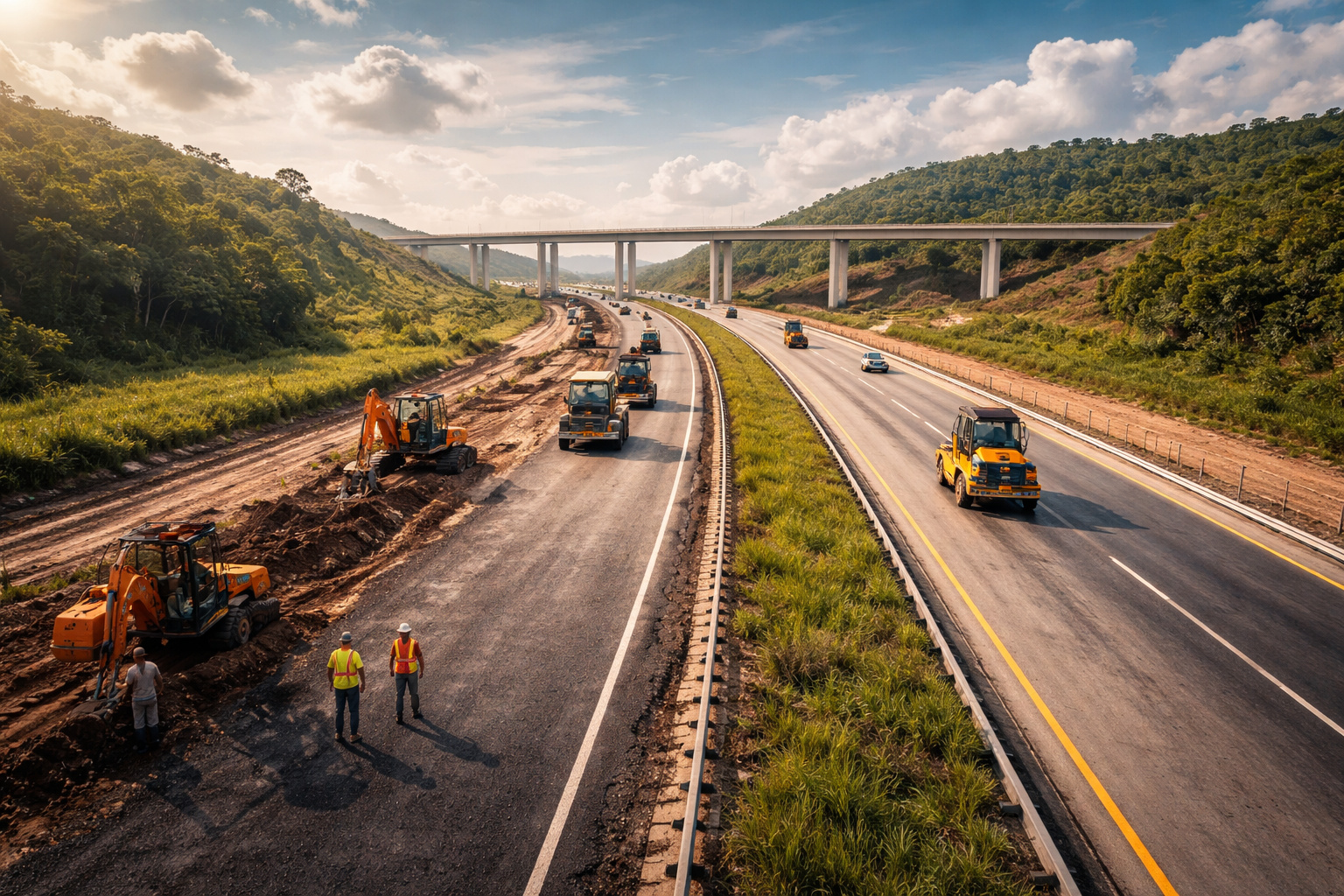
Billion-dollar investment in federal highway repositions logistical axis between Alagoas and Pernambuco, expands traffic capacity, integrates strategic regions, and accelerates works with direct impact on mobility, road safety, and freight transport in the Northeast.
The duplication of BR-104 in Alagoas has entered the execution phase with two sections authorized by the federal government and investments officially announced at R$ 756.3 million.
The package includes a lot of 12.7 kilometers between União dos Palmares and Branquinha, authorized on February 26, 2026, and another of 28.3 kilometers between Messias and Branquinha, for which the service order was signed on December 15, 2025.
More than just expanding the roadway, the intervention repositions the highway as one of the main integration axes of the state with Pernambuco and other hubs in the Northeast.
-
50 viaducts, 4 tunnels, 28 bridges, and 40 kilometers of bike paths: BR-262 in Espírito Santo will receive 8.6 billion reais for the largest engineering project in the state’s history, inspired by the Immigrant Highway in São Paulo.

-
Brazil produces too much clean energy and doesn’t know what to do with it: over 20% of solar and wind capacity was wasted in 2025 while investors flee and 509 renewable generation projects were abandoned in the last year.

-
Piauí will produce a new fuel that replaces diesel without needing to change anything in the truck’s engine and reduces pollutant gas emissions by half: truck drivers from all over the Northeast are already celebrating the news that will arrive later this decade.

-
A new Brazilian shopping center worth R$ 400 million will be built in an area equivalent to more than 4 football fields, featuring 90 stores, 5 cinemas, a supermarket, a college, and parking for 1,700 cars, potentially generating 3,000 jobs.

Authorized sections and progress of works on BR-104
The most recent section to advance was the one connecting União dos Palmares to Branquinha, with an investment of R$ 274.5 million.
According to the Ministry of Transport, the project is part of the New PAC and was presented as part of a set of investments in infrastructure aimed at increasing capacity, road safety, and modernizing strategic corridors in Alagoas.
This segment adds to the previously released lot between Messias and Branquinha, which concentrated an investment reported between R$ 481 million and R$ 481.7 million, according to official announcements published by the Ministry and DNIT.
In practice, the two contracts place the highway in a new stage.
BR-104 has moved from being merely an announced project to having an open front, a public schedule, and ongoing execution.
DNIT reported in March 2026 that the services already include earthworks, installation of fences in the domain area, drainage, and also the root piles of the Murici viaduct, a stage related to the foundation of a special work planned in the project.
Strategic importance of BR-104 in the Northeast
The significance of the project is not limited to the amount invested.
In official communications, the federal government treats BR-104 as a strategic route for the connection between the border of Alagoas with Pernambuco and Maceió, in addition to highlighting its connection with hubs in Pernambuco, Paraíba, and Rio Grande do Norte.
This framing helps explain why the duplication has gained regional significance: the road serves the daily movement of residents, freight transport, and circulation between urban areas, producing municipalities, and consumer centers.
Moreover, the corridor crosses or directly influences a significant stretch of Alagoas territory.
DNIT reports that the set of interventions on BR-104 has been structured into four lots, covering São José da Laje, União dos Palmares, Branquinha, Murici, Messias, Rio Largo, and Maceió.
This expands the reach of the duplication and reinforces the understanding that the project does not serve just an isolated point on the map, but an axis that articulates the interior, the forest zone, and the capital.
Infrastructure includes viaducts, concrete, and marginal roads
The technical dimension also helps explain the centrality of the project.
The lot authorized in December 2025 provides, in addition to the duplication, for the implementation of bridges, viaducts, and marginal roads, focusing on eliminating critical points and increasing road safety.
DNIT emphasizes that the intervention adopts concrete pavement on the new lane and the restoration of the existing lane also in concrete, a solution presented by the agency as part of a long-range modernization project.
This aspect differentiates the duplication from road works limited to the simple opening of new lanes.
By combining capacity expansion with the recovery of the existing structure, the project aims to address wear, operational bottlenecks, and sections historically pressured by mixed traffic of cars, buses, and trucks.
In official documents, the use of concrete is associated with the durability of the lane and the improvement of circulation conditions over time.
Execution in progress and logistical impact
For years, BR-104 sustained greater regional importance than its physical capacity in part of the Alagoas layout.
The new phase changes this scenario by bringing together two service orders in a short interval and transforming the corridor into an explicit priority of federal infrastructure in the state.
The announcement in February 2026, for example, already treated the lot between União dos Palmares and Branquinha as a direct complement to the segment released in December, consolidating the perception of project continuity.


There is an evident economic effect in this change.
When a highway with interstate function operates below demand, the impacts fall on travel time, logistical predictability, safety, and the ability to attract investments.
By expanding BR-104, the federal government seeks to reduce these barriers in a corridor that functions as a connection through the interior and, in part of the state, also as an alternative to BR-101.
The project, therefore, is not limited to local displacement: it interferes with the circulation of goods, supply, and integration between different northeastern markets.
The most recent stage of the project reinforces this movement.
In March 2026, DNIT reported that the works began this year and have a 24-month execution period.
The update is relevant because it shifts the agenda from the field of expectation to that of effective execution, with active construction sites and services already underway in strategically considered segments.
As a result, BR-104 now occupies a prominent place among the largest recent road investments in Alagoas.
The sum of resources, territorial reach, construction model, and the sequence of authorizations in December 2025 and February 2026 consolidate the highway as a structuring work for regional mobility and logistics.
The final impact will depend on the pace of execution and the delivery of the planned lots, but the road has already moved from a condition of reiterated promise to a concrete entry in the state’s infrastructure agenda.







Seja o primeiro a reagir!