





 Portuguese
  English
  Spanish
  3 min of reading
  0 comments


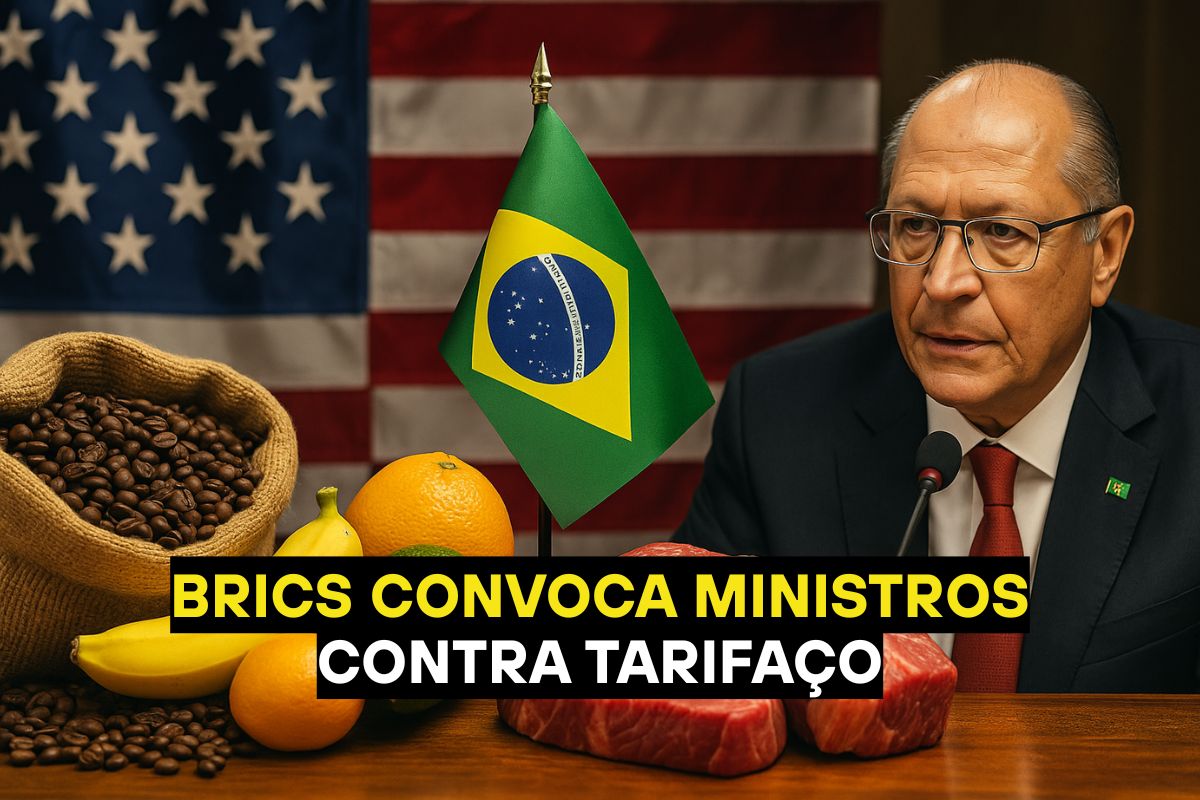
According to the Senate Agency, the meeting will discuss the direct impact of tariffs on coffee, fruits, and meats, as well as other strategic projects for the national economy
The BRICS has become a key player in the economic debate in Brasília after the United States imposed a tariff of 50% on Brazilian coffee, fruits, and meats. The Senate has summoned Geraldo Alckmin, Vice President and Minister of Development, Industry, Commerce, and Services, and Fernando Haddad, Minister of Finance, to clarify how the government intends to respond to this measure.
According to the Senate Agency, the meeting is scheduled for Wednesday (24) at 2:30 PM, and it will be the first of 2025 for the Parliamentary Group on Relations with the BRICS. In addition to tariffs, other strategic topics, such as the North Arc Waterway Project and the carbon credit market, will be on the agenda.
Impact of Tariffs on Brazilian Agribusiness
The 50% tariff directly affects sectors where Brazil is a global leader: coffee, fruits, and meats.
-
50 viaducts, 4 tunnels, 28 bridges, and 40 kilometers of bike paths: BR-262 in Espírito Santo will receive 8.6 billion reais for the largest engineering project in the state’s history, inspired by the Immigrant Highway in São Paulo.

-
Brazil produces too much clean energy and doesn’t know what to do with it: over 20% of solar and wind capacity was wasted in 2025 while investors flee and 509 renewable generation projects were abandoned in the last year.

-
Piauí will produce a new fuel that replaces diesel without needing to change anything in the truck’s engine and reduces pollutant gas emissions by half: truck drivers from all over the Northeast are already celebrating the news that will arrive later this decade.

-
A new Brazilian shopping center worth R$ 400 million will be built in an area equivalent to more than 4 football fields, featuring 90 stores, 5 cinemas, a supermarket, a college, and parking for 1,700 cars, potentially generating 3,000 jobs.


These products are among the main items on the national export agenda, generating billions of dollars annually.
With the trade barrier in place, Brazilian competitiveness in the United States decreases drastically, opening up space for competitors from other countries.
According to the Senate Agency, this policy is seen as a continuation of American protectionism that began during Donald Trump’s administration.
Although it has internal support in the U.S., it represents a severe blow to Brazilian producers, especially those who rely on the North American market to sell a significant portion of their production.
Alckmin, Haddad, and the Government’s Strategy
The simultaneous presence of Geraldo Alckmin and Fernando Haddad at the meeting demonstrates the relevance of the topic.
The government’s challenge will be to find alternatives to mitigate damages without causing instability in the agro-export sector, which is responsible for a significant share of Brazil’s GDP.
The expectation is that both diplomatic measures and internal incentives will be discussed.
Brazil can call upon international trade forums, but it also needs to prepare credit lines and support programs to prevent a sharp drop in income among producers.
The Role of BRICS in International Negotiations
The Parliamentary Group on Relations with the BRICS aims to deepen ties among member countries and advocate for Brazilian interests in multilateral arenas.
In addition to Brazil, Russia, India, China, and South Africa, the bloc also includes Saudi Arabia, Egypt, the United Arab Emirates, Ethiopia, Indonesia, and Iran.
The Senate understands that, in light of the closure of traditional markets, Brazil needs to expand its network of partners.
In this context, BRICS gains significance, providing access to large consumers and opportunities for technological and logistical cooperation.
Tariff and Strategic Agenda for the Future
The meeting will also address the North Arc Waterway Project, essential for improving the infrastructure for transporting agricultural production from the North of the country.
Additionally, the carbon credit market, viewed as an opportunity to monetize sustainable practices and attract investments, will be discussed.
According to the Senate Agency, these topics complement the central debate on tariffs, indicating that Congress intends to adopt a comprehensive approach, combining immediate reactions to external protectionism with long-term policies to enhance Brazilian competitiveness.
The struggle over the tariff imposed by the U.S. is not just about immediate losses for agribusiness.
It exposes the risks of dependence on a few markets and reinforces the need for commercial diversification.
The government’s collaboration with the Senate and the BRICS may define the future of Brazilian foreign and economic policy in the coming years.
And you, do you believe that the rapprochement with the BRICS can offset losses with the American market? Or should Brazil prioritize bilateral negotiations with Washington to reduce tariffs? Leave your opinion in the comments.










-

3 pessoas reagiram a isso.