





 Portuguese
  English
  Spanish
  5 min of reading
  13 comments




Diplomatic Moves Renew Debate on BRICS, Mercosur, and the Search for New Global Markets Amid Economic Uncertainties, Trade Agreements Under Negotiation, and Regional Strategies to Expand Exports, Attract Investments, and Reduce Historical Dependency on Traditional Partners.
The possibility of rapprochement between Mercosur countries and BRICS has returned to the center of regional debate at a time when South American governments are trying to expand markets and reduce exposure to traditional partners.
However, so far, there is no public and verifiable record of a joint and formal signal from Argentina, Paraguay, and Uruguay to join BRICS as members or in the newly created “partner country” category.
While the discussion gains space in analyses and occasional statements, confirmed facts indicate a more fragmented scenario: Argentina was invited to join BRICS as a full member, but President Javier Milei officially announced in December 2023 that the country would not join the group; in the case of Uruguay, the Brazilian government invited Uruguay to participate in a BRICS summit meeting in 2025; regarding Paraguay, there are mentions of interest attributed to diplomatic statements, without public announcement of membership or formal request.
-
Unemployment rises again to 5.8% at the beginning of 2026, raising alarms about the end of temporary positions and its impact on the Brazilian job market.

-
Document organization can cut invisible costs in small businesses, a simple step that prevents waste, rework, and losses in daily operations.

-
Chinese giant worth nearly R$ 4 billion that manufactures cables for electric cars, solar energy, and robotics wants to open a factory in SC.
-
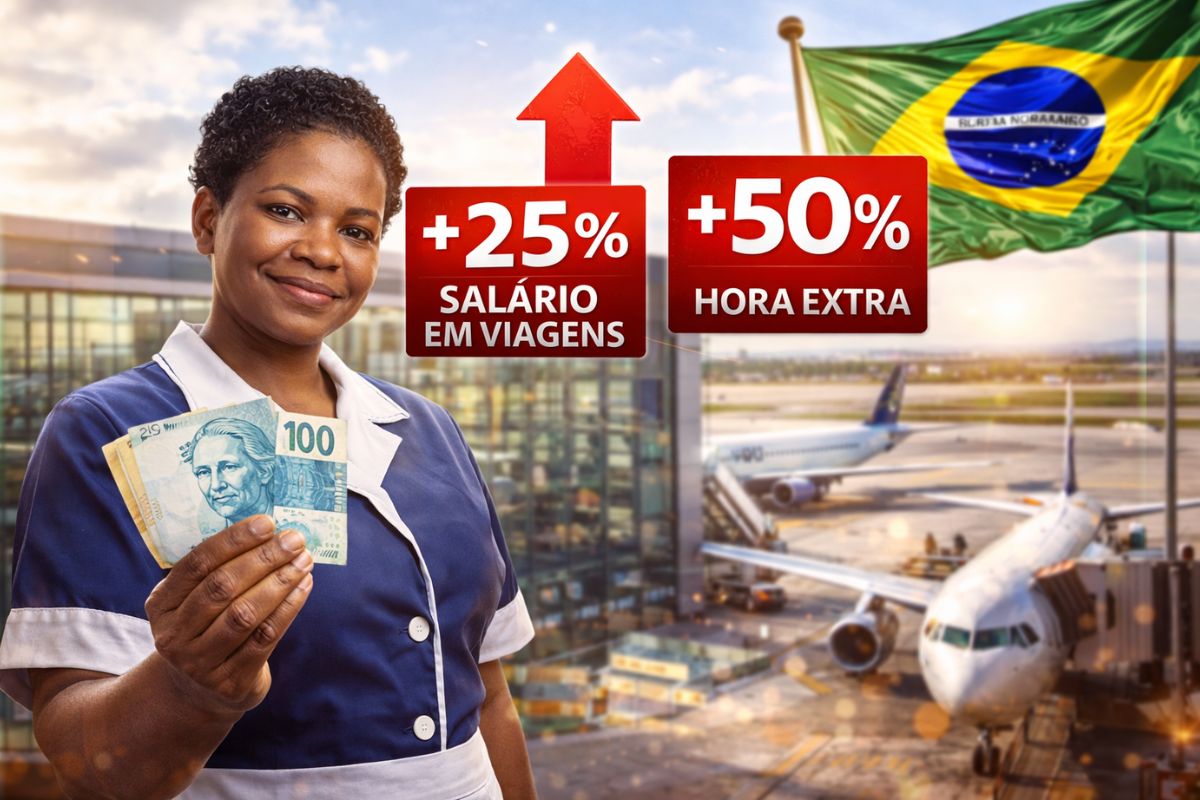
Many employers do not know, but the law guarantees domestic workers a 25% increase in salary during trips, 50% for overtime, 20% for night shifts, and 17 additional benefits that can lead to labor lawsuits if not paid.

BRICS Expansion and the Creation of the Partner Country Model
Initially formed by Brazil, Russia, India, and China, BRICS incorporated South Africa in 2011 and has since expanded its international projection as a forum for political and economic coordination among emerging countries.
The group gained new momentum with the expansion decided at the 2023 summit and with institutional changes adopted in 2024, when leaders endorsed the creation of the “partner country” category.
This modality allows invited nations to participate in meetings and discussions, but without the decision-making power reserved for members.
In January 2025, the Brazilian government announced nine countries as the first partners, inaugurating the model, with memberships from different regions.
In 2025, Brazil also announced the entry of Vietnam as a partner country, showing that the mechanism remains active and may open doors for gradual rapprochements.
Argentina Between Formal Invitation and Refusal to Join the Block
In the Argentine case, the most sensitive point is that the publicly confirmed information is contrary to the idea of imminent entry.
In August 2023, Argentina was included among the countries invited to become full members starting January 1, 2024.
However, already under Javier Milei, the government sent a letter to the block’s leaders informing that Buenos Aires would not participate in BRICS, in a decision announced at the end of December 2023.
In practice, this does not prevent Argentina from maintaining trade or political relations with BRICS countries, nor from discussing cooperation with block members in parallel forums.
Still, the official recorded gesture is a refusal to enter as a full member, making it necessary to differentiate economic interest in expanding trade from an institutional step to enter the group.
Uruguay and Paraguay Seek Dialogue Without Formal Membership Request
Conversely, Uruguayan movements have appeared more linked to participation in BRICS agendas than to a formal membership process.
In March 2025, President Luiz Inácio Lula da Silva invited Uruguay, Colombia, and Mexico to participate in a meeting related to the BRICS summit in Brazil.
The invitation was interpreted by analysts as a sign of openness to expand dialogue with Latin American countries, although it does not equate to an invitation to join the group as a member or partner.
Regarding Paraguay, international news registered statements indicating “interest” in BRICS, attributed to diplomatic authorities.
Still, there is no announcement of a formal membership request, nor is the country included in the officially announced list of partners.
In this context, rapprochement tends to mean political talks and economic cooperation, not necessarily an immediate path to integrate the block’s structure.
Mercosur, Agreement with the European Union, and Diversification Strategy
The discussion about new alliances occurs in the wake of international negotiations that Mercosur has advanced in recent years.
The Mercosur–European Union agreement had its negotiations concluded on December 6, 2024, according to official communications from the Brazilian government.
Despite this, the process still faces obstacles in Europe.
In January 2026, the European Parliament approved sending the text to the European Court of Justice for legal evaluation, a measure that may delay the parliamentary vote on the agreement.
Brazilian authorities, such as Vice President Geraldo Alckmin, have argued that internal processing in Brazil may help accelerate steps on the European side.
Still, there is no set deadline for the final decision.
This scenario reinforces the logic of diversification pursued by South American governments.
Even with advanced negotiations with the European Union, the region seeks alternatives to export and attract financing, reducing risks in a more unstable global economic environment.
Investments, Exports, and Limits of Available Information
The idea that a rapprochement with BRICS could boost exports and attract investments is associated with traditional sectors of South America, such as agribusiness, energy, and infrastructure.
However, there are no confirmed numbers, projects, or commitments to support the expression “billion-dollar investments” in the specific context of Argentina, Paraguay, and Uruguay regarding BRICS.
When examining regional trade, there are official indicators showing growth and economic relevance, such as data from the Brazilian government on exports and trade flow with Paraguay.
This helps explain why Asunción is seen as a strategic partner and why issues of productive integration remain on the radar.
On the other hand, these data do not confirm the existence of an open negotiation for Paraguayan entry into BRICS.
The same applies to the assertion that there would be an explicit strategy to break dependency on the United States and Europe.
There is a historical tendency for market diversification and the pursuit of autonomy in regional foreign policy.
However, attributing this objective directly to formal membership decisions in BRICS requires official statements, which are not present in the available material.
At the current stage, the most accurate picture is of a region attempting to expand its maneuvering room.
Mercosur accelerates agreements and negotiations while BRICS creates more flexible formats, such as that of a partner country, which can serve as a bridge for new dialogues.
The central question is whether any of the three mentioned countries will transform economic interest into a concrete institutional move, with a formal request and political negotiation within the block.
If BRICS continues to expand its network of partners and South America maintains the search for new markets, what will be the first real step that Argentina, Paraguay, or Uruguay would be willing to publicly announce?









Ohhh, bando de ditadores. Que não tem ****. Cuidem de seus povos com democracia. Bando de canalhas, **** do povo ****.
Só vão querer entrar para pegar dinheiro emprestado e não pagar…E o que sabem fazer de melhor tão matando seu povo de fome três países picareta…
ARGENTINA NO BRICS?? DUVIDO!!
Vai entrar, questão de tempo. Sem o Brics e sem o Brasil ela não sobrevive. Os EUA sufocam e usam o Milei como boneco do posto, não há na Argentina nada que interesse tanto assim ao tio Sam…
Seu **** socialista. Monte uma empresa, e vá trabalhar de verdade.