





 Portuguese
  English
  Spanish
  4 min of reading
  0 comments


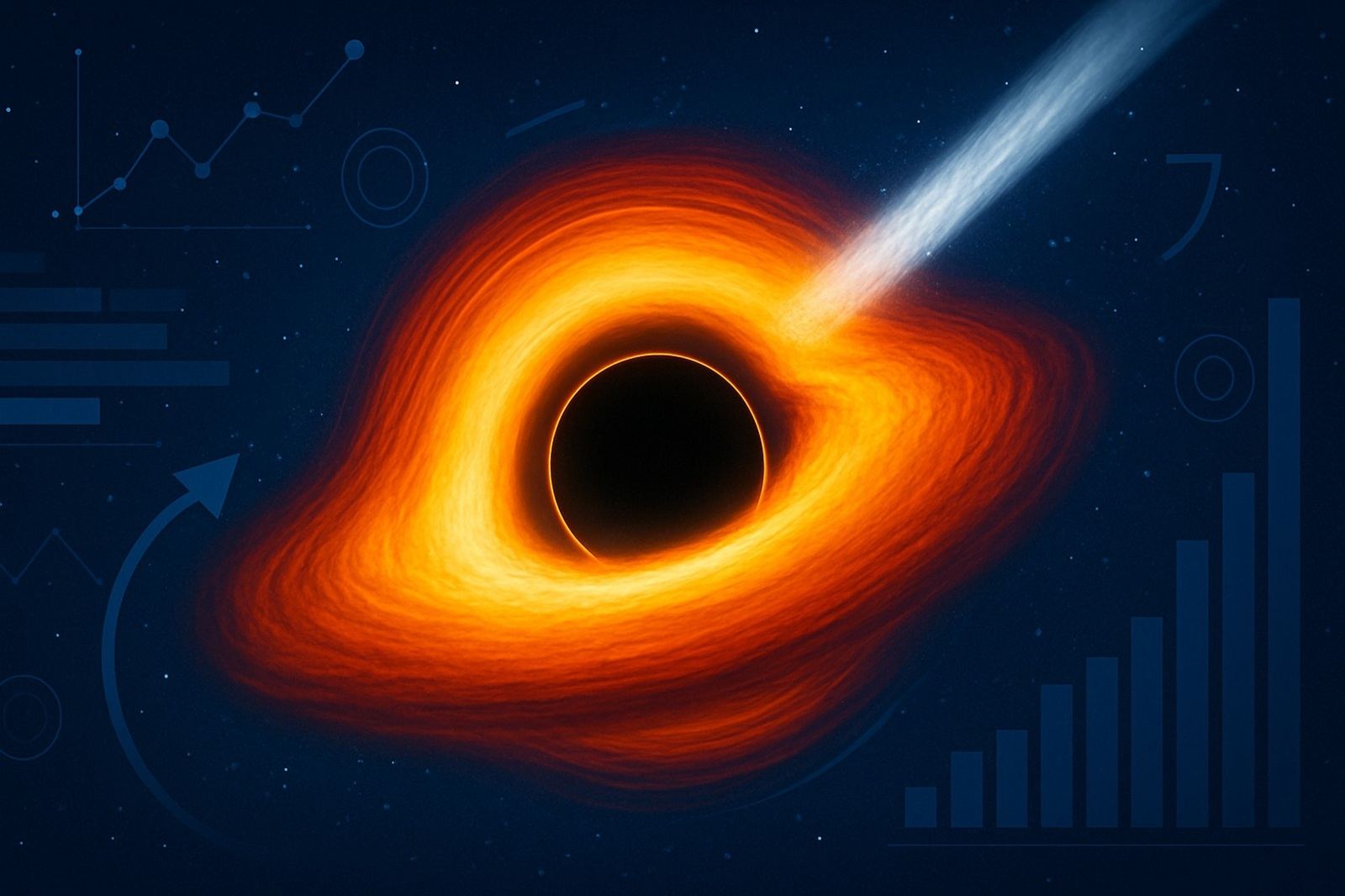
Astronomers Identify The Black Hole RACS J0320-35 That Challenges Theories, Swallows Thousands Of Suns Per Year And Launches Rare Jets Into The Cosmos.
In the depths of the distant universe, a surprising find has left astronomers around the world astonished. They discovered a black hole that defies the known rules of growth for these cosmic giants.
The object has been named RACS J0320-35 and is so distant that its light took 12.8 billion years to reach us. This means we see it as it was only 920 million years after the Big Bang.
At that time, the black hole had already accumulated a mass equivalent to one billion suns and shone in X-rays with an unprecedented intensity for objects of this type in the universe’s first billion years.
-
A “silent skill” is allowing Brazilians to earn up to R$ 22,000 per month without a degree and become indispensable for companies that rely on millions of data to survive.

-
Researchers at the Toyota Research Institute found that if a human uses robotic arms to flip a pancake 300 times in an afternoon, the robot learns to do it on its own the next morning, and this is currently the most promising method to solve the biggest bottleneck in modern robotics.

-
Goodbye iron: a common item in households is starting to lose space to technology that smooths clothes in minutes without an ironing board and with less energy consumption.

-
Antarctica reveals an unusual clue high in the Hudson Mountains, and what appeared to be just an isolated rock began to expose a secret hidden under the ice for ages.

The phenomenon reveals a surprising story, as this black hole seems to be growing at a much faster pace than theory allowed.
“It was a bit shocking to see this black hole growing rapidly,” said Luca Ighina, author of the study on RACS J0320-35.
Capturing A Giant Cosmic Anomaly
It all began with the detection of a bright and distant object. It was first identified in a radio survey conducted by the Australian Square Kilometer Array Pathfinder (ASKAP).
After that, observations in Chile confirmed its nature. The Dark Energy Camera and the Gemini South Telescope showed that it was a quasar, a galaxy powered by a supermassive black hole. These objects devour gas and shine so brightly that they can outshine entire galaxies.
However, only in 2023, using the Chandra X-ray observatory, researchers realized what set RACS J0320-35 apart from the others. When matter falls into a black hole, it heats up and releases radiation, including powerful X-rays. This process usually obeys the so-called Eddington limit, a kind of natural barrier that regulates the growth rate of a black hole.
But the case is different now. Data showed that RACS J0320-35 is surpassing this limit. It grows about 2.4 times faster than theory predicted, consuming the equivalent of 300 to 3,000 suns per year. This is the fastest rate ever observed for a black hole in the first billion years of the cosmos’ existence.
What Does This Growth Mean?
Until recently, astronomers believed that the only way a black hole could reach a mass of one billion solar masses in such a short time would be if it was born massive. That is, it would need to emerge with at least 10,000 times the mass of the Sun, from the direct collapse of giant clouds of pure gas.
Now, this scenario may change. If RACS J0320-35 indeed feeds so intensely for long periods, it could have been born smaller, at around 100 suns, similar to black holes that result from the death of massive stars.
This detail opens a new avenue for explaining the emergence of these giants. “Knowing the mass of the black hole and calculating its growth rate, we can work backward to estimate its mass at the moment of birth. With this calculation, we can now test different ideas on how black holes are born,” explained Alberto Moretti, a researcher at INAF-Brera Astronomical Observatory in Italy.
The Mystery Of Jets And New Questions
RACS J0320-35 is also intriguing for another reason: it produces jets of particles that travel nearly at the speed of light. This characteristic is not common among observed quasars and may be related to the atypical growth rate.
Therefore, the discovery represents not just a record. It challenges old theories about the formation and evolution of black holes and forces scientists to reevaluate their understanding of the early universe.
If regular black holes can grow this quickly, it may no longer be necessary to imagine exotic and rare conditions to explain the existence of objects with billions of solar masses so soon after the Big Bang. They may have arisen from common stars that collapsed and then found the ideal environment to develop at maximum speed.
Still, important questions remain. Can RACS J0320-35 sustain this pace for hundreds of millions of years, or does it only experience a brief period of cosmic frenzy? Moreover, what exactly is the connection between its powerful jets and the extreme growth rate?
The Next Step For Science
Astronomers now want to search for other quasars that break the rules. They rely on Chandra itself and also on future observatories to continue the investigation.
The study, which is already sparking debates in the scientific community, was published in the Astrophysical Journal Letters.
This black hole not only challenges predictions. It opens a new chapter in the quest for answers about how the universe evolved so quickly in its early moments.







-

4 pessoas reagiram a isso.