





 Portuguese
  English
  Spanish
  5 min of reading
  0 comments


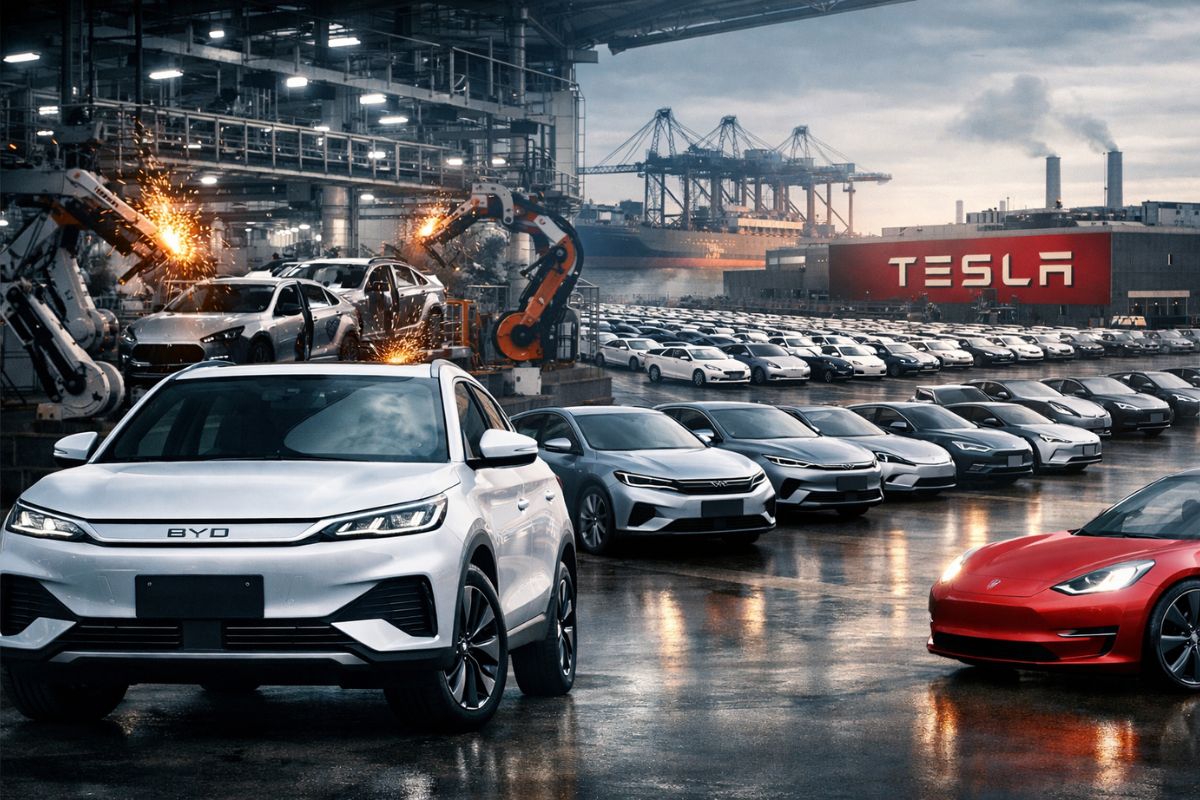
BYD Achieved Its Annual Target and May Have Surpassed Tesla, Becoming the Largest Electric Vehicle Manufacturer in 2025. There Were 4.6 Million Units, an Increase of 7.7% Compared to 2024, After Downward Revision of Target by 16%. For 2026, China Is Expected to Reduce Incentives and Foreign Markets to Impose Barriers.
BYD has gained prominence in 2025 by delivering 4.6 million vehicles in the year, a rise of 7.7% compared to 2024, according to an official statement. With this volume, the Chinese automaker achieved its annual sales target, which had been revised downward by 16%, and is now seen as a contender to surpass Tesla as the largest electric vehicle manufacturer in the world.
The milestone of 2025, however, comes with warnings for 2026. The consensus indicates that China is likely to reduce incentives that boosted electric vehicle sales, and that new models are raising domestic competition, while trade barriers complicate BYD‘s plans to expand operations abroad, at a time when Tesla is also facing its own issues.
What BYD Delivered in 2025 and Why the Number Is Critical
The central data is clear: BYD delivered 4.6 million units in 2025. The increase of 7.7% compared to 2024 reinforces that growth continued, even in a market with intense competition and consumers more attentive to technology and price.
-
OMODA & JAECOO grows in Europe in 2026 with an integrated strategy of sales, innovation, local production, and technological advancement in the United Kingdom, Italy, and Spain.

-
OMODA & JAECOO expands after-sales service in Brazil with competitive maintenance, a 7-year warranty, and high availability of parts for technological SUVs.
-
OMODA & JAECOO appoints Alessandra Souza as executive marketing director in Brazil and accelerates brand expansion with a focus on innovation, networking, and hybrid portfolio.

-
Jaecoo 7 with super hybrid SHS system exceeds 1,200 km of combined range with a 1.5 turbo engine, high-density battery, and intelligent energy management.

The base text highlights that, with this result, BYD achieved its annual target and may have surpassed Tesla in 2025 in the electric vehicle segment. This is significant because it involves global leadership in a sector that has become a reference for industrial transition and geopolitical technology competition.
At the same time, there is a point that relativizes the impact: the target had been revised downward by 16%. In other words, part of the achievement comes from a reduced target, which, in the market’s view, slightly diminishes the symbolic effect of “we met the target,” even with a very high absolute number.
Target Revised Downward by 16%: How This Changes Market Perception
When a company meets a revised downward target, it demonstrates execution capability, but also sparks debate about initial expectations.
The basis affirms that the 16% revision reduced some of the impact of the result.
In practice, this means that the performance in 2025 is strong in volume and growth, but the narrative of “overcoming” is contingent upon the fact that the target was adjusted along the way.
Still, 4.6 million units in a year is a level that places BYD on a global scale and reinforces the argument that it can threaten Tesla’s lead in electrics.
The Scenario for 2026: Fewer Incentives in China and Barriers Abroad
The base text describes 2026 as challenging due to two main drivers:
- China is expected to reduce incentives that boosted electric vehicle sales.
- Trade barriers may limit BYD‘s expansion abroad.
Additionally, new models are increasing domestic competition. This is important because BYD is described as a leader in the Chinese market, and the very “strong domestic market” has always been a driver of the company’s scale.
In an environment of fewer incentives and more competition, the competition shifts to margins, technological differentiation, and speed of launch, as well as the ability to maintain growth.
Domestic Competition: Geely, Xiaomi, and 18% Decline in December
The basis states that BYD faced competition from companies like Geely and Xiaomi, which launched models with technological innovations.
This detail helps explain why the pressure has increased: it is no longer just a battle with traditional automakers, but also with companies that bring a culture of technology and novelty to the product.
The text points out a warning sign in the short term: in December, BYD‘s sales fell 18% year-over-year.
This number is relevant because it shows that even with a strong year overall, there was a moment of deceleration.
The company’s president, Wang Chuanfu, acknowledged that the company’s technological advantage has decreased. At the same time, he stated that advancements are under development, supported by a team of 120,000 engineers.
This engineering scale data is used to support the thesis that the company is trying to recover or expand its capacity to innovate rapidly.
International Growth: 1.05 Million Outside China and Target of 1.5 to 1.6 Million
The basis provides a clear snapshot of external progress: sales outside China reached 1.05 million units in 2025.
The target for 2026 is to raise this number to between 1.5 million and 1.6 million, according to a report by Citigroup.
This leap is significant and indicates that the strategy depends on international growth.
Therefore, the trade barriers mentioned in the base appear as a central risk. If foreign markets are blocked or made more expensive by tariffs and restrictions, the company may struggle to meet the target of 1.5 to 1.6 million outside China.
The text also points out an analyst projection reported by Bloomberg: total sales of BYD could reach 5.3 million units next year, driven by new launches and a technology platform that is expected to enhance competitiveness. This ties together two factors: new product and platform technology.
The Dispute with Tesla: What Weighs Against the Rival in 2025 and 2026
While BYD tries to sustain growth, Tesla faces its own problems.
The basis indicates that Tesla’s sales plunged at the beginning of 2025 due to reconfiguration of production lines for the Redesigned Model Y.
Additionally, there is a brand perception factor mentioned: Elon Musk‘s role in the Trump administration alienated some consumers.
And there is a demand risk linked to public policy: the end of subsidies for vehicle purchases in the U.S. tests the demand for this type of car.
Taken together, this creates a scenario in which Tesla enters 2026 with operational and commercial challenges, while BYD faces challenges related to incentives and barriers.
The dispute for global leadership in electrics becomes a combination of industrial execution, market policy, and consumer acceptance.
What These Numbers Suggest About BYD in the Short Term
Based on the data presented, three insights are clear:
- Scale: 4.6 million in 2025 places BYD at a volume level that supports the ambition of global leadership.
- Domestic Risk: an 18% drop in December and innovative competitors show that leadership in China requires a quick response.
- External Risk: the target of 1.5 to 1.6 million outside China depends on overcoming barriers and maintaining competitiveness.
The most sensitive point for 2026 is that several factors are exogenous, such as reduced incentives and trade barriers.
In your opinion, will BYD really surpass Tesla and consolidate global leadership in electrics, or will 2026 be the year when lower incentives and external barriers slow this turnaround?










Seja o primeiro a reagir!