





 Português
  Inglês
  Espanhol
  4 min de leitura
  23 comentários


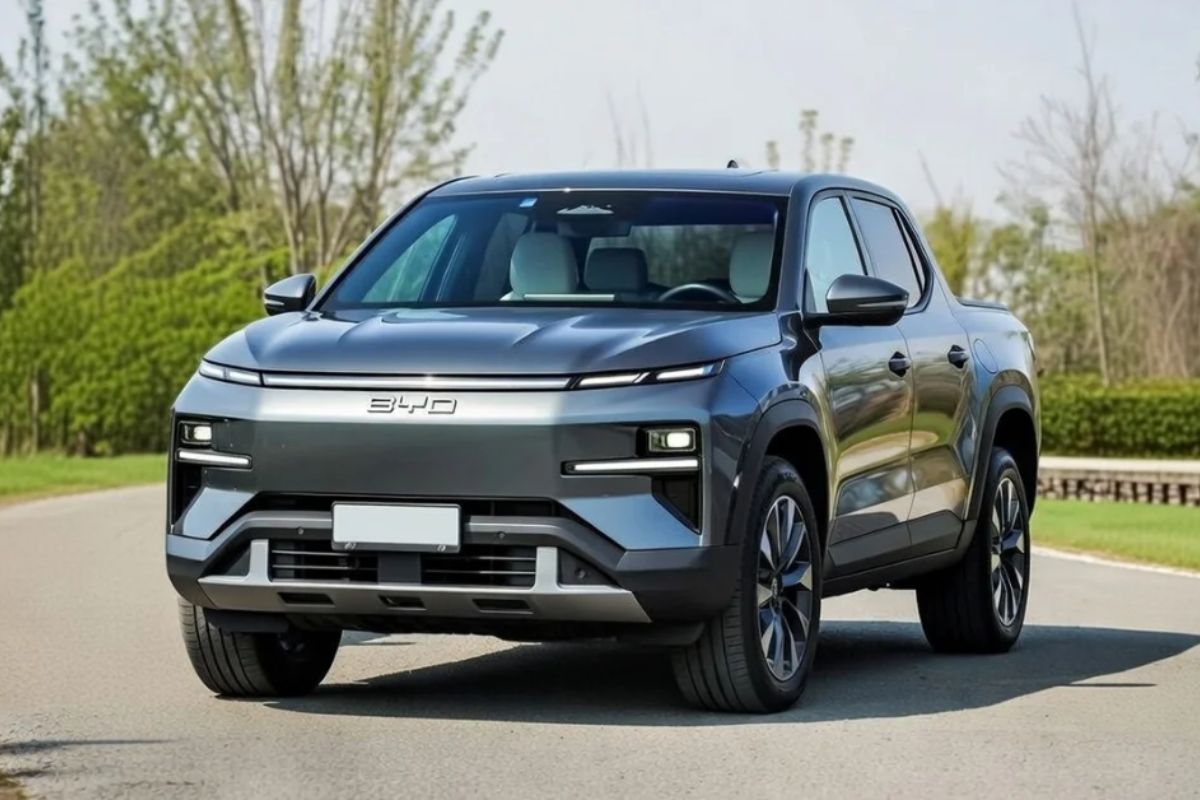


In an Interview with Autoesporte, Alexandre Baldy Says That BYD Assembled an Exclusive Team for Pickups and Intends to Reach Up to Five Models in Brazil. The Offensive Begins with the Shark and Continues with Electrified Trucks, Including a Mid-Size Inspired by the Song Plus That Should Be the Big News in 2026
BYD wants to expand its presence in Brazil targeting one of the most competitive niches in the national market: pickups and trucks. The signal came in an interview with the brand’s vice president in the country, Alexandre Baldy, stating that there is an exclusive team dedicated to this portfolio and that the plan may include up to five models.
The move gains weight because the starting point, the BYD Shark, has not yet turned into significant volume, with limited sales according to Autoesporte. From there, 2026 enters the center of the schedule with a mid-size truck already spotted in tests and designed to face rivals that already dominate the conversation on the streets and in dealerships.
The Exclusive Team and the Design of BYD’s Offensive
By saying that BYD created an exclusive team for pickups, Alexandre Baldy establishes that the strategy is not opportunistic but structured.
-
OMODA & JAECOO grows in Europe in 2026 with an integrated strategy of sales, innovation, local production, and technological advancement in the United Kingdom, Italy, and Spain.
-
OMODA & JAECOO expands after-sales service in Brazil with competitive maintenance, a 7-year warranty, and high availability of parts for technological SUVs.
-
OMODA & JAECOO appoints Alessandra Souza as executive marketing director in Brazil and accelerates brand expansion with a focus on innovation, networking, and hybrid portfolio.

-
Jaecoo 7 with super hybrid SHS system exceeds 1,200 km of combined range with a 1.5 turbo engine, high-density battery, and intelligent energy management.

The declared focus is on product suitability and viability, with development aimed at succeeding in Brazil, where consumer preferences and the real use of trucks often demand robustness and practicality.
This point is relevant because the pickup segment is less tolerant of generic projects.
When BYD talks about assembling a dedicated team, it signals that it intends to calibrate size, positioning, and usage proposal, rather than just adapting a foreign model and putting it on the Brazilian market without adjustments.
Shark as a Starting Point and the Market Thermometer
Up to this point, BYD’s main bet in the sector is the hybrid pickup Shark.
The fact that the model is facing limited sales, as pointed out by Autoesporte, serves as an internal alert: entering the segment is different from dominating the segment.
In practice, the Shark becomes a thermometer to understand what hinders the purchasing decision, even when there is electrification in the package.
In a country like Brazil, where pickups compete on image, capability, and cost of use, the performance of a first product helps define how BYD should prioritize the next wave of trucks.
The Mid-Size Truck of 2026 and the Inspiration from Song Plus
The first launch described as the big news from BYD in 2026 is a mid-size truck that has already been seen in tests.
The reading is straightforward: the company wants to enter where volume is more sensitive to price, proposal, and size, without immediately facing only market extremes.
According to Autoesporte, this project will be based on the Song Plus SUV, repeating a formula that competitors have already explored in Brazil.
The logic of starting from a known base tends to reduce complexity and accelerate the product cycle, but the challenge is to deliver a truck that supports the promise in everyday use, because pickup consumers quickly perceive when the engineering was designed just for asphalt.
Up to Five Trucks in Brazil and a Portfolio by Sizes
The plan described by Baldy for BYD is to reach up to five models of pickups and trucks in Brazil.
The projection includes a small truck, a mid-size, a medium, and a large, in addition to the Shark itself, comprising a portfolio that covers very different uses, from urban to heavy-duty.
The common feature, according to the executive’s remarks, is electrification.
The intention is to bet on trucks with plug-in hybrid or electric drivetrains, maintaining the view that plug-in hybrids and electric vehicles are the future of the market.
In this effort, BYD seeks to convert technology into practical argument while expanding the presence of electrified trucks to more size and positioning ranges.
Why the Direct Confrontation with Toro, Maverick, and Rampage Matters
By targeting rivals such as Fiat Toro, Ford Maverick, and Ram Rampage, BYD acknowledges that 2026 will be a test of perception in Brazil.
These names already occupy the consumer’s imagination and set a reference standard for finishing, proposal, and use, which adds extra pressure on any newcomer.
The effect is twofold. On one hand, the entry of more electrified trucks tends to raise the bar for technology in the category, as electrification becomes a shelf differential.
On the other, the pickup segment punishes inconsistency: the market demands coherence between promise and delivery, and BYD will have to prove that it can compete in a territory where reputation is built on repetition, service, and getting the right product in the right place.
BYD’s plan to bring up to five pickups and trucks to Brazil, focusing on plug-in hybrid or electric models, positions 2026 as a turning point.
The strategy starts with an initial presence with the Shark and moves on to a mid-size truck inspired by the Song Plus, directly targeting an already consolidated segment.
If execution matches ambition, Brazil may see a more intense competition for who delivers electrified trucks with a clear proposal, rather than just novelty.
If it doesn’t keep up, the Shark itself serves as a reminder: technology alone does not guarantee commercial traction.
What type of truck do you think would help BYD gain space in Brazil: one of the smaller electrified trucks for the city or a mid-size for mixed-use in everyday life?









Pequena como a toro
Uma intermediária para uso misto
O Erro da maioria das montadoras chinesas, assim como Toyota com Yaris Cross, é que saem com preço nas alturas e depois vai baixando para ver o quanto o Brasileiro consegue pagar pelo produto, enquanto isso a GWM nada de braçada e cai nas graças do consumidor, pois traz um preço **** de início e posteriormente vai adequando o mesmo a demanda.