





 Português
  Inglês
  Espanhol
  6 min de leitura
  14 comentários


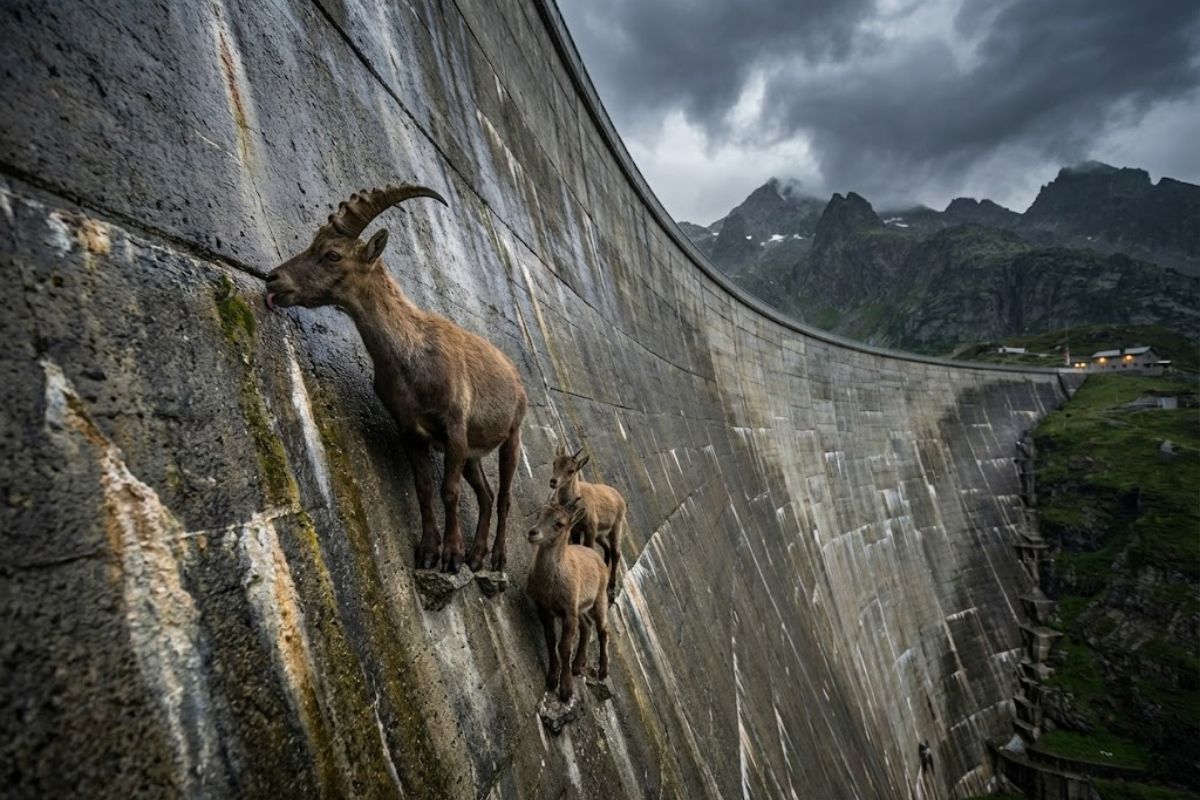


Wild Ibex Defies Gravity, Climbs Nearly Vertical Dam for Vital Salt, Guides Kids on Concrete, and Exposes How Invisible Minerals Sustain Strength, Balance, and Life in the Mountains.
In the mountains, a wild ibex transforms a nearly vertical dam into a daily survival route. She climbs the concrete as if it were rock, not out of stubbornness, but out of necessity: salt and essential minerals dissolved in the water that flows down the structure.
These minerals, including calcium, are crucial for maintaining strong bones and for the proper functioning of nerves and muscles. Without this “invisible fuel,” the body loses stability, coordination fails, and life on the slopes becomes a constant risk. The most striking detail is that she doesn’t climb alone: kids follow every step, guided by the bond with their mother, learning early that balance is not just skill; it’s chemistry.
The Nearly Vertical Dam Becomes a Survival Route in the Mountains

The scene seems impossible until you pay attention to the pattern: the wild goat is not “climbing for sport.”
-
Found in one of the most radioactive places on Earth, this Chernobyl fungus may be doing something with radiation that no one has been able to explain to this day.
-
A bright yellow mushroom imported from Asia escaped from a cultivation farm in the United States in 2010 and is now aggressively spreading across 25 states, destroying entire communities of native fungi in American forests.

-
Buried under China, a colossal machine weighing 20,000 tons began operating as the largest neutrino detector on the planet and, in just 59 days, surpassed results that science took half a century to achieve.

-
Iran enters the center of a climate alert after the war emitted 5.6 million tons of CO2 in two weeks, surpassing the annual pollution of entire countries.


She chooses a specific point on the dam because there is a water path that has passed over mineral-rich rocks and reached the concrete carrying dissolved substances.
The surface of the dam, which for humans is just cement and stone, serves as a “map” of nutrients for the ibex.
The dam, despite being artificial, becomes part of the ecosystem.
The concrete holds fragments of the rock used in its construction, and over time, water dissolves mineral components. This creates a simple yet powerful effect: where the water touches and flows, it leaves traces of salts.
The wild goat follows exactly that trail, climbing towards the point where the concentration is worth the risk.
What the Ibex Is Really Looking For: Salt, Calcium, and Essential Minerals

What looks like a “licking of concrete” is, in fact, a behavior with a clear purpose: the ibex is looking for vital salts and minerals that, in the body, perform functions that go far beyond strength.
Calcium is mentioned as essential to keep animals strong. Without these salts and minerals, bones do not grow, and the nervous system and muscles cannot function properly.
This means it’s not just about “health,” but about immediate survival, because life in the mountains depends on precise movement.
When minerals are lacking, the body does not just lose energy: it loses control.
And that’s where the most dangerous part comes in for an animal that lives on rocky cliffs and steep slopes: movement and coordination can fail. In a high-altitude environment with wind and incline, to fail for a second is to fall.
The Chemistry of Water: How Invisible Minerals Reach the Body of the Wild Goat
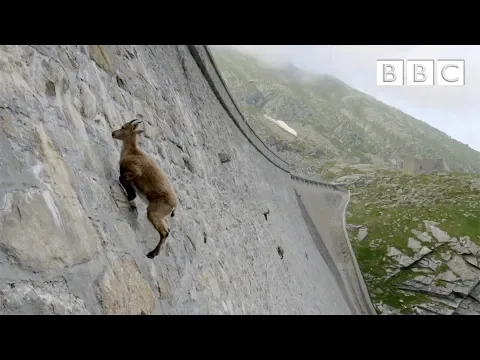

The path of these minerals is almost invisible, but extremely efficient.
Water dissolves salts from the earth and rock and transports them.
When the ibex reaches the top or the right section of the dam, she finds the “reward”: dissolved mineral salt, accessible and concentrated enough to compensate for the climb.
The most revealing detail is that the salt is not just consumed and “disappears.”
It continues its journey within the animal’s body. The salt from the earth dissolved in water moves to the body, where it is used in nerves and muscles.
In other words: a simple chemical element, carried by water, becomes the difference between a stable body and a fragile one.
The wild goat relies on this replenishment to keep the system functioning as needed.
The Body at Risk: When Bones, Nerves, and Muscles Decide Everything
Extreme climbing becomes more understandable when you look at what is at stake:
Bones: without minerals, there is no proper growth and no strong foundation. For an animal that relies on minimal surfaces, strong bones are literally a lifeline.
Nerves: control of the body, reflexes, and balance depend on the nervous system functioning well.
Without minerals, the nervous system cannot operate as it should.
Muscles: it’s the muscles that hold the body, correct the step, pull up, and stabilize the animal in fractions of a second.
Without minerals, muscle function fails.
The practical danger: movement and coordination can fail.
In an environment where every step must be precise, it explains why the ibex cannot simply “choose” not to climb.
If it does not replenish what it needs, it loses the ability to do exactly what keeps it alive.
Claw-Shaped Hooves: The Tool That Transforms Concrete into Mountain

The ibex does not climb with “claws,” but with precision. Its hooves, described as “claw-like,” are used deftly.
This means the hooves function as a mechanism of grip and pressure: the animal seeks out micro-protrusions, fits the tip of its hoof into it, and supports its weight with control.
The crucial point is that these hooves are not just about “shape.”

They are controlled by nerves and muscles, exactly the systems that depend on the minerals consumed.
It creates a brutal circular logic:
- The wild goat climbs to obtain salts and minerals.
- These salts and minerals are used in the nerves and muscles.
- Nerves and muscles control the hooves.
- Controlled hooves allow climbing.
Thus, these minerals are “vital ingredients,” not just a figure of speech.
They sustain the very ability to execute the movement that ensures survival.
Kids Following Their Mother: Strong Bond and Learning at Height
What makes the story even more tense is that the mother does not climb alone. There is a strong bond between mother and kid, and thus, the kid follows wherever she goes.
On a nearly vertical dam, this means that the survival route is also a learning route.
The kid observes where the mother steps, how she distributes her weight, how she slows down, and how she shifts support from one foot to another.
This is not a planned training session, but an inevitable learning process: to keep up with the mother and stay alive, the kid needs to master the same system of steps.
Here an important detail appears: the mother is not just “seeking minerals.”
She is ensuring that the kid grows strong, with bones and systems functioning, in an environment where any deficiency becomes vulnerability.
The climb becomes part of motherhood, because the path of salt is also the path of physical stability.
The “Prize” Is Not Just Salt: It’s Strength, Balance, and the Continuity of Life in the Mountains
When the ibex finally reaches the right spot, she attains what truly matters: the dissolved mineral salt, calcium, and essential minerals.
This is not a luxury; it’s body maintenance in a place that demands constant performance.
The story reveals a silent rule: it’s not just visible food that sustains life, but invisible minerals that sustain bones, nerves, muscles, and coordination.
And when you see this, the dam takes on new meaning.
It ceases to be merely concrete and becomes an unexpected “mineral shortcut” in the mountainous environment, a kind of concentrated source that can guarantee survival in periods or regions where these salts are not as accessible.
What This Scene Reveals About Nature and Survival
The wild ibex is not challenging logic.
She is showing that the logic of life is built by details that almost no one sees:
- Water dissolves minerals from rocks.
- Water carries these minerals to the concrete.
- The concrete becomes an accessible surface.
- The ibex uses precise hooves to get there.
- The body uses the salts to keep nerves and muscles functioning.
- Coordination is maintained.
- Survival continues.
It’s a simple yet powerful cycle.
And that is precisely what makes the scene so impressive: an invisible necessity, driven by basic chemistry, drives an animal to do something that seems impossible.
Do you think this wild goat should have another source of salt and minerals without risking its life on the dam, or does this type of extreme risk come with life in the mountains?







Muito bem aceitável pela seu despertar de curiosidade.
Sensacional, impressionante ver isto, mostrando que a vida desafia todos os obstáculos pra sobrevivência. Deus está presente..!!
Deus? O que não existe? Se existisse tudo seria perfeito, sem dor e sofrimento, o chamado paraíso.
A quantidade de pessoas (crianças, idosos, jovem…) que já sofreram e ainda sofrem nesse mundo inviabiliza um Deus bom pra falar o mínimo
Só **** e ainda passam pano pra essa ideia de Deus… aff
As cabras pularam nas pedras, que absurdo