





 Portuguese
  English
  Spanish
  5 min of reading
  2 comments


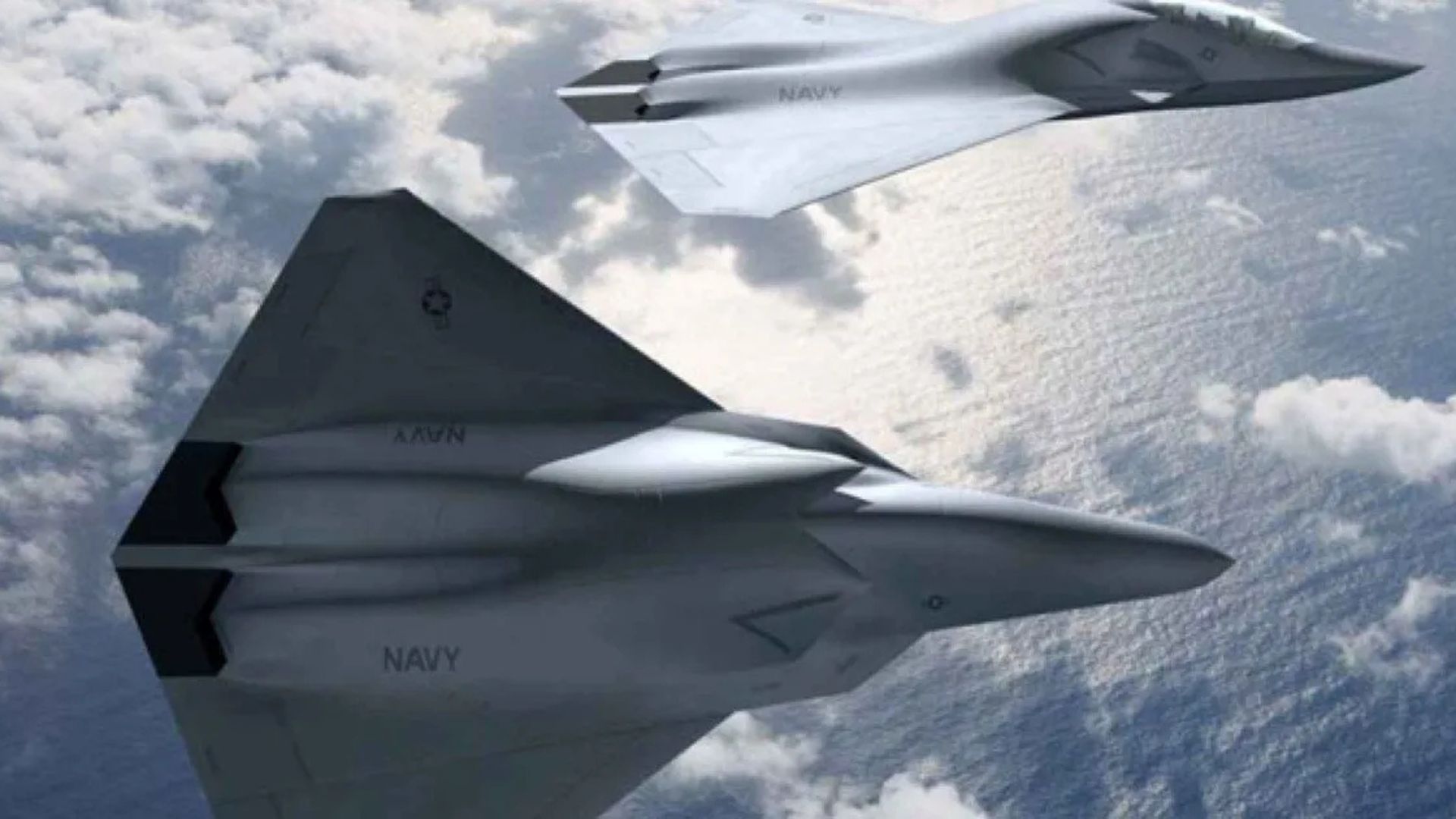


NGAD And GCAP Programs Accelerate Development of Sixth Generation Fighters Focused on Network Integration, Collaborative Drones, and Directed Energy Weapons Aiming for Air Superiority in Highly Contested Environments Starting Next Decade.
The United States and a consortium led by the United Kingdom, Italy, and Japan are accelerating programs to achieve the next generation of fighter aircraft, with manned aircraft acting as the core of a network that integrates sensors, communications, and drones in coordinated missions.
The bet is that these projects, now referred to as “families of systems”, will deliver greater range, survivability, and operational capacity in environments with dense air defenses, a scenario that informs decisions and investments in the next decade.
Although there are promises about speed, range, and “invisibility,” the very design of these programs includes a central point: critical details remain classified, and published specifications tend to be general, focusing on capability directions.
-
Motorola launched the Signature with a gold seal from DxOMark, tying with the iPhone 17 Pro in camera performance, Snapdragon 8 Gen 5 that surpassed 3 million in benchmarks, and a zoom that impresses even at night.

-
Satellites reveal beneath the Sahara a giant river buried for thousands of kilometers: study shows that the largest hot desert on the planet was once traversed by a river system comparable to the largest on Earth.

-
Scientists have captured something never seen in space: newly born stars are creating gigantic rings of light a thousand times larger than the distance between the Earth and the Sun, and this changes everything we knew about stellar birth.

-
Geologists find traces of a continent that disappeared 155 million years ago after separating from Australia and reveal that it did not sink, but broke into fragments scattered across Southeast Asia.

System of Systems Concept Redefines Air Combat
Unlike fifth generation platforms, which already combine stealth and sensor fusion, the fighters at the center of the sixth generation initiatives are designed to coordinate external elements, turning the pilot into a mission manager rather than just an operator.
In this concept, the value is not only in the manned aircraft but in the set formed by data links, distributed sensors, mission software, and unmanned vehicles that extend range, saturate defenses, and reduce risk to the main fighter.
At the same time, the discussion about artificial intelligence shifts from generic discourse to practical applications, with autonomy for navigation, target prioritization, and sensor management, while maintaining human oversight when force is employed.
NGAD and F-47: What Has Been Officially Confirmed

In the American case, the Department of the Air Force announced on March 21, 2025, the selection of Boeing to conduct the development phase of the manned fighter of the NGAD program, which has been designated F-47.
The decision was presented as part of a response to modern threats and the need to operate at long distances, with the aircraft intended to replace the F-22 and to function alongside drones that support the main mission.
Prior to this, the Air Force had already acknowledged that at least one full-scale demonstrator of the NGAD concept was designed, built, and flew in secret, information confirmed in 2020 by acquisition authorities.
Even with the announcement of the contract, the data released in official sources are high level, such as the intention to surpass fifth generation capabilities in range and resilience, without publishing definitive numbers on unit cost, internal armament, or exact signatures.
GCAP and the Successor of the Typhoon Expected to Enter Service by 2035
In parallel, the United Kingdom, Italy, and Japan have structured the Global Combat Air Programme, known for its association with the Tempest project, with the goal of achieving an aircraft that replaces the Eurofighter Typhoon and is compatible with distinct doctrines.
The timeline released for the program indicates formal development starting in 2025, a demonstrator expected to fly in 2027, and the entry into service of production aircraft starting in 2035, still subject to industrial and budgetary revisions.
In this type of partnership, companies divide responsibilities among structure, sensors, engines, and system integration, and the final design tends to reflect commitments between national requirements, interoperability, and upgrade capability over the life cycle.

Collaborative Drones Extend Range and Reduce Risks
The U.S. Air Force has been presenting Collaborative Combat Aircraft as a key piece of this new model, with the ambition of forming an inventory of about a thousand autonomous drones to operate alongside manned fighters in various roles.
These vehicles are designed to perform escort, reconnaissance, electronic warfare, and attack tasks, allowing the main aircraft to preserve ammunition, maintain distance from threats, and distribute risks in scenarios with modern air defense.
By tying drones and fighter into the same package, the logic of combat tends to shift from dueling to managing multiple vectors simultaneously, which requires robust communications, low latency, and the ability to operate even under interference.
Laser Weapons and Technical Limits of Directed Energy
Directed energy weapons frequently appear as a response to the challenge of neutralizing drones and missiles at a lower cost per shot, but the historical obstacle is physical: electrical power, thermal dissipation, and volume remain severe constraints on aircraft.
The Airborne Laser program, which used a modified Boeing 747 with a megawatt class chemical laser, demonstrated engagement viability in tests but also exposed the complexity of the system, and was ultimately canceled after years of high costs.
More recently, initiatives like SHIELD have been described with an expectation of power below 100 kW in a pod for fighters, precisely because the goal of hundreds of kilowatts increases energy and cooling demands in a non-linear way.
Stealth, Sensors, and Parameters Kept Secret

The narrative surrounding sixth generation often attributes radical gains in stealth and reduction of infrared signature, but measurements such as RCS and percentages of thermal emission reduction are rarely disclosed accurately by armed forces, due to operational value.
Still, the trend that appears in public statements and technical materials is the pursuit of aircraft that are harder to detect and track, combining geometry, materials, thermal management, and electronic warfare, along with distributed sensors and advanced processing.
In the case of NGAD, American officials indicated speeds above Mach 2 and a combat radius exceeding a thousand nautical miles as general references, without tying these parameters to a definitive package, which limits direct comparisons with the F-22.
Replacement of the F-22 and Coexistence with the F-35
The replacement of the F-22 is an explicit goal of the manned component of NGAD, while the F-35 is expected to remain the backbone of allied fleets for many years, coexisting with new vectors and upgrades, not as an immediate blackout.
When the debate shifts from marketing to operation, the decisive point becomes integration: whoever can connect fighter, drones, sensors, and command with resilience to interference gains the margin to decide, attack, and survive before the adversary in a contested theater.







Depois que os F-2 “Mitsubishi se mostraram com suas novas atualizações superiores a tudo e todos com seus sistemas que copiaram, melhoraram e pegaram de tudo que é aeronave, EUA, que não é ****, logo entrou no mesmo projeto de cabeça com rodas as suas mais fodas empresas no processo.
Os F-2 (Viper Zero) já estão operando com 3 a 5 drones, tem inúmeras coisas dos F-22 Raptor, F-35 Lightning II, J-20F, SU-57, F-39 Gripen, Eurofighter Typhoon, Rafale F-15EX, F-16 (Viper) e tecnologias únicas que fazem deles, os únicos com sistemas de Inteligência Artificial capazes de terem uma cobertura camaleão, radares em toda à Aeronave, estão usando RAM, e ademais coisas que se fosse falar aqui, não iria caber. Fiz algumas pesquisas e estudos à partir do que pilotos e cientistas de Guerra e Geopolítica estavam debatendo falando que o Viper Zero é o melhor 4.5 que existe, sendo hoje um Fantástico híbrido mais personalizável que tem para qualquer tipo de Combate somando suas mais de mil interceptações anuais, numa média de 3 / 4 por dia e aprendendo com tudo e todos, além de todas as aeronaves da China, Russia e Coreia do Norte incluindo interceptações e abates dos Mísseis da Coreia do Norte que foram até as águas Niponicas. O Viper Zero está sendo tratado como um caçador de 5° Geração e mostrado em todos os testes sua eficácia e eficiência…
Por não incentivar o desenvolvimento entre nações com o objetivo de crescimento e distribuição de renda . Ao invés de morte