





 Portuguese
  English
  Spanish
  8 min of reading
  1 comment


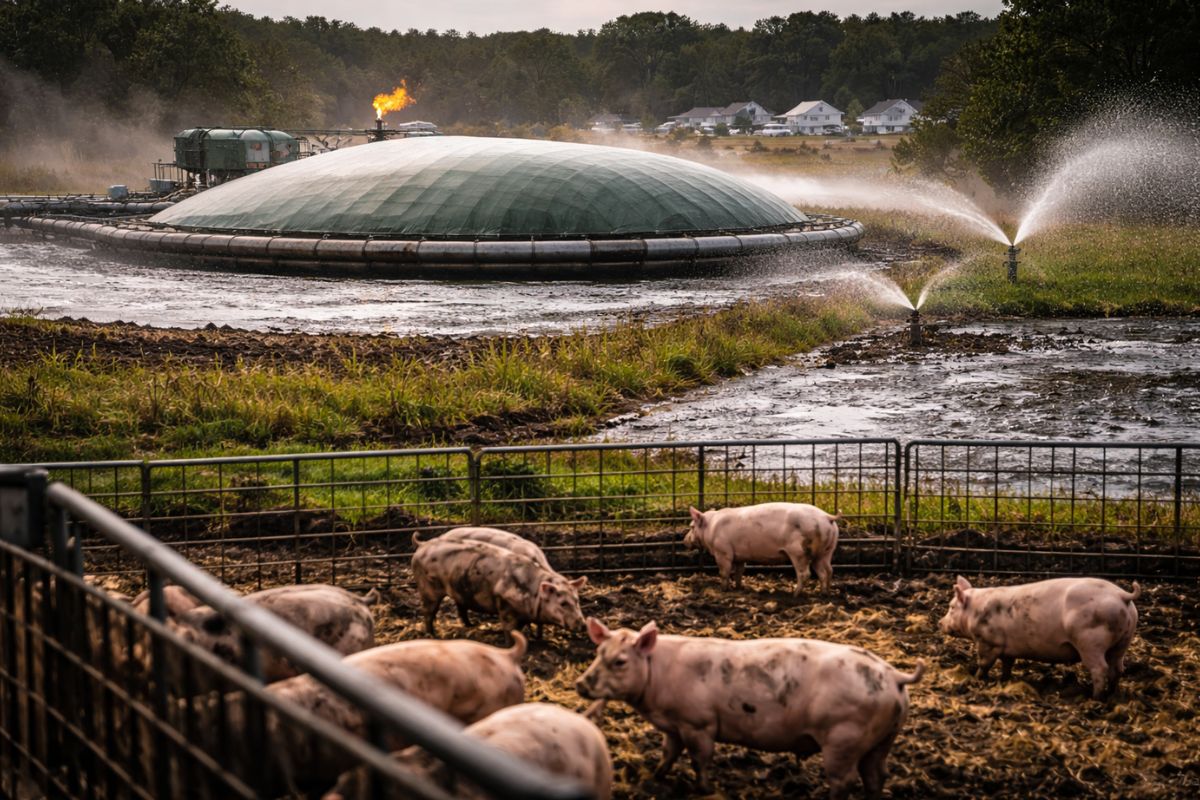


California Finances Pig Farms for Biogas in North Carolina and Sells Carbon Credits in Transport, While Biodigesters, 48 km Pipelines, and Spraying Ponds Transform Turkey and Warsaw into Climate Laboratory by 2026 Without Notice
In Turkey, North Carolina, the climate agenda has taken an unexpected turn as a California program began supporting pig farms that promise to capture methane, produce biogas, and convert this effort into carbon credits linked to transport. The infrastructure arrives with a discreet appearance, but with potential effects on air, water, and neighborhood routines.
The conflict arises from the clash between the promise of clean fuel and the local history of waste lagoons and waste spraying in rural areas. Environmental justice organizations describe surprise and little transparency regarding pipelines and facilities, while companies and model advocates argue that methane capture reduces emissions and odors, and that viability depends on subsidies and market rules.
How the California Program Pushes Biogas Out of State

The money that has reached pig farms is linked to the Low Carbon Fuel Standard, a market for carbon credits created to reduce transportation emissions in California.
-
The sugar-energy sector advances with agricultural technology, but agricultural productivity still raises concerns.

-
The eggshell that almost everyone throws away is made up of about 95% calcium carbonate and can help enrich the soil when crushed, slowly releasing nutrients and being reused in home gardens and vegetable patches.

-
This farm in the United States does not use sunlight, does not use soil, and produces 500 times more food per square meter than traditional agriculture: the secret lies in 42,000 LEDs, hydroponics, and a system that recycles even the heat from the lamps.
-
The water that almost everyone throws away after cooking potatoes carries nutrients released during the preparation and can be reused to help in the development of plants when used correctly at the base of gardens and pots, at no additional cost and without changing the routine.


Launched in 2012, the program imposes a declining trajectory for the average carbon intensity of fuels, requiring higher-emission fuels to purchase carbon credits from alternatives assessed as less intensive, including biogas from methane from animal waste and landfills.
This design pushes impacts and infrastructure away from where the financial benefits are concentrated. By 2025, the mechanism reached the epicenter of pig farming in North Carolina, and the previous year, six pig farms were the first in the state to receive funding linked to the program.
For community leaders in the Warsaw area, the central friction is speed: the trade of carbon credits accelerates pipelines and construction without neighbors knowing exactly what is being installed, on which route, and with what risks.
What Changes in Pig Farms When Biodigesters and Ponds Are Introduced

Inside the pig farms, the central technology is the installation of biodigesters over waste lagoons, typically as dome-shaped covers that capture methane.
The captured gas stops escaping directly from the lagoon and is collected and sent for processing, sustaining the promise of biogas and carbon credits associated with transportation.
The sensitive point lies in the remainder of the material and the operational logic of the system. After capture, the remaining wastewater is pumped into open lagoons for post-digestion storage, and at the end of the cycle, the waste is sprayed on agricultural fields.
Critics argue that the chain maintains the lagoon and spraying model, with risks of groundwater infiltration and spills during floods, and that covering the lagoon does not automatically neutralize pollutants such as nitrogen, phosphorus, and fine particles.
The result may be a reduction of one problem and reinforcement of others, which fuels the controversy over selling carbon credits as if the equation were resolved.
Pipelines, Compression, and the Align RNG Plant in Turkey

The processing plant associated with the Align RNG project was described as small, with silver structures near a 30-meter grain silo, in a landscape dominated by slaughterhouses, barns, and feed logistics.
The contrast helps to explain why residents say they were caught by surprise: the facility does not have the visual size of a plant but integrates a chain that connects pig farms to an industrial stage of gas compression and refining.
The project design connects 19 pig farms through about 48 kilometers of underground pipelines to a central processing unit known as the Grady Road Project, which began operations in November 2022.
The farms are within a radius of approximately 21 kilometers and include properties linked to Smithfield or contracted by it, with herds described between 10,000 and 20,000 pigs per farm.
The raw biogas flows through the pipelines to compression, is refined to meet specifications, and is injected into a utility pipeline, while the carbon credits can be traded in another market.
Carbon Credits Separated from Fuel and Transport Accounting
One feature of the model is to separate the molecule from the environmental attribute. The biogas, after being processed and injected into pipelines, can supply homes and businesses in the region, while the carbon credits are sold separately to offset emissions from transportation elsewhere.
For residents of North Carolina, this separation creates a sense of asymmetry: the territory lives with lagoons, spraying, and construction, but the “benefit” is accounted where the fuel does not always physically arrive.
This accounting engineering is at the center of the criticism from environmental justice groups and organizations like Food & Water Watch.
One point mentioned in the debate is that about 45% of the carbon credits from biogas in the California market would go to producers outside the state, linked to 196 farmers in various parts of the country, reinforcing the perception that the program allows offsets without local fuel delivery.
When the policy is about transportation, the question shifts to governance: what is the acceptable limit of local impact on the communities surrounding the pig farms?
Local Pollution, Ammonia, Nitrates, and the Pollution Swapping Argument
The east of North Carolina experiences high density of industrial farming, with counties where pigs outnumber residents at a ratio of about 40 to 1. REACH operates in Duplin County, cited as the second county with the highest density of pigs in the country, behind neighboring Sampson County.
Many operations are hidden behind curtains of trees, but the effects described for decades include sprayed manure carried by the wind, contamination associated with phosphorus and nitrates, and impacts on rivers and wells, in a territory with significant social vulnerability issues.
In the technical debate about biodigesters and biogas, specific alerts arise. There are mentions of studies indicating that biodigesters, depending on their operation, can increase ammonia release, associated with 12,400 deaths per year in the United States.
There is also a warning from the U.S. Department of Agriculture that methane capture can exacerbate water quality issues by increasing nitrogen solubility, raising the risk of nitrate contamination in drinking water, which is particularly concerning where many families rely on wells.
Researchers also point out that burning surpluses and the infrastructure can add nitrogen oxides, sulfur oxides, and particulate matter, feeding the idea of pollution swapping.
Licenses, Civil Rights, and the Ongoing Investigation
The implementation of biodigesters on pig farms has become a legal and regulatory dispute.
Two groups, the Community Action Network for Environmental Justice and Cape Fear River Watch, have sued the North Carolina Department of Environmental Quality over permits granted for biodigesters on farms linked to the sale of carbon credits, claiming the state did not consider less harmful treatment systems and did not adequately assess the impacts of post-digestion waste.
In addition to state litigation, a complaint based on Title VI of the Civil Rights Act was filed with the EPA against the same department, on behalf of organizations such as the Duplin County NAACP and the North Carolina Poor People’s Campaign, alleging disproportionate impact on Black, Latino, and Indigenous communities.
A chief administrative judge ruled in favor of the state agency in 2022 in the case of the licenses, but the EPA decided to investigate the civil rights complaint, and the inquiry was reported as still ongoing.
On the California side, the regulatory authority mentioned in the debate indicated that it could invalidate carbon credits if there is generation or transfer in violation of laws outside the program itself.
Who Profits, Who Signs, and Why the Subsidy Decides the Pace
The controversy involves corporate structure and cost. The Align RNG project was described as a $500 million joint venture between Dominion Energy and Smithfield, aimed at processing methane from pig farms and converting the gas into fuel and carbon credits.
The project set a goal of capturing 142,000 metric tons of methane per year, compared to removing 30,000 cars from the streets, an argument designed to justify the climate benefit of biogas.
Even at this scale, economists point out that building and operating biodigesters costs nine to ten times more than producing natural gas through direct extraction.
This differential explains why biogas relies on political support and carbon credits, with two pillars cited as decisive: the federal renewable fuels standard and California’s low carbon standard.
For the community, what matters is the counterpoint: if the subsidy makes the project feasible, what monitoring and local pollution reduction obligations come along with it?
The Next Wave of Pipelines and the Transparency Issue
The feeling of surprise is repeated in reports from local organizers. Sherri White Williamson from the EJCAN group described that public hearings attracted neighbors who did not know what was going on, and that the organization had to go door to door to explain what biodigesters and biogas routes were.
For residents, the question shifts from being abstract to territorial: where does the pipeline run, what changes in spraying, and who measures the air quality around the pig farms.
There is also discussion about emissions from the infrastructure itself. An air quality permit for the Turkey unit was described with a potential emission of between 64 and 220 tons of pollutants per year, and residents reported observations of gas burning releasing pollutants associated with respiratory risks.
Researchers cited in the debate also warn about the risk of fires and explosions when methane becomes concentrated in pipelines and tanks, especially with more intense storms.
In the same horizon, the state recorded, in August 2025, 30 applications for biodigesters under review and 59 already licensed, while Smithfield announced plans to expand biodigesters to a large part of its pig farms.
The case of the pig farms financed by California shows how a transportation climate policy can reshape infrastructure, incentives, and risk in another state.
Biogas and carbon credits can reduce some methane emissions, but they do not automatically eliminate lagoons, spraying, and pollutants that affect air and water in eastern North Carolina, where the historical burden is already high.
If your region received biodigesters in pig farms with a promise of biogas and carbon credits, what requirement would you prioritize first to protect those living near lagoons and spraying fields, and who should oversee this account: the state, the EPA, or independent community monitoring?










Os porcos vão poluir os rios.
Porcos São imundos.
Minha cunhada quase matou o bebê recém nascido, só porque comeu comida com banha de porco.
O bebê ficou cheio de perebas.