





 Portuguese
  English
  Spanish
 7 min of reading
  0 comments


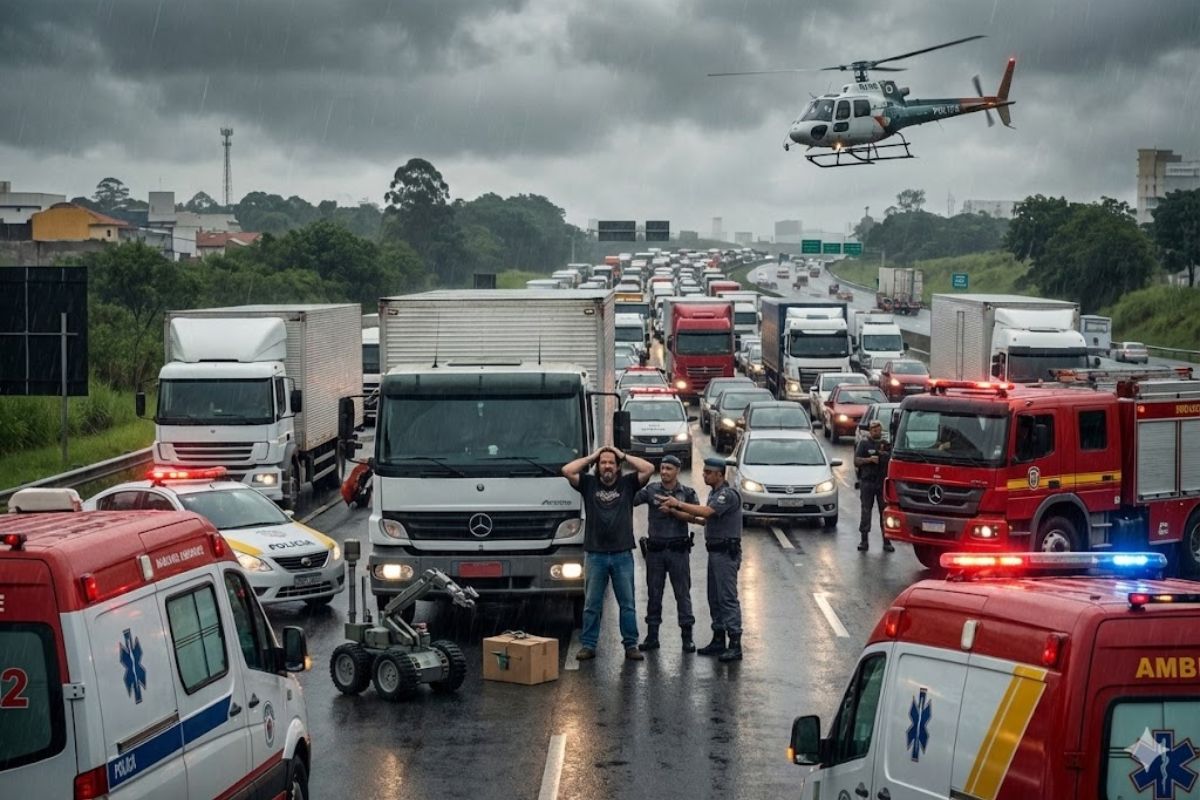
In November, Truck Driver Dener Laurito Stopped The Rodonel For Five Hours With A Hoax Of Robbery And Fake Bomb Causing 44 Kilometers Of Traffic Jams While Reporting Cargo Theft, Weak Security On The Roads, And The Daily Pressure On The Profession Of Truck Drivers In Current Brazil On Main Brazilian Highways
Truck driver Dener Laurito dos Santos, who caused a 44-kilometer traffic jam for five hours on the Rodonel in São Paulo in November by claiming to have been the victim of a robbery involving a bomb, admitted that it was all a hoax. In interviews given on November 14 and 20, he presented contradictory versions until he acknowledged that he fabricated the false crime scene, in an incident that mobilized an elite task force, bomb squad, and paralyzed one of the country’s main roads.
The case, revealed in detail by a television report, is now under analysis by the authorities and may result in liability for false communication of a crime, which carries a penalty of one to six months imprisonment or a fine. At the same time, the truck driver’s story reignites the debate about the routine of fear, violence, and thefts that affect truck drivers throughout Brazil, with reports of kidnappings, physical assaults, psychological trauma, and a decline in the number of professionals on the roads.
The Hoax Of The Truck Driver Who Stopped The Rodonel For Five Hours

In the first version presented, the truck driver claimed that three criminals in a pickup had chased him, thrown stones at the truck’s windshield, and forced him to make a sudden stop on the Rodonel.
-
The government puts R$ 8.6 billion on the table to change the highway (BR) with 50 overpasses, 28 bridges, 4 tunnels, and 40 km of bike lanes in 180 km of historic duplication.

-
BRL 20.1 Million Bridge Project Kicks Off: 200-Meter Construction to Improve Access in Three Cities in Minas Gerais

-
‘Endless Road’ In Brazil Is One of The Largest In The World: 145 Km Stretch On An Important Highway (BR) Crosses The West Of Bahia And Had 135.9 Km Revitalized With R$ 35.3 Million
-
Engineer From ITA Who Worked at Embraer Leads Free Flow Expansion With National Artificial Intelligence and Technology for Toll Without Barriers in Brazil

He stated that he had been tied up, assaulted, and held hostage in the truck, which was blocking the road for hours.
Images of the stopped vehicle, completely blocked traffic, and the presence of specialized teams spread across the country.
The GAT, a tactical action group from the São Paulo police, and the bomb squad were called due to suspicions of explosives.
Traffic only began to be cleared after long hours of negotiation and security procedures, while the truck driver appeared in apparent shock.
Days later, however, the narrative began to fall apart.
At the police station, Dener confessed that he himself had thrown the stone that broke the windshield, fabricated the fake bomb with a gallon and other objects, blocked the road with the truck, and tied his own hands.
According to the truck driver, the idea was to “call attention” to the lack of security for truck drivers on the roads.
Contradictions, “Psychotic Episode”, And Psychiatric Analysis


Between the interview on November 14 and the exclusive on November 20, the truck driver alternated between regret, memory gaps, and claims of having a “psychotic episode.”
At times, he stated that he did not remember throwing the stone at the truck or tying himself up; at other times, he acknowledged that he had staged the scene, but said he could not explain why he made that decision.
In an assessment presented in the report, a forensic psychiatrist questioned the episode’s psychotic thesis.
The expert indicates that there was no psychotic episode, but rather a deceitful behavior with full awareness of his actions, noting that people in true psychosis do not usually recognize their own state in that way.
According to the expert, Dener was aware of the sequence of actions he performed to simulate the crime.
The truck driver himself, now suspended for 30 days, claims to be regretful and ashamed, admits that he “will pay for what he did,” and says he lost control.
At the same time, he insists that he didn’t mean to defame the category, stating that he “loves what he does” and thought of the truck drivers when staging the scene.
Truck Driver In The Crosshairs: Official Data Show Increasing Violence
Behind the hoax, there is a real and serious context. Truck drivers report living under a constant sense of insecurity, especially in major logistical hubs and in areas where goods are delivered.
According to data from the Ministry of Justice and Public Security, Brazil recorded 6,226 cargo thefts between January and September of this year, with 84.72% of incidents concentrated in Rio de Janeiro and São Paulo.
Surveys by the São Paulo Public Security Secretariat indicate that most of these thefts occur in the morning, often during delivery, when the truck driver is stopped in front of companies or commercial establishments.
Food items lead the list of cargo most targeted by criminals, and more than 90% of truck drivers who are victims of theft are held during the act, often under threat of death or physical violence.
In this scenario, the truck driver’s choice to use insecurity as justification for the hoax exposes a contradiction: while his act generates outrage within the category, the problem he cites as motivation is real and recurrent on Brazilian roads.
Reports Of Aggression And Trauma In The Truck Driver Routine
The report features the testimony of Claudemir, a truck driver with seven years on the road, who experienced a robbery in front of a food company near Jundiaí, in the interior of São Paulo.
It was around 7 o’clock in the morning when he heard knocks on the cabin door and the call of “motor, motor.” When he opened it, he was surprised by armed men.
Right at the beginning of the approach, Claudemir was hit in the forehead with a gun, was tied up, and thrown onto the truck bed, facing away from the robbers.
For nearly three hours, he remained under the control of the criminals while the vehicle was diverted from its predetermined route and followed under the company’s monitoring.
When the tracking system froze the truck, the criminals became irritated and began to assault him again, believing he had triggered some device.
Upon hearing the order over the intercom to “take out the driver and get out,” Claudemir decided to jump from the moving truck.
He had already managed to free himself from the bindings and ran about 50 meters until he found the police, alerted by the tracking center.
In addition to the physical scar, he reports that he still carries the psychological trauma, describing recurring fear regarding unknown vehicles nearby, the route, and mandatory stops.
Fewer Truck Drivers, More Risk And Families On The Road
The risks and pressure on the category are reflected in the workforce composition itself.
Between 2014 and 2024, the number of truck drivers in Brazil decreased by 22%, according to data cited in the report.
The country still has about 4 million truck drivers who travel from north to south, east to west, often under low wages, long hours, and little effective protection.
In some cases, families travel together in the cabin. Jorge, a truck driver with 15 years on the road, often drives with his wife Kelly and children on certain stretches.
He states that having the family around demands heightened attention, choosing safer routes, and constantly evaluating where to stop to rest.
For him, one of the most critical highways is BR-251, which connects Bahia to Mato Grosso, described as a stretch with “everything that is bad,” from irresponsible drivers to a high crime rate.
Even when at home, Kelly tracks his route on her cell phone, asking for location updates, messaging when entering and leaving coverage areas, and alerting him at every stop.
The concern is constant about thefts, accidents, and road conditions.
The couple reports that their youngest son has already expressed a desire to become a truck driver like his father, but the response is firm: the parents do not want him to pursue the same profession, given the current perception of risk.
What Lies Ahead For The Truck Driver Who Staged The Hoax
In the specific case of the Rodonel, truck driver Dener Laurito is suspended for 30 days and still does not know what his professional situation will be at the end of the period.
He admits to having harmed “many people,” asks for forgiveness from the population of São Paulo affected by the traffic jam, and to fellow truck drivers who were outraged by the episode.
From a legal standpoint, he may face charges for false communication of a crime, with a penalty of one to six months detention or a fine, in addition to potential civil liabilities for damages.
Experts emphasize that the overload of work or the real fear experienced on the roads does not justify creating artificial panic situations, especially on essential roads for cargo transport and the circulation of millions of people.
At the same time, the case brings to light an already known situation: the trucking profession continues to be exposed to cargo theft, violence, poor roads, and limited support.
The Rodonel hoax does not obscure the reality of the numbers, the reports of robberies, and the accumulated traumas of those who live behind the wheel.
In light of an episode where a truck driver creates a hoax to draw attention, while millions of truck drivers face real risks every day, do you think Brazil needs to prioritize more security on the roads or first change the working conditions of this profession?









-

Uma pessoa reagiu a isso.