





 Português
  Inglês
  Espanhol
  5 min de leitura
  1 comentário


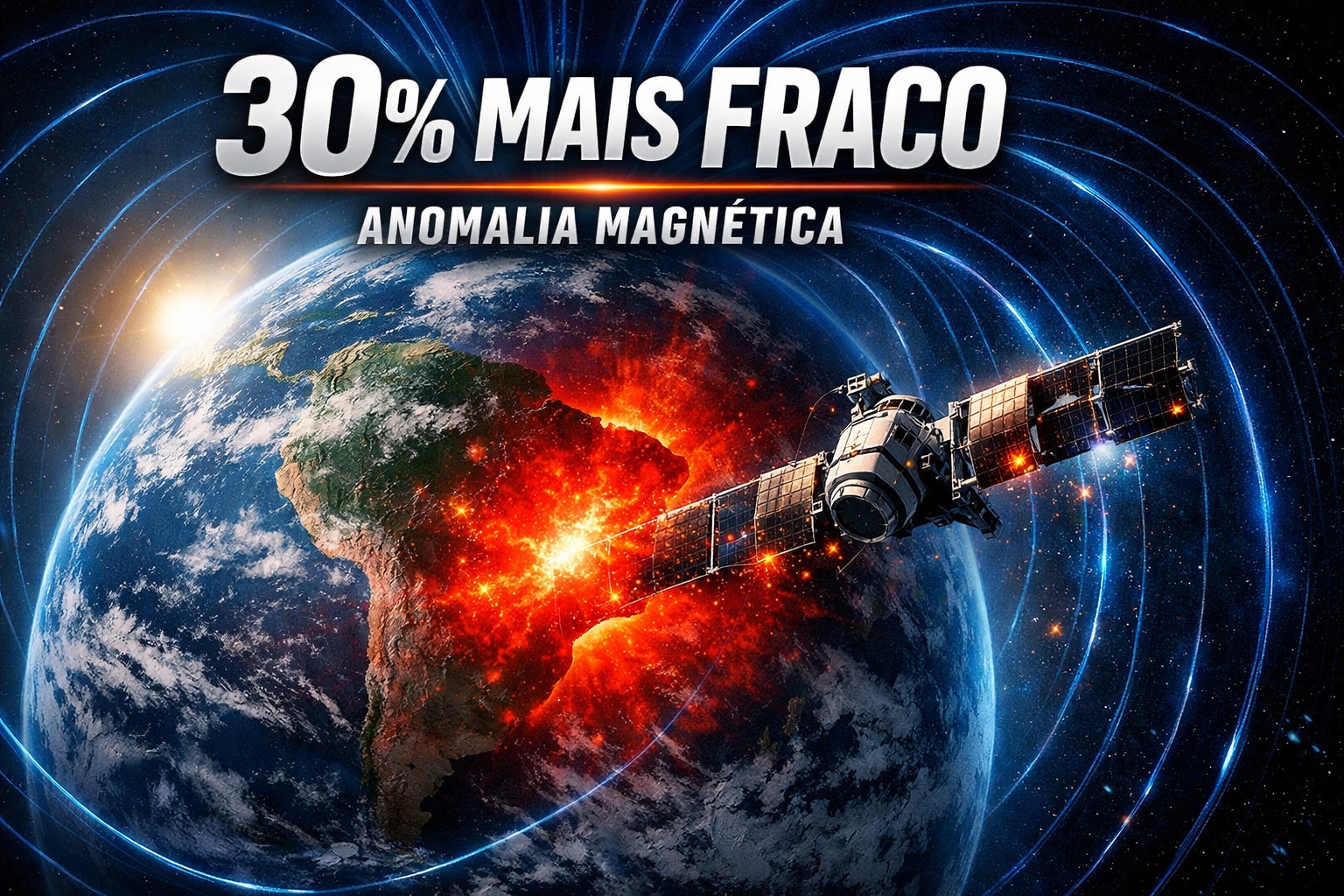


With Magnetic Field Up to 30% Weaker Over Brazil, the South Atlantic Anomaly Affects Satellites and Exposes Flaws in the Earth’s Natural Shield.
In 2020, data from the Swarm mission by the European Space Agency (ESA) confirmed something that had been monitored for decades: the Earth’s magnetic field is significantly weaker in a vast area over the South Atlantic and part of South America, including Brazilian territory. This region is known as the South Atlantic Magnetic Anomaly (SAMA), or South Atlantic Anomaly (SAA) in English.
According to geomagnetic measurements, the field strength in this area can be up to 30% lower than the global average at certain orbital altitudes. The phenomenon is not visible to the naked eye, but its effects are felt by satellites, space missions, and scientific instruments that regularly cross the region.
What is at stake is not just a geophysical curiosity but the behavior of the very magnetic “shield” that protects the Earth from space radiation.
-
Found in one of the most radioactive places on Earth, this Chernobyl fungus may be doing something with radiation that no one has been able to explain to this day.
-
A bright yellow mushroom imported from Asia escaped from a cultivation farm in the United States in 2010 and is now aggressively spreading across 25 states, destroying entire communities of native fungi in American forests.

-
Buried under China, a colossal machine weighing 20,000 tons began operating as the largest neutrino detector on the planet and, in just 59 days, surpassed results that science took half a century to achieve.

-
Iran enters the center of a climate alert after the war emitted 5.6 million tons of CO2 in two weeks, surpassing the annual pollution of entire countries.


What Is the South Atlantic Magnetic Anomaly and Why Does It Exist
The Earth’s magnetic field is generated by the movement of liquid iron in the planet’s outer core, about 3,000 km deep. This movement creates electric currents that produce a global magnetic field similar to that of a large magnet tilted approximately 11 degrees relative to the Earth’s rotation axis.
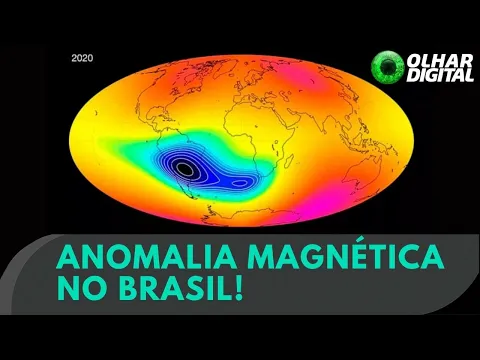

However, the magnetic field is not perfectly symmetrical or uniform. It exhibits irregularities caused by complex flows within the deep interior of the Earth.
The South Atlantic Anomaly arises precisely because the magnetic axis does not coincide exactly with the geographic center of the planet, and because there is a specific region at the boundary between the core and the mantle where magnetic flow exhibits atypical behavior.
The result is an area extending from southern Africa to Brazil where the magnetic field is significantly weaker.
This weakness allows energetic particles from the Van Allen belts—regions of radiation trapped around the Earth—to come closer to the surface.
Why Do Satellites Shut Down Systems When Passing Through the Region
Satellites in low Earth orbit, typically between 200 and 1,000 km altitude, regularly cross the South Atlantic Anomaly.
When they enter this area, they are exposed to higher levels of radiation from energetic particles. This can cause:
- Temporary failures in electronic systems
- Interference in sensors
- Errors in digital memory
- Automatic rebooting of equipment
- Preventive shutdown of scientific instruments
The Hubble Space Telescope, for example, halts sensitive observations when crossing the anomaly to avoid damage to its detectors.
The International Space Station (ISS) also periodically crosses the region, requiring monitoring of radiation exposure.
The phenomenon does not “knock out” satellites, but it significantly increases the risk of radiation events that can compromise equipment.
Is the Anomaly Growing? What Do Recent Data Show

Since the 1970s, measurements have indicated that the Earth’s global magnetic field has been gradually weakening. In the region of the SAMA, this weakening is more pronounced.
Data from the Swarm mission revealed that:
• The area of the anomaly has increased in recent decades
• The field strength has progressively decreased
• The region appears to be splitting into two magnetic lobes
This behavior has intrigued geophysicists, as it suggests that complex processes are occurring in the Earth’s core.
It is important to highlight: while the weakening is significant in the region, this does not mean that the global magnetic field is about to collapse.
Does the Compass Really Point Down?
The idea that “compasses point down” is an exaggerated simplification.
What occurs is a change in the intensity and tilt of the magnetic field lines, but not a sudden local inversion of direction.
The field still exists. It is just weaker in that area.
In technical terms, the global average intensity of the magnetic field varies between 25,000 and 65,000 nanoteslas. In the anomaly region, values can fall significantly below this average.
This difference is enough to alter the behavior of energetic particles in space, but not to cause widespread disorientation on the surface.
Is There a Relation to Magnetic Pole Reversal?
One of the most frequently asked questions is whether the South Atlantic Anomaly indicates a future magnetic pole reversal.
The Earth has undergone various magnetic reversals throughout its geological history. During these reversals, the magnetic field weakens and the poles swap positions.
However, experts indicate that:
• The current weakening is part of natural variations
• There is no evidence of an imminent reversal
• The process, if it occurs, would take thousands of years
The anomaly may be a symptom of internal complexity of the core, but not necessarily a harbinger of catastrophe.
Real Impacts for Brazil and South America
The SAMA region covers a large part of Brazilian territory at orbital altitudes.
For the surface population, the impact is practically nonexistent. The magnetic field still protects against most solar and cosmic radiation.
The effects are primarily technological and orbital.
Space agencies and satellite companies need to consider the anomaly when designing electronic systems, shielding, and operational protocols.
Brazil, being at the center of the affected area, has become a strategic point for global geomagnetic studies.
Why Does the South Atlantic Anomaly Intrigue Scientists So Much?
The SAMA serves as a window into the deep interior of the Earth.
It offers clues about:
• Dynamics of the outer core
• Magnetic flows at the core-mantle boundary
• Secular evolution of the geomagnetic field
Modern satellites, such as those from the Swarm mission, allow for unprecedented precision in mapping the magnetic field.
These data help improve geophysical models and better understand how the Earth’s magnetic shield evolves over time.
The Future of the Earth’s Magnetic Shield
The Earth’s magnetic field is essential for life. It deflects charged particles from the solar wind, protecting the atmosphere and reducing exposure to radiation.
The South Atlantic Anomaly does not mean that this shield is disappearing.
It means that it is dynamic.
Like the climate, the magnetic field also changes over time.
What is today a region 30% weaker may evolve, shift, or even dissipate over centuries.
For now, the phenomenon represents:
A challenge for space engineering
A natural laboratory for geophysics
A reminder that the Earth’s interior remains active
And while satellites adjust their systems as they cross the sky over Brazil, scientists continue to carefully observe the invisible behavior that protects the planet every day.






Tinha que ser no brasil kkk.
Seremos os primeiros a sermos assados…