





 Portuguese
  English
  Spanish
  3 min of reading
  157 comments


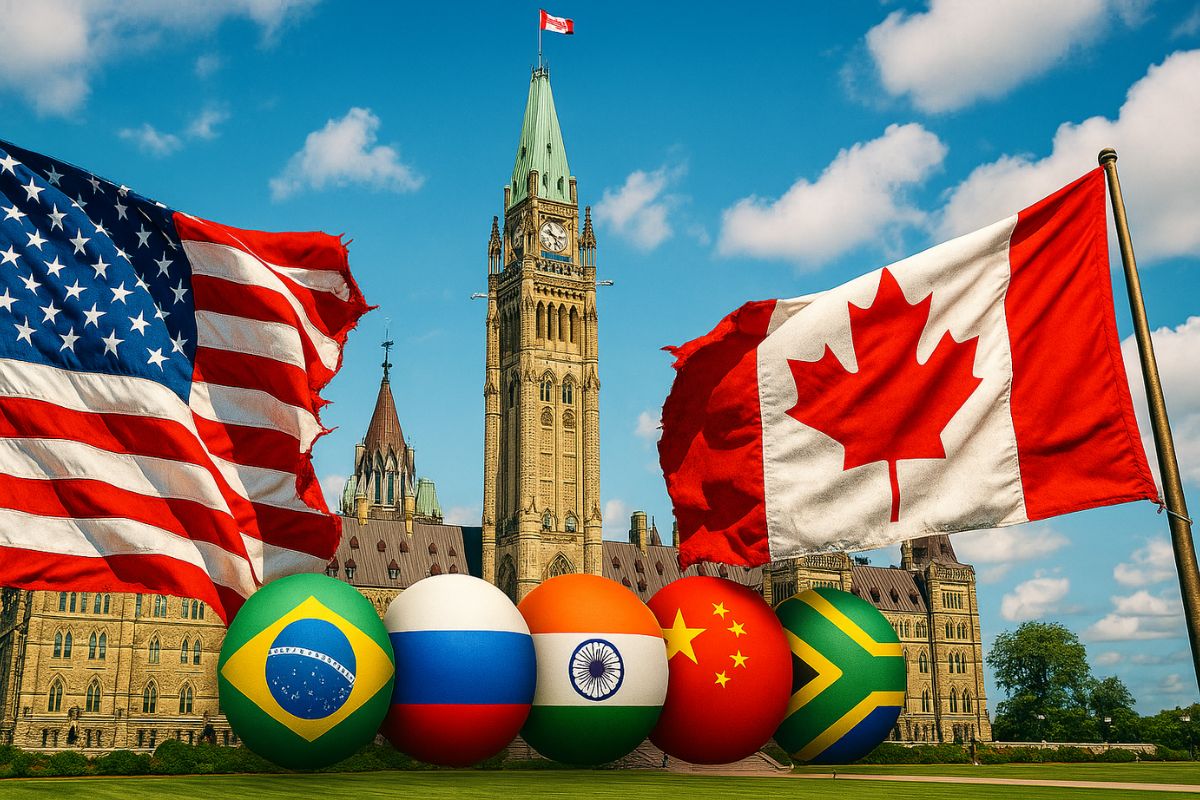


Canada in BRICS: The Turnaround That Changes the Global Game and Challenges Trump. Discreet negotiations indicate that Canada may become the first G7 country to join the bloc, altering the global geopolitical balance
The Canada in BRICS is no longer just speculation. High-level negotiations have been taking place since July, bringing Ottawa closer to a bloc that unites emerging powers and directly challenges the hegemony of the United States. Possible membership represents a historic break from Canada’s traditional alignment with Washington.
According to information from Canada Diario, private meetings with representatives from China, Brazil, and Russia discussed everything from trade agreements to converting Canadian reserves into currencies like yuan and rupee. This strategic shift gained momentum after the escalation of tariffs imposed by the Trump administration on Canadian products, deepening an unprecedented trade crisis.
How Tensions with the U.S. Paved the Way for BRICS
The breaking point came with Donald Trump’s resumption of the presidency and the decision to withdraw from free trade agreements. Tariffs of up to 35% were imposed on wood, steel, aluminum, dairy, and automobiles, affecting key Canadian exports.
-
Larger than entire cities in Brazil: BYD is building a 4.6 km² complex in Bahia with a capacity for 600,000 vehicles per year, but the discovery of 163 workers in conditions analogous to slavery has shaken the entire project.

-
With an investment of R$ 612 million, a capacity to process 1.2 million liters of milk per day, Piracanjuba inaugurates a mega cheese factory that increases national production, reduces dependence on imports, and repositions Brazil on the global dairy map.

-
Brazilian city gains industrial hub for 85 companies that is equivalent to 55 football fields.

-
Peugeot and Citroën factory in Argentina cuts production by half and opens a layoff program for more than 2,000 employees after Brazil drastically reduced purchases of Argentine vehicles.


The impact was immediate: companies like General Motors and Magna saw market declines of over 9% in a single day, while unions and retail networks began boycotting American products. Internal surveys show that 91% of Canadians support reducing dependence on the U.S. and 71% intend to avoid products coming from there.
Why BRICS Is Attractive to Canada
Joining BRICS offers strategic advantages that go beyond trade. One of these is protection against sanctions, inspired by Russia’s experience, which redirected business after Western punishments.
Another attraction is economic diversification: the bloc, now with 10 countries, represents 46% of the global population and 35.6% of global GDP. Furthermore, BRICS is discussing alternatives to the dollar, which could strengthen the Canadian dollar and reduce inflationary pressures.
Risks and Challenges of Changing Blocs
Joining BRICS also carries considerable risks. Washington’s reaction may include sanctions, technological isolation, and diplomatic wear within the Five Eyes alliance, which includes Canada, the U.S., the UK, Australia, and New Zealand.
Additionally, there is the challenge of balancing economic interests with political and security issues, as BRICS includes members with agendas diverging from those of Western nations.
Global Impact of Canadian Membership
If confirmed, Canada’s entry into BRICS would have symbolic and practical effects. It would be the first G7 country to join the bloc, making it truly global and increasing its weight in trade and financial negotiations.
Experts warn that this could inspire other U.S. allies, such as Mexico and South Korea, to reconsider their alliances. In practice, dollar-based globalization would experience its biggest shock since World War II.
Trump and the Reverse Effect of His Policy
Donald Trump’s stance, marked by punitive tariffs and economic threats, may be accelerating exactly what he aims to avoid: the distancing of historical allies and the strengthening of rival blocs.
Projections from Oxford Economics estimate that a potential Canadian membership in BRICS could cost the U.S. up to $90 billion in trade and reduce GDP by up to 0.3%.
And you, do you believe that Canada in BRICS could usher in a new global order, or will it just be a symbolic move? How would this affect Brazil and the global economy? Share your opinion in the comments.










Olá o BRICS será num presente momento a saída aos países que estamos e vão sofrer qualquer interferência americana. Infelizmente o presidente dos USA acha que tem poderes sobrenaturais, tem uma fortuna sempre.apoiada nos mais pobres, ele que repetir isso nos outros países, deixar mais.pobres é ele intervir tomando os poderes através de eleições manipuladas a seu favor
Sei lá; o que estes chefes de estado gostam é suas contas bancárias cheias
Do dinheiro que é do público, pois eles não plantam um caroço de feijão e suas fortunas vão triplicando!
Ainda bem que o juízo de Deus está chegando!
Sei