





 Portuguese
  English
  Spanish
  4 min of reading
  0 comments


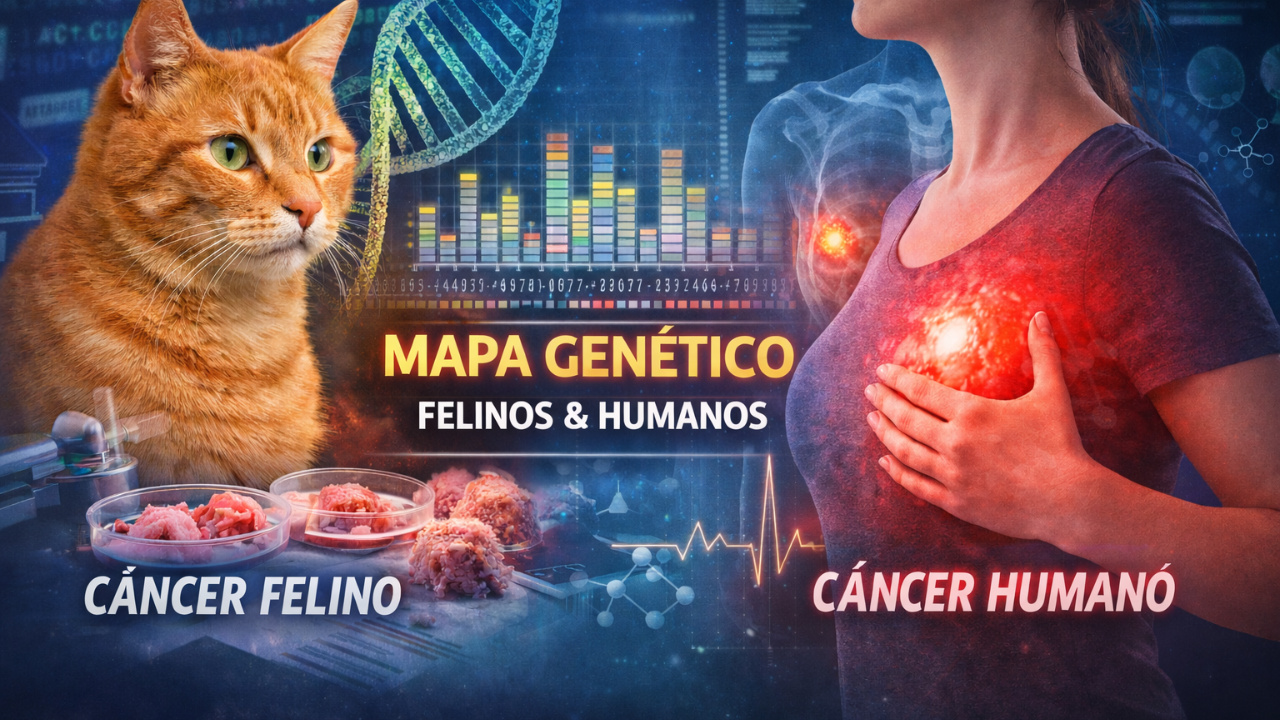
Genetic Map of Feline Cancer Reveals Similarities with Human Cancer and May Help in Triple-Negative Breast Cancer.
An extensive international study has revealed, for the first time, a detailed genetic map of feline cancer, bringing discoveries that could transform the understanding of human cancer.
The research was conducted by scientists led by the Wellcome Sanger Institute in Cambridge, UK, with participation from experts in Canada and other countries.
Published in the journal Science, the study analyzed tumor DNA from nearly 500 domestic cats, examining nearly a thousand genes linked to 13 different types of tumors.
-
Motorola launched the Signature with a gold seal from DxOMark, tying with the iPhone 17 Pro in camera performance, Snapdragon 8 Gen 5 that surpassed 3 million in benchmarks, and a zoom that impresses even at night.

-
Satellites reveal beneath the Sahara a giant river buried for thousands of kilometers: study shows that the largest hot desert on the planet was once traversed by a river system comparable to the largest on Earth.

-
Scientists have captured something never seen in space: newly born stars are creating gigantic rings of light a thousand times larger than the distance between the Earth and the Sun, and this changes everything we knew about stellar birth.

-
Geologists find traces of a continent that disappeared 155 million years ago after separating from Australia and reveal that it did not sink, but broke into fragments scattered across Southeast Asia.

The goal is clear: to understand how the disease develops in felines to find new paths for prevention and treatment for both animals and humans.
Right from the first results, researchers identified significant genetic mutations that also appear in humans.
This suggests that cats and people share essential biological mechanisms that allow tumors to grow and spread.
Therefore, understanding cancer in felines can accelerate advances in what is called comparative medicine, a field that studies diseases in different species to broaden scientific knowledge.
Feline Cancer and Human Cancer Share Genetic Bases
The central point of the discovery lies in the similarity between the genes driving feline cancer and those already known in human cancer.
According to the researchers, this genetic proximity indicates that the processes leading to the onset and progression of tumors may be much more similar than previously thought.
“The genetics of cancer in cats has been a true unknown until now,” says researcher Louise Van der Wayden, leader of the study.
“The more we can understand about cancer in any species, the better for everyone.”
Until now, studies on cancer in domestic animals have primarily focused on dogs.
Meanwhile, cats have remained relatively unexplored by science.
Now, with this new genetic map, a new door opens for deeper investigations.
Triple-Negative Breast Cancer: Why Cats May Be Decisive
Among the most relevant findings is the relationship of feline cancer with the subtype of breast cancer known as triple-negative breast cancer.
This type accounts for about 15% of breast cancer cases in women and is considered more aggressive, as it does not respond to traditional hormonal therapies.
Cats develop this subtype more frequently than humans.
Thus, scientists gain access to a larger number of biological samples, which may facilitate testing and accelerate the search for new medications.
This connection further strengthens the importance of comparative medicine, as it allows treatments tested in one species to bring direct benefits to another.
In other words, by studying cancer in felines, we can advance in the fight against cancer in women.
The Role of Environment in Feline and Human Cancer
Another relevant aspect of the study involves environmental factors.
Cats and humans share the same domestic spaces, breathe the same air, and coexist with similar substances in everyday life.
This means they are exposed to similar risks, such as pollutants, chemicals, and dietary habits from their environment.
Therefore, analyzing feline cancer may help understand how the world around us influences the development of human cancer.
“This can help us better understand why cancer develops in cats and humans, how the world around us influences cancer risk, and possibly find new ways to prevent and treat it,” says Geoffrey Wood from the Ontario Veterinary College in Canada.
Why This Discovery Matters Now
Cancer is one of the leading causes of disease and death in domestic cats.
Despite this, little was known about how it developed in these animals.
With the creation of this genetic map, science now has a solid foundation for new research.
In the UK, nearly a quarter of households own at least one cat.
In Brazil, there are more than 30 million felines as pets, according to the Brazilian Association of the Pet Product Industry (Abinpet).
This significant number reinforces the relevance of the study, both from a veterinary perspective and public health.
Moreover, by better understanding feline cancer, researchers broaden the scope of investigation into human cancer, especially in more challenging subtypes such as triple-negative breast cancer.
Comparative Medicine: A Bridge Between Species
Comparative medicine emerges, in this context, as a promising strategy.
Instead of studying diseases in isolation within each species, scientists analyze shared patterns to accelerate discoveries.
As a result, advances in the treatment of tumors in cats can directly benefit human patients.
And likewise, therapies developed for people may be adapted to improve the quality of life of animals.
In summary, the new genetic map of feline cancer is not just a veterinary achievement.
It represents a strategic step in the global fight against cancer, reinforcing that when science connects different species, everyone can benefit.
See more at: Cancer Cure: How Cats May Provide the Key to Treating the Disease in Humans – BBC News Brazil








Seja o primeiro a reagir!