





 Português
  Inglês
  Espanhol
  5 min de leitura
  0 comentários


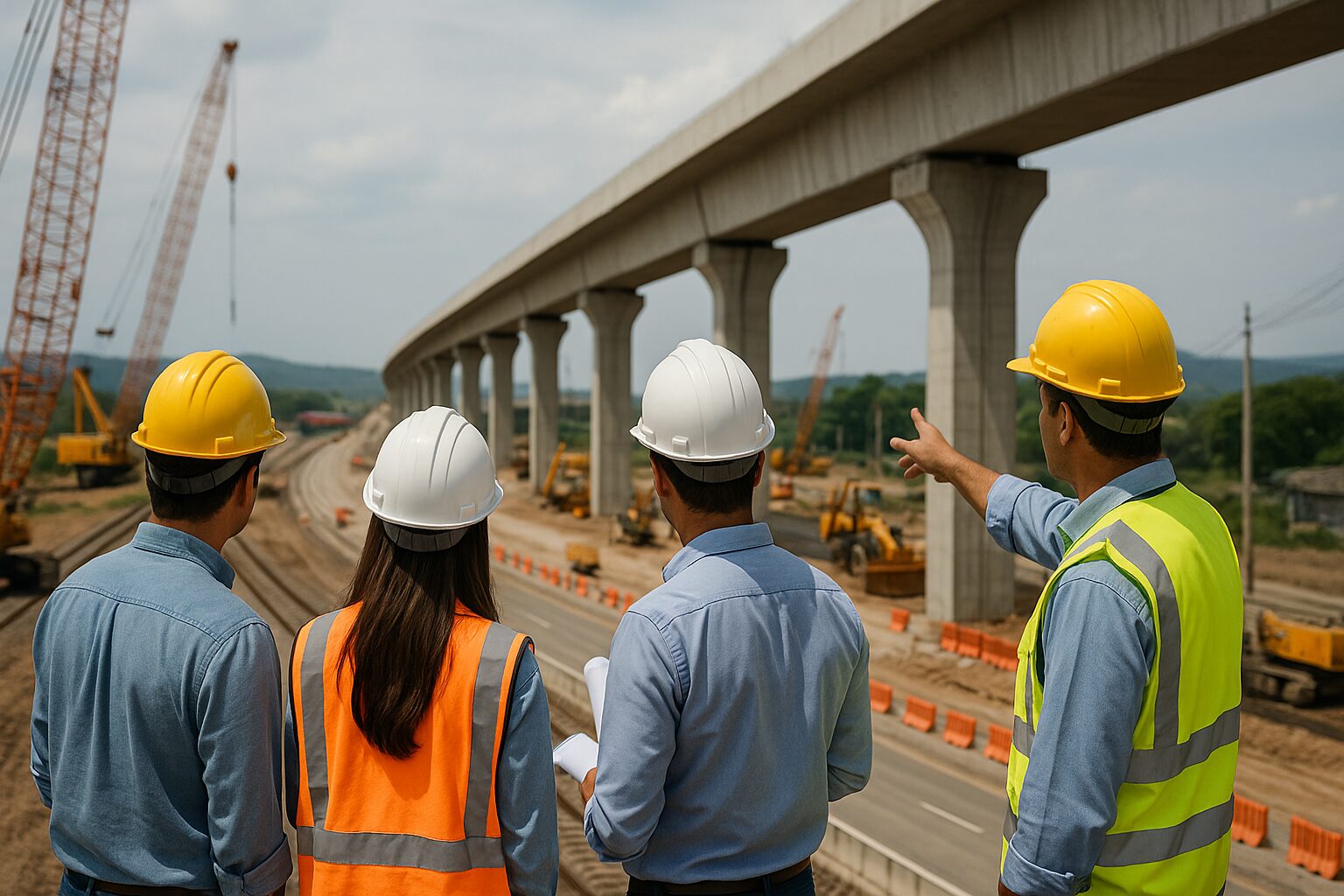
Understand Why Infrastructure Training Is the Path to Sustainable Development, with Qualified Professionals and Efficient Public Works at Any Time.
When we talk about a country’s development, few topics are as strategic as infrastructure training.
Roads, bridges, railways, basic sanitation, electricity, and communication networks form the backbone of a nation. However, having only the physical structures is not enough.
Human preparation and efficient management are essential to ensure that everything functions with quality and safety.
-
Employee Fired After Accumulating 114 Days of Medical Leave in One Year, Labor Court Upholds Company’s Decision

-
Employee Fired While Treating Depression Wins in Court and Vale Is Required to Rehire Him Following Decision Based on the CLT and INSS Benefits

-
Workers Should Be Aware! March 6 Will Be The Fifth Business Day Of March And The Final Deadline For Companies To Pay Salaries According To The CLT

-
2026 FGTS Anniversary Withdrawal Is Released According to Birth Month, Sets Amounts by Balance Range, Establishes Deadlines for March and April, and Changes Rules in Case of Dismissal


In this context, training comes as a continuous and essential process for sustainable growth.
Historically, infrastructure has always been linked to the evolution of civilizations.
For example, the Romans, over two thousand years ago, already realized the importance of investing in roads and aqueducts for the transport of troops, food, and drinking water.
According to the Roman historian Pliny the Elder, the Roman roads were built so well that some of them still exist today.
Over time, public works have become vital for urban planning and social organization.
In Brazil, investments in infrastructure intensified especially from the 20th century onwards, with rapid industrialization and urbanization.
During the government of Juscelino Kubitschek in the 1950s, Brazil experienced a period of great construction, with the inauguration of Brasília and the expansion of federal highways.
This movement represented a revolution in national infrastructure, but also highlighted the need for adequate training to ensure that the works were carried out efficiently.
Civil engineers, building technicians, electricians, heavy equipment operators, and many others began to play crucial roles in turning projects into reality.
However, the labor market in the sector still faces a significant challenge: the shortage of qualified professionals to meet the growing demand for quality infrastructure.
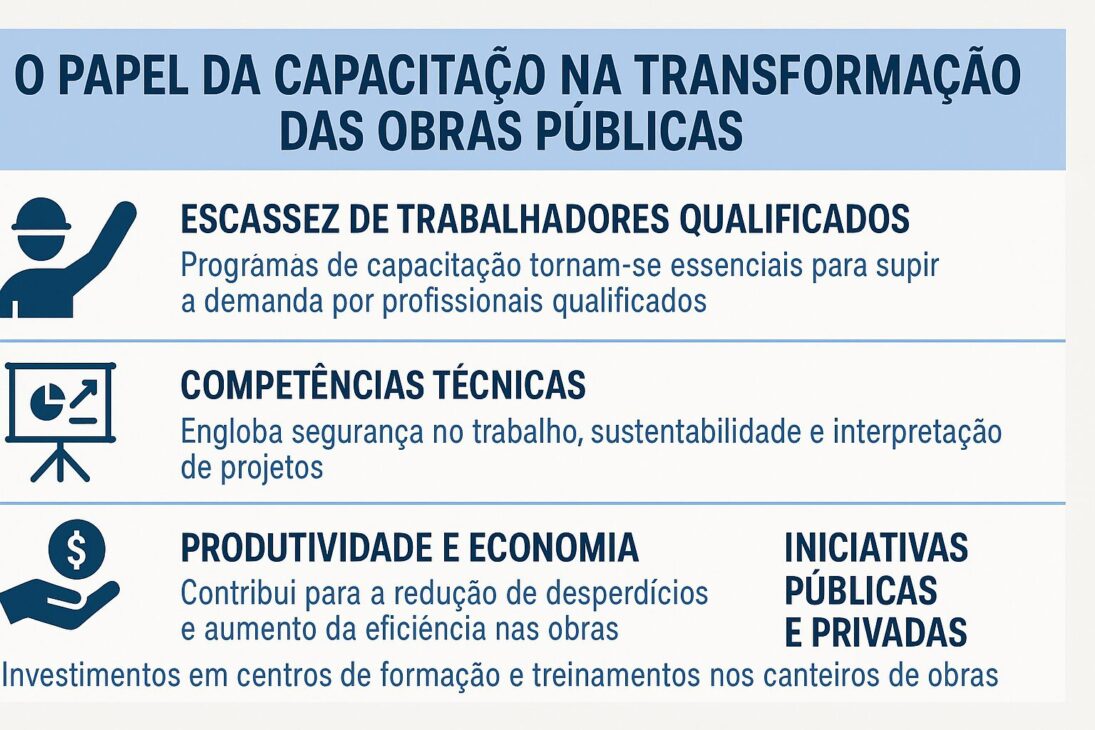
The Role of Training in the Transformation of Public Works
However, having only the available workforce does not solve all the problems.
One of the biggest challenges faced by both governments and private companies is the shortage of qualified workers.
This means that many positions remain unfilled, while few prepared professionals competently occupy these roles.
In this sense, programs for infrastructure training become essential to train individuals capable of handling the sector’s demands, from planning to execution and maintenance of the works.
According to the National Confederation of Industry (CNI), companies in the sector face a deficit of qualified professionals, which directly affects project progress.
Training is not just about teaching machines or applying technical standards. It involves a complete education that includes workplace safety, sustainability, reading and interpreting projects, resource management, and problem-solving.
Additionally, technical training contributes to waste reduction, accident prevention, and the increase in productivity of the teams involved in the works.
As a result, significant savings are generated, both in the execution of the works and in their maintenance over time.
In recent years, several initiatives, both public and private, have invested in professional training centers, qualification courses, and training conducted directly on construction sites.
These actions aim to align the development of technical competencies with the real needs of the infrastructure market.
According to the National Service for Industrial Learning (SENAI), since 2010, over 3 million Brazilians have been trained to work in sectors related to construction and infrastructure through technical education and improvement courses.
These programs have been fundamental for the improvement of quality in the workforce in Brazil, raising the standard of the works carried out and ensuring greater efficiency.
Training and the Impact of New Technologies in the Sector
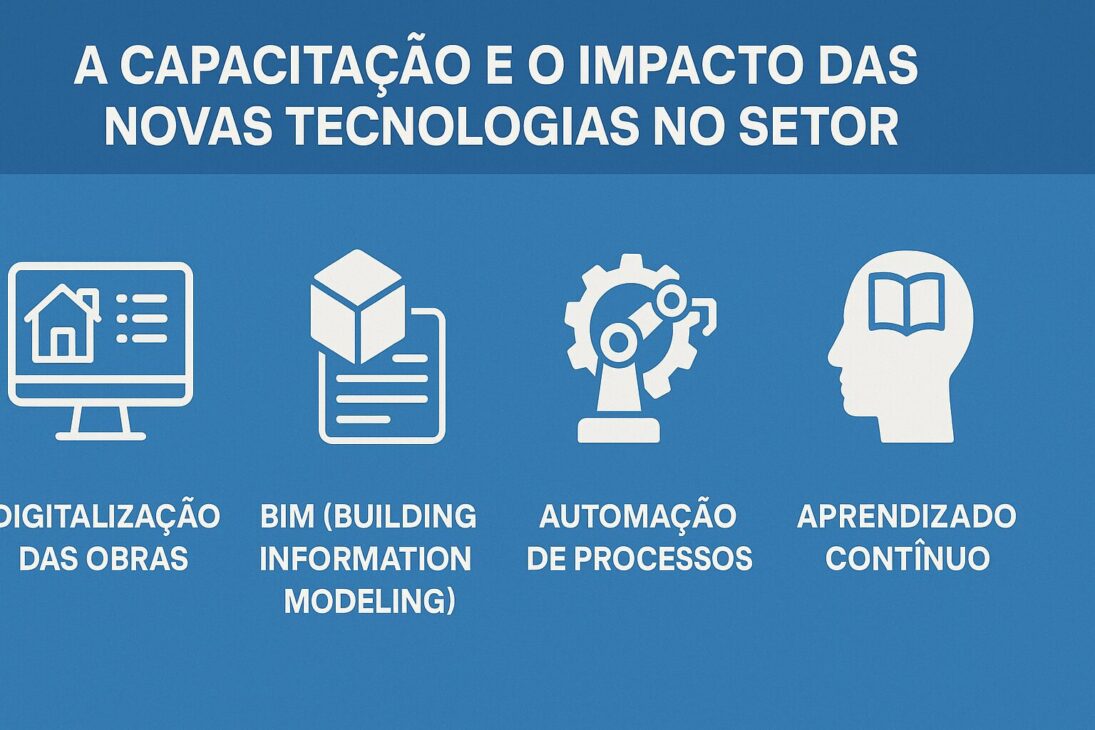
Moreover, it is crucial to highlight the modernization of technologies in the sector.
The digiitalization of works, the use of modeling software such as BIM (Building Information Modeling), and the automation of processes require more updated professionals. This reinforces the idea that infrastructure training should not be seen as a one-time event, but as a continuous process of learning and updating.
The use of innovative technologies optimizes project management, reducing errors and increasing the accuracy of timelines and budgets.
According to the Brazilian Association of Technical Standards (ABNT), the adoption of new technologies in the construction sector has expanded over the last 15 years, reflecting the need for specific training to handle advanced tools.
The COVID-19 pandemic also brought important reflections about infrastructure, especially concerning public health, basic sanitation, and digital connectivity.
According to the World Health Organization (WHO), in 2020, the pandemic exposed the fragility of many health infrastructures around the world.
It revealed the urgency of training professionals to respond quickly and effectively in times of crisis.
In many regions, there was a lack of trained workers to expand hospital networks, install wastewater systems, or guarantee the supply of clean water to vulnerable populations.
In this context, training proved to be a priority.
Investing in infrastructure training is, therefore, an important step to promote social inclusion.
Young people from peripheral communities or areas far from major urban centers find in technical training an opportunity to enter the job market with good growth prospects.
When the sector is strengthened, it generates direct and indirect jobs, boosting local commerce and improving the quality of life of the populations served by the works.
Training as the Foundation for the Progress of Any Country

In summary, infrastructure training is an essential pillar for the progress of any country.
It is not just about preparing people to work on construction sites, but about transforming lives, strengthening the economy, and improving collective well-being.
According to the Ministry of Infrastructure of Brazil, the continuous training of workers in the sector is a key element for the success of the large planned works for the coming years.
In 2023, the government announced an investment of R$ 10 billion for the construction of new roads and railways.
This highlights the need for a growing number of qualified professionals.
In an increasingly dynamic and interconnected world, investing in technical and human knowledge is not just a choice, but a necessity.
Thus, if we seek a future with organized cities, efficient mobility, universal access to water, clean energy, and safe constructions, we must start with the basics:
Training those who build all of this.
Knowledge is indeed the true foundation of any solid structure. And when it comes to infrastructure, this truth is even more literal.
The future of the sector depends on the formation of qualified professionals, committed to developing innovative and sustainable solutions, ensuring stable and long-term growth.










Seja o primeiro a reagir!