





 Português
  Inglês
  Espanhol
  5 min de leitura
  0 comentários



Discover Why Workforce Development Is Essential for Professional Success and How It Can Transform Your Journey at Any Stage of Life.
Throughout history, the relationship between training and the job market has always been fundamental for the development of societies.
From ancient civilizations, where trades were passed down from generation to generation, to today, where technology constantly changes professional demands, preparing oneself to carry out an activity with competence and up-to-date knowledge is an ongoing necessity.
Therefore, it is essential to understand the role of training in the job market.
-
Employee Fired After Accumulating 114 Days of Medical Leave in One Year, Labor Court Upholds Company’s Decision

-
Employee Fired While Treating Depression Wins in Court and Vale Is Required to Rehire Him Following Decision Based on the CLT and INSS Benefits

-
Workers Should Be Aware! March 6 Will Be The Fifth Business Day Of March And The Final Deadline For Companies To Pay Salaries According To The CLT

-
2026 FGTS Anniversary Withdrawal Is Released According to Birth Month, Sets Amounts by Balance Range, Establishes Deadlines for March and April, and Changes Rules in Case of Dismissal


In the past, professional qualification was, in many cases, limited to a few. Manual trades, such as carpentry, sewing, or agriculture, for example, were learned within the family or with master craftsmen. Moreover, there was not yet a structured training system as we know it today.
The Industrial Revolution, which began in the late 18th century, was a decisive landmark in this process.
With the emergence of factories, the need for specialized labor grew, along with the demand for a new type of training: technical training aimed at operating machines and handling more complex processes.
The Impact of the Industrial Revolution on Training
Thus, this context showed that practical knowledge needed to be complemented with more technical skills, leading to the establishment of vocational training schools.
Throughout the 20th century, formal education became increasingly relevant in shaping the workforce.
Consequently, with the expansion of industry and services, the demands of the job market diversified, making training an essential criterion for obtaining and maintaining a job.
According to the Ministry of Education (MEC), in 2022, technical and vocational education has gained ground in Brazil as a pathway to reduce youth unemployment and increase employability, given that technical training prepares individuals for the job market more quickly and effectively.
Technical Training Versus Behavioral Skills
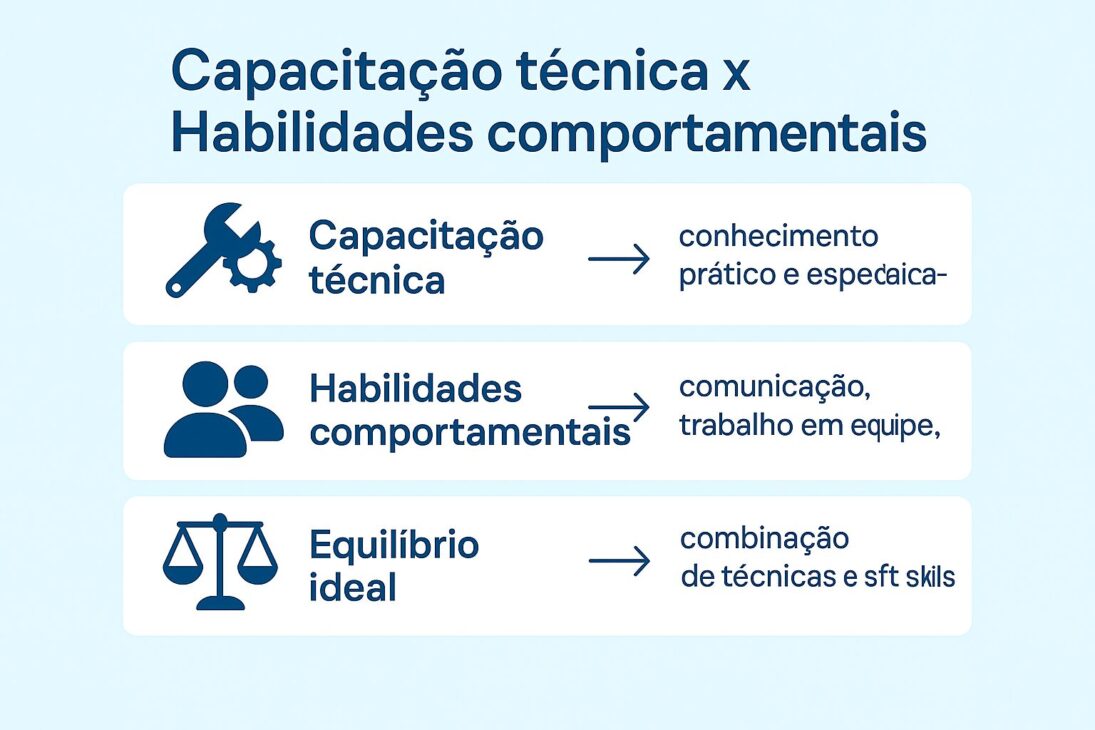
However, simply having a diploma is not enough. The professional landscape has changed significantly over the past few decades, especially with the advancement of the internet and automation.
Today, the market seeks professionals who can solve problems, work in teams, communicate clearly, and adapt quickly to changes. These are known as behavioral skills or soft skills, just as important as technical knowledge.
Moreover, globalization and digital transformation have created new professions and eliminated others. According to the Brazilian Institute of Geography and Statistics (IBGE), in 2021, Brazil saw a significant increase in professionals in the IT sector, driven by the digitalization of companies and the pandemic.
The new ways of working and the advancement of technology make the need for ongoing training even more urgent.
Another example is remote work, which has expanded hiring possibilities and increased competition among professionals from different regions. In this scenario, ongoing training has ceased to be a differentiator and become a basic requirement.
The Role of Ongoing Training in the Current Scenario
Therefore, it is important to remember that training is not restricted to those starting their careers. Even those who have been in the market for years need to seek new learning opportunities.
The idea of continuous education — also known as lifelong learning — emphasizes that knowledge must keep pace with social, economic, and technological transformations.
According to the federal government, in 2022, more than 60% of Brazilians participating in training courses were seeking updates to improve their position in the market or to get reemployed after the pandemic.
Thus, a professional who does not keep up risks becoming obsolete, regardless of their previous experience.
Furthermore, training also contributes to personal growth. By acquiring new knowledge, we broaden our worldview, increase our self-confidence, and feel more prepared to face challenges.
This, in turn, directly impacts self-esteem and well-being, reflecting how we interact with colleagues, bosses, and clients.
In Brazil, in recent years, there has been much discussion about the importance of professional qualification, especially among youth and informal workers.
As a result, the high unemployment rate and the growth of self-employment have generated a greater need for accessible training programs.
According to the National Confederation of Trade (CNC), in 2023, qualification initiatives, such as free courses, have been an important strategy to try to reduce educational inequality in the country.
Challenges and Opportunities for Training in Brazil
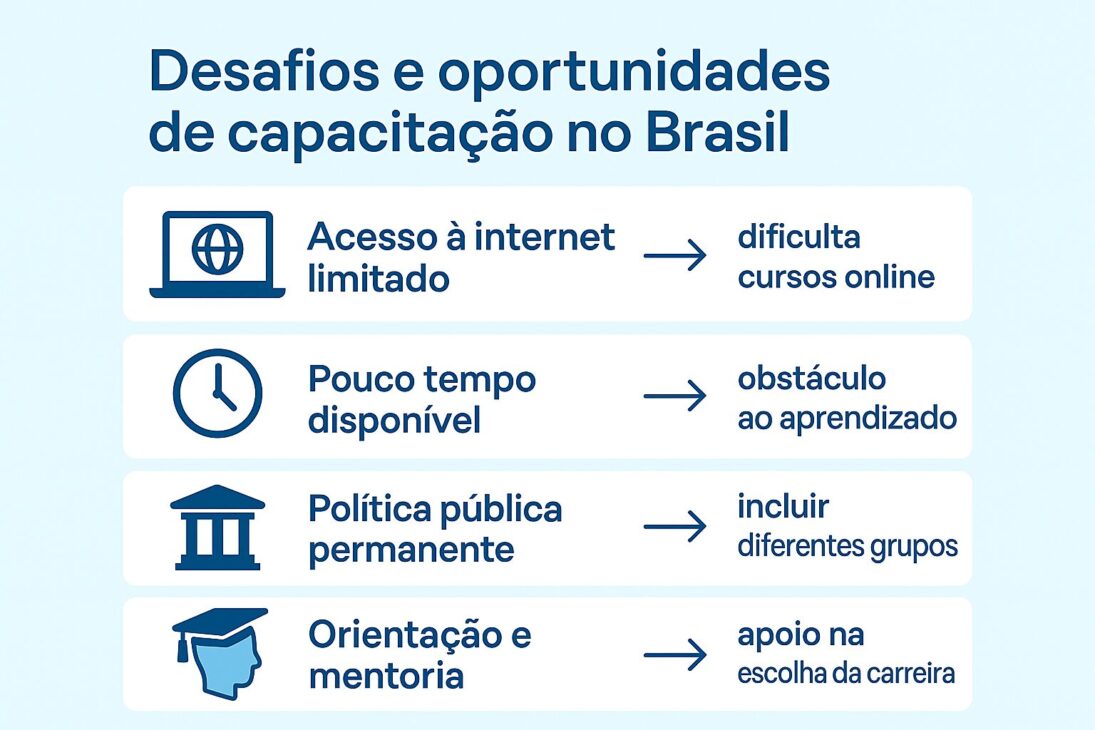
Still, the popularization of online courses has also facilitated this process.
Distance learning platforms today offer a vast variety of accessible content anytime and anywhere. This allows workers to learn at their own pace, balancing professional routines with studies.
However, inequality in internet access and available study time remain significant challenges.
According to the Committee for Internet Management in Brazil (CGI.br), in 2021, over 30% of the Brazilian population still did not have regular internet access, making it difficult to participate in online courses and digital training programs.
Therefore, training needs to be considered as a permanent public policy that takes into account the realities of different social and regional groups.
Additionally, another important point is career guidance. Many young people enter the job market without knowing exactly what they want or which areas they are most suited for.
The lack of guidance can lead to frustration and early abandonment of opportunities. In this sense, the support of teachers, mentors, and career incentive programs can make all the difference.
The Importance of Self-Awareness in Training
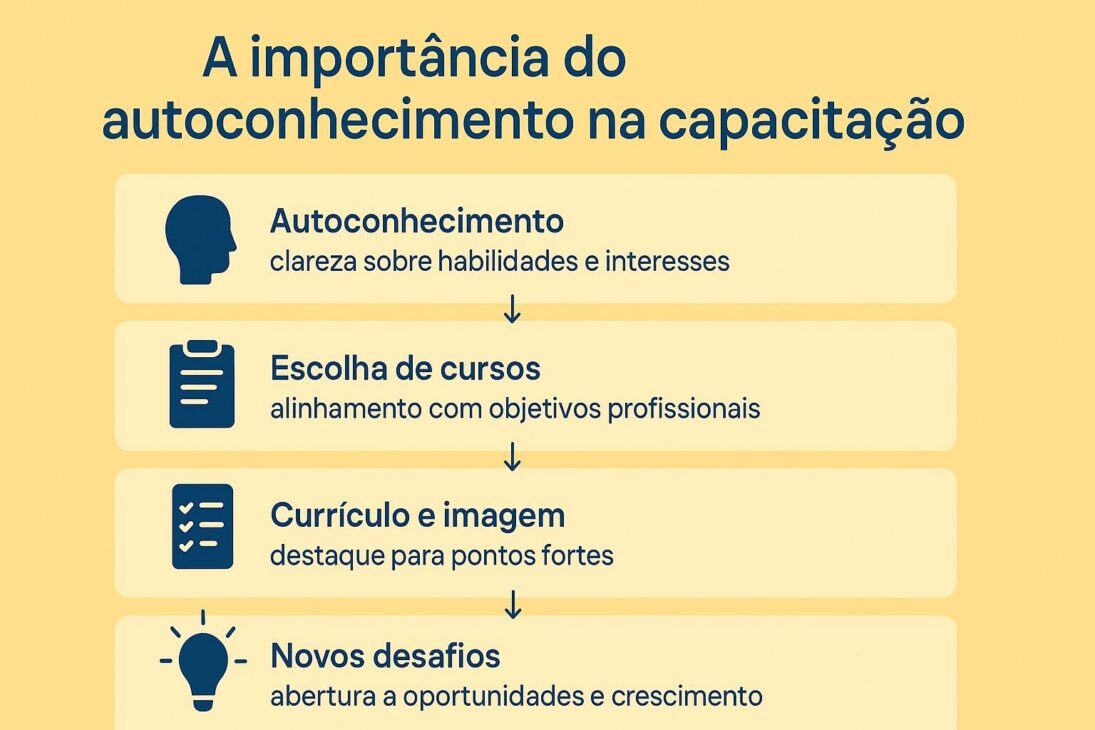
For those starting out or seeking reemployment, it is essential to have clarity about which skills are most valued at the moment.
Self-awareness is a fundamental step. Knowing what you are good at, what you enjoy doing, and which areas you want to explore helps in choosing courses and paths more effectively.
Furthermore, it is also important to create a good resume, manage your professional image on social media, and be open to new challenges, even if they initially take you out of your comfort zone.
Training in the job market is, therefore, a dynamic process that follows the evolution of society.
It does not just consist, as we can see, of attending a classroom, but involves a willingness to learn, curiosity, resilience, and ongoing effort.
In this way, the professional of the future — and already of the present — is one who understands that there is always something new to be learned, regardless of age or position.
According to the International Labour Organization (ILO) report, 2023, ongoing training has become one of the biggest global trends as the market requires rapid adaptation to technological and social changes.
In summary, training is the bridge between the individual and opportunities. Only through it can a solid path be built, based on knowledge, experience, and adaptability.
In a constantly changing world, the greatest investment anyone can make is in themselves.











Seja o primeiro a reagir!