





 Portuguese
  English
  Spanish
  3 min of reading
  0 comments


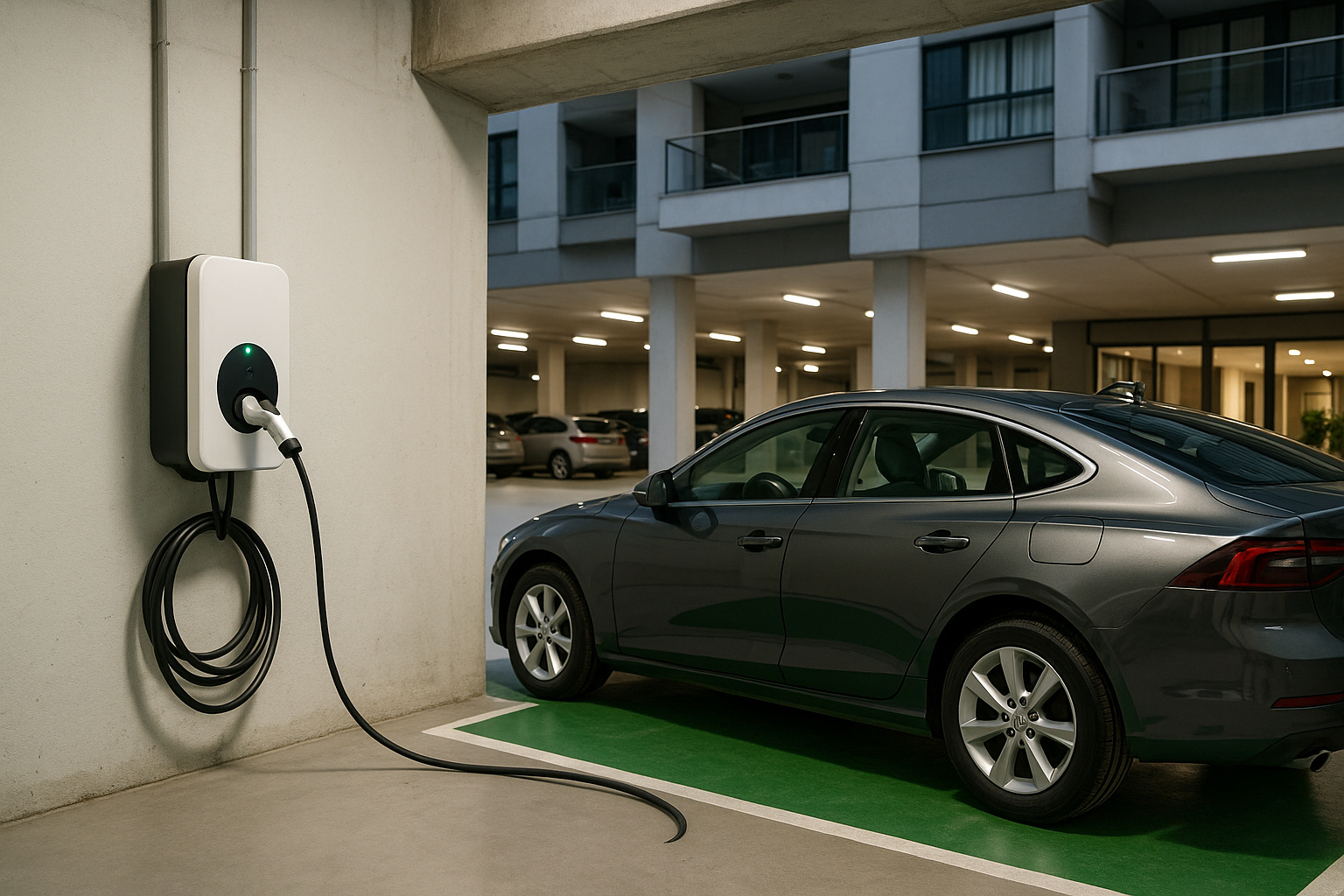
A Direct Analysis of Rights, Duties, Costs, and Technical Standards Regulating the Charging of Electric Vehicles in Condominiums
The charging of electric cars in condominiums, according to lawyers and specialists, requires planning, safety, technical compliance, and defined procedures.
This is because, as determined by ABNT standards (NBR 5410 and NBR 17019), the installation must follow specific standards to avoid risks.
This topic, therefore, brings recurring doubts since 2020, when São Paulo approved pioneering rules.
Applicable Technical Standards and Legal Rules
The discussion gained momentum in 2024 because, despite the expansion of electric vehicles, there is no specific federal law.
Thus, according to Daniela Poli Vlavianos from Arman Advocacia, the civil code, in art. 1.336, iv, indicates that residents can install chargers.
This installation must respect safety, electrical capacity, technical standards, and internal authorizations.
Additionally, as the lawyer states, any structural change in common areas requires the approval of the condominium.
Installations in private parking spaces may occur as long as they do not harm the community.
It is noted that São Paulo has had a municipal law since 2020 mandating new buildings to provide charging infrastructure.
Subsequently, in 2022, state law 17.573 authorized installation without a general assembly.
This authorization depends on compliance with safety requirements.
Finally, bill 158/2025 is under consideration in 2025, aiming to ensure minimal structure for residents.
As lawyer Marcos Poliszezuk highlights, such installations must follow standards of the CNCGBM (General Commanders of Fire Departments).
These standards unify safety rules for chargers.
Rights, Duties, and Mandatory Procedures
The installation, although permitted, requires a balance between individual rights and collective safety.
The building manager, as Daniela explains, can require electrical studies, reports, ART (Technical Responsibility Annotation), and certified equipment.
They can also require an individual meter.
At the same time, the condominium must preserve the integrity of the building.
This includes checking network capacity, approving compatible projects, and notifying the insurer of changes.
The installation alters the fire risk.
If not communicated, the absence of notification may compromise coverage.
Furthermore, installing chargers without authorization or outside the rules may result in civil liability.
The resident is responsible for damages to the condominium or third parties.
-
China Surprises Automotive Industry With Battery That Promises Electric Car Able to Run Up to 1,000 km Without Recharge
-
Why BYD Grew So Fast in Brazil and How Blade Batteries, Electric Cars, and Industrial Incentives Shaped This Expansion in the National Automotive Sector

-
Electric Cars Make Progress in Brazil in 2026 and Promise to Reduce Drivers’ Costs with Cheaper Energy, While Infrastructure Grows Slowly Across the Country

-
This Helix Electric Motor Weighs Only 33 Kg and Turns the McMurtry Spéirling Into a Compact 1,000 Hp Missile That Takes Just 1.5 Seconds to Reach 100 Km/H


Who Pays: Charging and Cost Sharing Methods
The payment, as specialists highlight, follows a simple rule: those who use pay.
Thus, according to Daniela Vlavianos, there are three models:
• Individual metering, allowing the exact consumption to be charged.
• Estimated calculation, based on power and usage time.
• Shared stations, with cost-sharing approved in assembly.
Therefore, when the initiative comes from the resident, they bear the expenses.
However, if the condominium installs common infrastructure, the cost must be approved according to rules for useful or necessary works.
Additionally, as Marcos Poliszezuk warns, chargers cannot be connected to the common network.
This measure prevents undue charges to other residents.
Insurance, Penalties, and Best Practices
The installation requires mandatory communication to the insurer.
This is because the inclusion of chargers alters structural risk.
Consequently, communication failures may harm coverage.
Additionally, violations may result in internal fines, according to regulations.
Therefore, lawyers recommend ongoing dialogue, clear rules, and uniform internal procedures.
These measures apply to requests for installation and technical verification.
Thus, as Daniela concludes, adaptation occurs safely.
It also occurs transparently and fairly.










-

Uma pessoa reagiu a isso.