





 Portuguese
  English
  Spanish
  5 min of reading
  0 comments


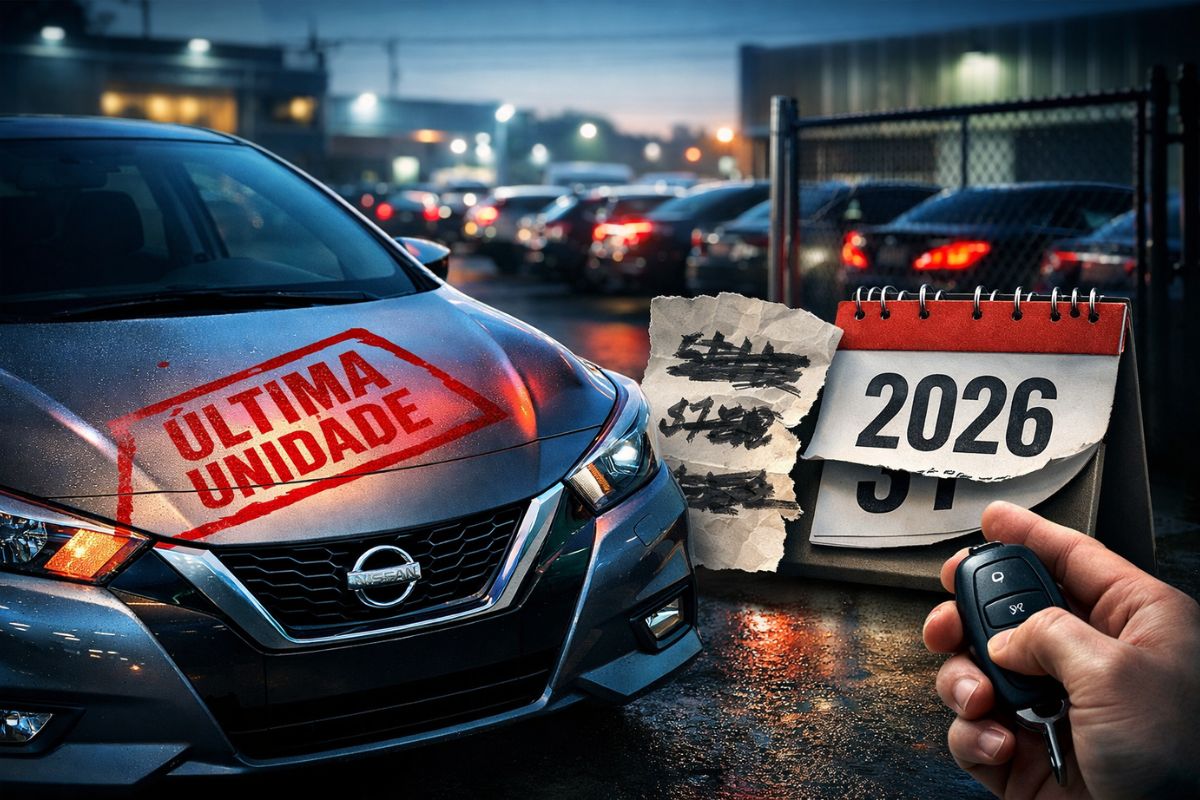
Nissan Confirms End of Versa, Former Cheapest New Car in the U.S., Amid Accessibility Crisis with Average Price Above US$ 50,000 and Financing Debt Hitting US$ 1.66 Trillion, 20 Percent Higher Than in 2020 for Families
Amid a historic automotive accessibility crisis in the United States, Nissan has confirmed the end of Versa production for the American market, discreetly concluding the cycle of the cheapest new car available in the country. With the sedan’s exit, the last brand-new vehicle with a starting price below $20,000 disappears, precisely as the entry point to a first vehicle closes for millions of low-income consumers.
The announcement comes at a time when the average price of a new car has already surpassed $50,000 and the stock of financing hits $1.66 trillion, up about 20 percent from 2020, even exceeding federal student loan debt and credit card balances. As the cheapest new car disappears from the catalog, the dream of a first automobile shifts to longer installments, higher interest rates, and increasingly expensive SUVs, in a growing environment of default and vehicle repossession.
What the Death of the Cheapest New Car Reveals About the American Market

The end of the Versa is not an isolated case, but a symbol of a structural reconfiguration.
-
OMODA & JAECOO grows in Europe in 2026 with an integrated strategy of sales, innovation, local production, and technological advancement in the United Kingdom, Italy, and Spain.

-
OMODA & JAECOO expands after-sales service in Brazil with competitive maintenance, a 7-year warranty, and high availability of parts for technological SUVs.

-
OMODA & JAECOO appoints Alessandra Souza as executive marketing director in Brazil and accelerates brand expansion with a focus on innovation, networking, and hybrid portfolio.

-
Jaecoo 7 with super hybrid SHS system exceeds 1,200 km of combined range with a 1.5 turbo engine, high-density battery, and intelligent energy management.

The cheapest new car ceases to exist in a market where the average consumer finds themselves pressured by three simultaneous forces: record vehicle prices, high credit costs, and manufacturers’ preference for higher-margin models like SUVs and pickups.
Nissan’s decision comes precisely as analysts describe a true accessibility crisis in the sector.
Affordable new vehicles are already rare, and the list of models with entry prices below $30,000 has been shrinking year after year, as manufacturers remove compact sedans and hatchbacks from their lineups to make room for larger, better-equipped, and more profitable SUVs.
Why Nissan Decided to End the Versa
The Versa was Nissan’s smallest sedan in the United States, a kind of last entry-level step for those seeking a cheapest new car without compromising on warranty and minimal equipment.
The model came with a small four-cylinder engine, with performance considered modest in tests, taking more than nine seconds to accelerate from zero to 60 miles per hour on highways.
Inside, it offered exactly what one expects from an access car: fabric seats, simple trim, and a seven-inch multimedia center with wireless mirroring for Apple CarPlay and Android Auto, without unnecessary luxuries.
This simplicity, which once was a commercial advantage, ceased to generate enough customer flow to dealerships.
The numbers tell this turnaround. Versa sales in the United States peaked in 2016 when more than 16,000 units sold per month. By 2025, the average had dropped to about 4,600 cars per month.
For Nissan, maintaining a low-margin product with waning demand became difficult to justify in an environment where compact SUVs and mid-size sedans deliver more return per vehicle sold.
Expensive SUVs, $1.66 Trillion Debt, and the End of the Entry Point
As the cheapest new car leaves the stage, the credit picture deteriorates.
The total of auto loans reaches $1.66 trillion, exceeding federal student loan debt and credit card debt.
At the same time, market data indicates an increase in delinquencies, defaults, and vehicle repossessions due to non-payment, signaling that the costs are weighing heavier than expected on family budgets.
Paradoxically, even with this scenario, consumers continue to opt for more expensive SUVs and trucks, often chosen for space, status, or perceived safety.
The combination of long installments, high interest rates, and high-value vehicles means that the first brand-new car for many is also the largest debt of their lives, without the alternative of a truly cheap model to reduce risk.
The end of the Versa merely crystallizes this trend.
What’s Left in Place of the Cheapest New Car
With the discontinuation of the Versa, Nissan itself now positions the Sentra and the compact SUV Kicks as its most affordable alternatives.
The starting prices, however, rise to another level.
The Sentra takes the spot of the brand’s lowest-priced sedan, with a base price around $24,000, while the Kicks starts at approximately $23,000, both well above the range previously occupied by the former cheapest new car.
In the rest of the market, the scenario is not much different. Among the few models below $25,000 are the Kia K4 sedan, the Hyundai Venue SUV, and the Chevy Trax SUV, in addition to the two mentioned Nissans.
Recent surveys indicate that, by 2025, only 27 vehicles offered an entry price below $30,000 in the United States, a number reinforcing the disappearance of the classic access segment.
At the same time, low-cost rivals are being removed. Mitsubishi had already discontinued the Mirage at the end of 2024.
Ford ended the Focus in 2018 and the Fusion in 2020, keeping only the Mustang in a lineup dominated by SUVs and trucks. Chevrolet and Subaru also cleaned up their ranges, ending models like Malibu, Camaro, and Legacy.
The result is a mosaic in which truly cheap cars have become a statistical exception.
Impacts for Low-Income Families and the Future of the First Car
The death of the cheapest new car has a direct effect on low-income consumers, workers newly entering the market, and young people who rely on cars to access jobs, education, and basic services in areas with poor public transport.
Without an affordable option with a factory warranty, many become dependent on older used cars, with unpredictable maintenance costs, or are pushed into high-value financing, with a real risk of overindebtedness.
Consumer experts in the United States are already warning that the combination of more expensive vehicles, extended credit, and stagnant income creates a social funnel, in which a growing portion of the population is simply excluded from the formal market for brand-new cars.
Instead of expanding mobility, the automotive industry risks reinforcing inequalities, especially when the disappearance of the cheapest new car coincides with record debts and a lack of efficient public transportation options.
A Silent Warning for Other Markets
Although Nissan’s decision focuses on the American market, the move sheds light on a global trend.
As manufacturers prioritize more profitable SUVs, the space for entry-level vehicles shrinks, and the discussion around accessible mobility begins to depend on public policies, incentives, and new business models like subscriptions, sharing, and corporate fleets.
For developing countries, the case of the Versa serves as a warning.
If the logic of removing the cheapest new car from the portfolio spreads, the first impact will fall precisely on workers who most need a car for economic survival.
The question remains not just which model will be next to be discontinued, but who will be left out of the driver’s seat when the industry decides it is no longer worth it to sell truly cheap cars.
The end of the Versa as the cheapest new car in the United States, amid record debts and increasingly expensive SUVs, marks a turning point or just another predictable chapter in a market that has completely abandoned the popular car; in your opinion, what should be done to ensure that the first vehicle is affordable for low-income families?










-

-

2 pessoas reagiram a isso.