





 Português
  Inglês
  Espanhol
  4 min de leitura
  1 comentário


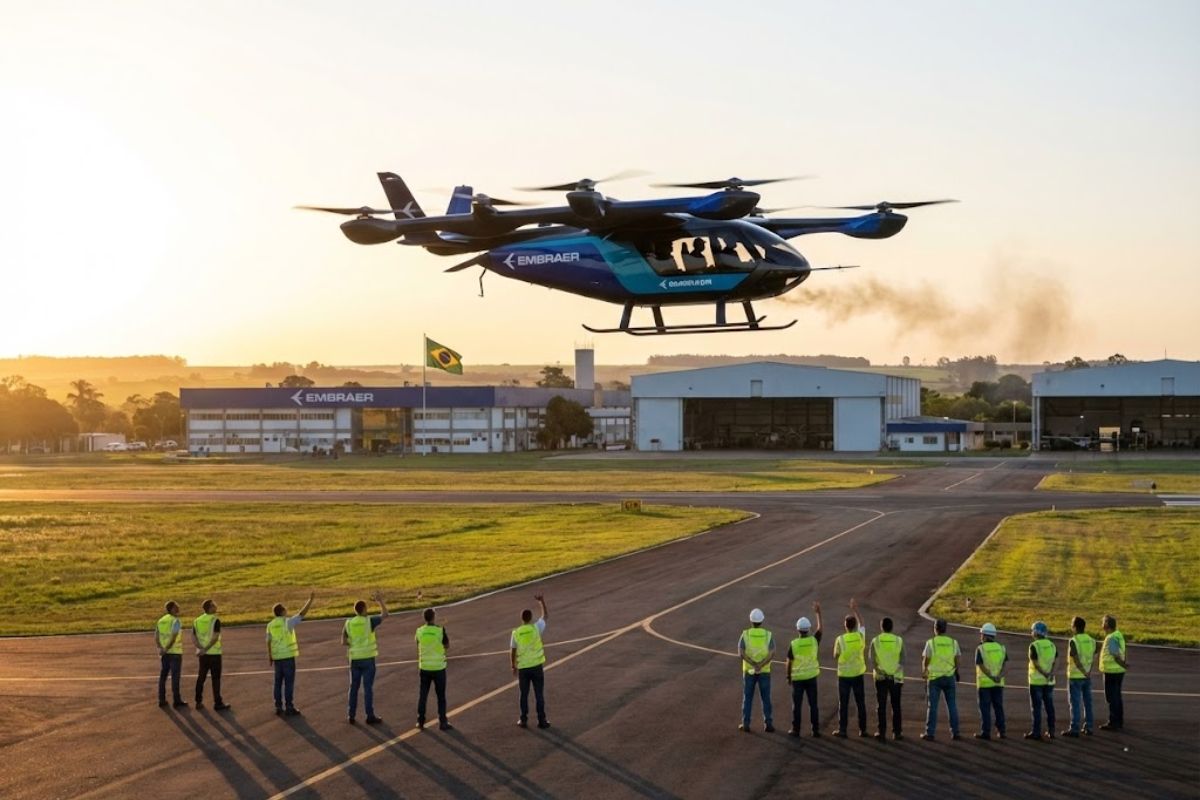


Produced In Taubaté, Embraer’s Flying Car Makes Its First Flight On December 19, 2025, In Gavião Peixoto, Enters The Flight Testing Phase, Promises To Operate 100 Kilometers And Aims For Commercial Urban Transportation In 2027, With Electric eVTOLs For Five People And Annual Manufacturing At Scale
On the morning of December 19, 2025, Embraer’s flying car made its first flight on the largest aviation runway in the Southern Hemisphere, located at the company’s plant in Gavião Peixoto, in the interior of São Paulo. The inaugural flight was conducted by Eve Air Mobility, a subsidiary of Embraer responsible for the development of the eVTOL, and marked the flying debut of the prototype produced in the São Paulo interior.
With this flight on Friday, the prototype officially enters the flight testing phase that precedes certification by the National Civil Aviation Agency, an indispensable condition for the new urban air mobility system to operate commercially. The company’s expectation is to start operations in 2027, aligning the certification and delivery schedule of the first eVTOLs to the market.
First Flight In Gavião Peixoto Marks The Beginning Of The Testing Campaign

According to Eve, the inaugural flight of Embraer’s flying car served to verify the integration of the eight electric propellers, evaluate energy management, and observe the noise level emitted by the prototype.
-
A bright yellow mushroom imported from Asia escaped from a cultivation farm in the United States in 2010 and is now aggressively spreading across 25 states, destroying entire communities of native fungi in American forests.

-
Buried under China, a colossal machine weighing 20,000 tons began operating as the largest neutrino detector on the planet and, in just 59 days, surpassed results that science took half a century to achieve.

-
Iran enters the center of a climate alert after the war emitted 5.6 million tons of CO2 in two weeks, surpassing the annual pollution of entire countries.

-
Lunar exploration may change after a Chinese probe finds a “cavity” of radiation that reduces the impact on astronauts by up to 20% at certain times on the Moon.


According to the company, the vehicle behaved as expected within the monitored parameters, reinforcing the plan to advance to a more extensive flight testing campaign.
The operation took place in the early morning, utilizing the infrastructure of the Gavião Peixoto plant, which houses the largest aviation runway in the Southern Hemisphere.
From this base, Eve intends to conduct several additional flights, starting from the inaugural hovering flight to progressively more complex flight profiles throughout 2026, until reaching complete routes that simulate real urban operation conditions.
Before transporting passengers on commercial routes, Embraer’s flying car and its future counterparts will need to obtain certification from Anac.
This process includes performance analysis, safety, reliability of systems, and adherence to specific regulations for electric vertical takeoff and landing vehicles.
eVTOL Prototype Produced In Taubaté Focused On Urban Mobility


Popularly referred to as flying cars, eVTOLs are electric vertical takeoff and landing vehicles developed for short trips in urban environments.
In the case of Embraer’s flying car, production occurs in Taubaté, in the interior of São Paulo, in a plant with the installed capacity to manufacture up to 480 units per year, which indicates a strategy focused on industrial scale.
The model has a capacity for five people, comprising four passengers and one pilot, and a range of 100 kilometers, positioning it for quick connections between neighborhoods, nearby cities, commercial centers, and service hubs.
The proposal is to reduce travel time in congested metropolitan areas, offering a short-distance air modal integrated with ground transportation.
Eve plans to build six prototypes for the flight testing phase, employing these models in different validation campaigns.
The intent is to accumulate data in multiple operational scenarios to support the technical dossier that will be presented to Anac and other international regulatory authorities.
Capacity, Orders, And Operation Horizon In 2027
The industrial plan disclosed by the company involves not only the certification of Embraer’s flying car but also the preparation of the production chain to meet already contracted demand.
Currently, there are about 3,000 units ordered of the eVTOL, a volume indicating a diverse initial market among regional airlines, urban mobility companies, and potential logistics partners.
Eve expects to begin deliveries of the eVTOLs in 2027, the same year it plans to start the commercial operation of Embraer’s flying car on routes specifically configured for the aircraft’s range and capacity profile.
The synchronization between certification, production in Taubaté, and service entry is considered central to enabling the business model of urban electric air mobility.
Global Fleet, Passengers, And Revenue Projections Until 2045
In long-term projections, the company estimates that the global eVTOL fleet could reach 30,000 units by 2045, considering the gradual expansion of this modal in large urban centers around the world.
The outlook disclosed by Eve indicates that over 3 billion passengers may be transported during this period, totaling regular operations across different continents.
Financially, the company projects that the operation and sale of eVTOLs, including Embraer’s flying car, could generate revenue of approximately 280 billion dollars by 2045.
These numbers combine the direct sale of aircraft, service contracts, maintenance, and potential business models based on mobility as a service, depending on the regulatory framework of each country.
Financing Development And Preparation For Certification
In early December 2025, Eve received a 200 million reais loan from BNDES aimed at supporting the integration phase of the electric motors and testing of the prototype in the eVTOL certification stage.
The funds are used to consolidate propulsion systems, expand testing infrastructure, and prepare the vehicle for the formal certification campaign with Anac.
This financing reinforces the critical phase in which Embraer’s flying car finds itself, combining flight testing, integration engineering, and regulatory requirements.
The technical performance of the prototype, combined with the robustness of the validation campaign, will be decisive to transform the flying car concept into a regular electric urban transport service starting in 2027.
With the first flight concluded, production concentrated in Taubaté, and an expanding testing schedule, Embraer’s flying car is approaching the moment when it will transition from being merely a prototype to actually integrating the urban mobility system. In your assessment, should Embraer’s flying car be a priority in future urban transportation routes, or is it still too early to trust eVTOLs in the daily lives of cities?







Carro com cara de avião!