





 Portuguese
  English
  Spanish
  6 min of reading
  0 comments


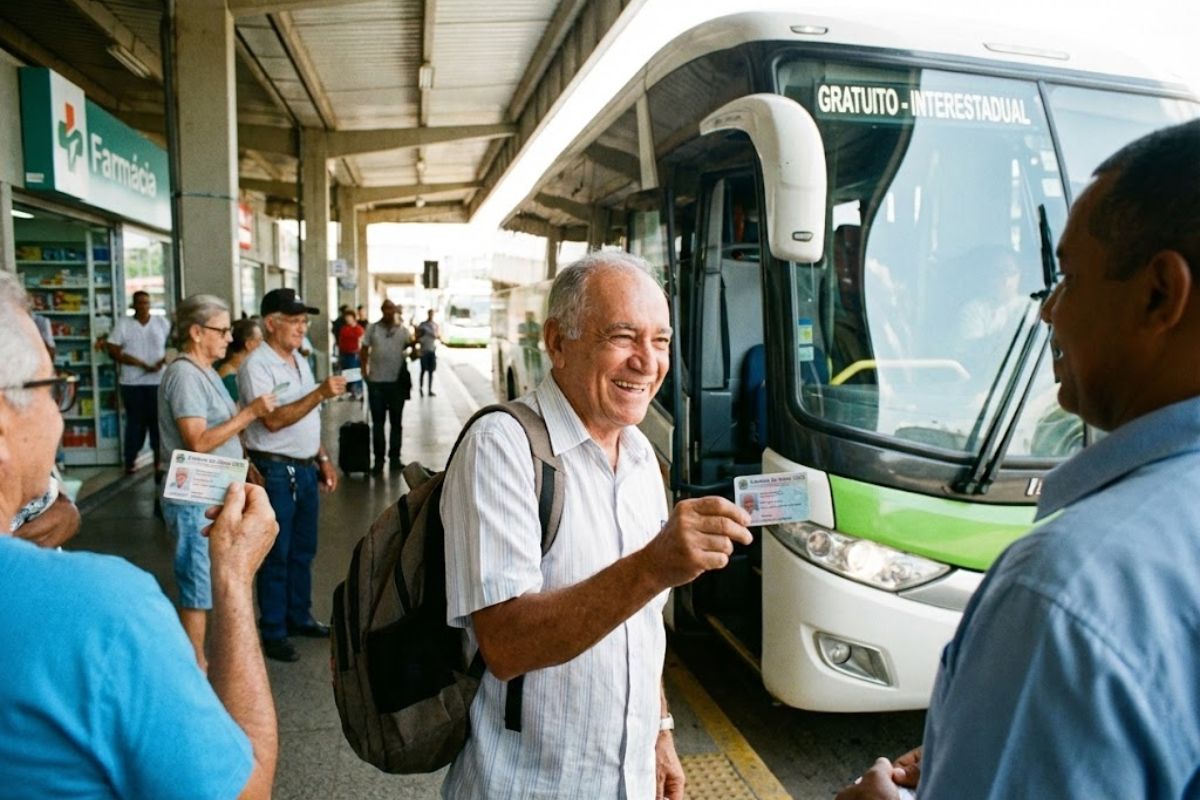
In 2025, the Elderly Card 2025 establishes itself as a document to secure free or discounted interstate travel, simplify access to social benefits and strengthen the autonomy of those who are 60 years or older with limited income, as long as they are registered and updated in the CadÚnico of their municipality.
The Elderly Card 2025 is treated by the federal government as a key to mobility and social protection in a rapidly aging country where the income of millions of elderly families is pressured by the cost of living. By organizing age, income, and registration in the CadÚnico into a single document, the benefit reduces bureaucracies and shortens the path to service counters.
In practice, the document facilitates the reservation of free or discounted seats on interstate trips, strengthens priority in public services, and connects elderly individuals to the local social assistance network. For those living on a tight budget, each free interstate ticket or 50 percent discount represents direct money back to the monthly budget.
What Is the Elderly Card 2025 and Who Is Eligible
The Elderly Card 2025 is an official document intended for people aged 60 or older, registered in the CadÚnico, and with a per capita family income of up to two minimum wages.
-
Unemployment rises again to 5.8% at the beginning of 2026, raising alarms about the end of temporary positions and its impact on the Brazilian job market.

-
Document organization can cut invisible costs in small businesses, a simple step that prevents waste, rework, and losses in daily operations.

-
Chinese giant worth nearly R$ 4 billion that manufactures cables for electric cars, solar energy, and robotics wants to open a factory in SC.

-
Many employers do not know, but the law guarantees domestic workers a 25% increase in salary during trips, 50% for overtime, 20% for night shifts, and 17 additional benefits that can lead to labor lawsuits if not paid.


It serves as standardized proof of socioeconomic profile to access benefits provided by law, particularly for interstate passenger transport.
The document does not create a new right, but organizes and operationalizes rights already guaranteed in the Statute of the Elderly and in complementary laws, allowing the elderly to prove, anywhere in the country, that they meet the rules for free or discounted services.
In many municipalities, the Elderly Card 2025 is also used as a reference in local services, facilitating screening, assistance, and referral to other programs.
In most cities, the CRAS is the entry point for those not yet registered in the CadÚnico or who need to update their information.
Without an active registration and within the income limit, the document is not issued, reinforcing the requirement to keep family information always up to date.
How to Apply for the Elderly Card 2025 at the CRAS
For those who prefer in-person service, the classic route to obtain the Elderly Card 2025 remains through the CRAS or another authorized post by the municipal social assistance.
The first step is always to check if the CadÚnico is active and updated, as the system will automatically cross-check age, income, and family composition information.
The basic step-by-step process follows a unique logic throughout the country:
Check if there is an active registration in the CadÚnico and if the data has been updated in recent years.
If absent or outdated, go to the CRAS with ID, CPF, proof of residence, and income information of the family.
Confirm with the technical team whether the per capita income fits within the limit required for the Elderly Card 2025.
Formally request the issuance of the document, either in person or through the electronic system provided by the municipality.
Wait for the release of the card, which can be accessed in digital or printed form, depending on local structure.
In many cases, the CRAS itself prints the card on paper for those who do not have regular access to the internet or are not familiar with using a smartphone or computer.
The idea is that technology helps, but does not exclude those who need the benefit the most.
Digital Issuance of the Elderly Card 2025 by gov.br
The digital version of the Elderly Card 2025 is gaining traction in 2025 with the advancement of online public services.
For elderly individuals who have the support of family members or already use gov.br, the process can be completed entirely online, avoiding unnecessary trips to the CRAS just to issue the document.
The basic flow through the digital platform follows standardized steps:
Access the gov.br portal and log in with the CPF and password of the holder or an authorized family member.
Check if the CadÚnico appears as active and with updated information.
Locate the specific service related to the Elderly Card or the interstate transport benefit for elderly persons.
Confirm the personal and family data displayed by the system, avoiding discrepancies with the registration maintained by the municipality.
Request the issuance of the digital card, saving the file in PDF or printing the document for physical use when required by transportation companies.
The digital card does not eliminate the validity of the printed version, and many elderly individuals continue to use both forms in parallel, depending on the situation.
Buses, trains, and interstate vessels may accept both the file on a smartphone and the printed proof, as long as the data is legible and meets the official standard.
What Benefits Does the Elderly Card 2025 Ensure in Practice
The most well-known benefit of the Elderly Card 2025 is linked to interstate public transport, where the document enables free slots and, in specific situations, minimum discounts of 50 percent on the fare.
The rule applies to buses, trains, and vessels that operate between states, respecting income verification and reservation deadlines.
Among the most important practical effects of the document are:
Reservation of free seats on interstate trips, limited to specific slots per vehicle.
Minimum 50 percent discount on the fare when all free seats have already been occupied, maintaining the right to a reduced fare.
Facilitation of age and income verification with public agencies, transport companies, and social services.
Support for the application of priority service, when linked to municipal and federal regulations regarding preferential service for the elderly.
In some municipalities, use of the card as an auxiliary criterion in programs for access to cultural, sports, and community living initiatives.
In practice, the card reduces disputes at the time of ticket purchase, standardizes the documentation required by companies, and provides more legal security for both the passenger and the service operator.
With the document in hand, the elderly have a technical and formal argument to demand compliance with the legislation.
The Role of the Elderly Card 2025 in Inclusion and Autonomy for the Elderly
The impact of the Elderly Card 2025 goes beyond immediate savings on tickets.
By facilitating travel between cities and states, the document helps maintain family ties, follow health treatments, and participate in religious, cultural, and community activities.
This reduces social isolation, one of the main risks among elderly individuals in vulnerable situations.
At the same time, the card integrates into the Unified Social Assistance System, as its issuance depends on updating the CadÚnico and contact with the CRAS.
This process allows social assistance teams to identify demands, monitor living conditions, and guide families on other programs, such as emergency benefits, coexistence services, or specific support for those aging with low income.
In a country that is rapidly aging and still facing deep inequalities, the Elderly Card 2025 serves as a public policy instrument that connects social protection, mobility, and the exercise of citizenship.
The document does not independently solve income or access to services issues, but makes the possibility of the elderly moving around more concrete, claiming rights and maintaining a less dependent routine.
Have you or someone in your family ever tried to apply for the Elderly Card 2025 at the CRAS or via gov.br, and what was the experience of using the document for interstate travel?










-

-

-

-

-

14 pessoas reagiram a isso.