





 Portuguese
  English
  Spanish
  9 min of reading
  0 comments


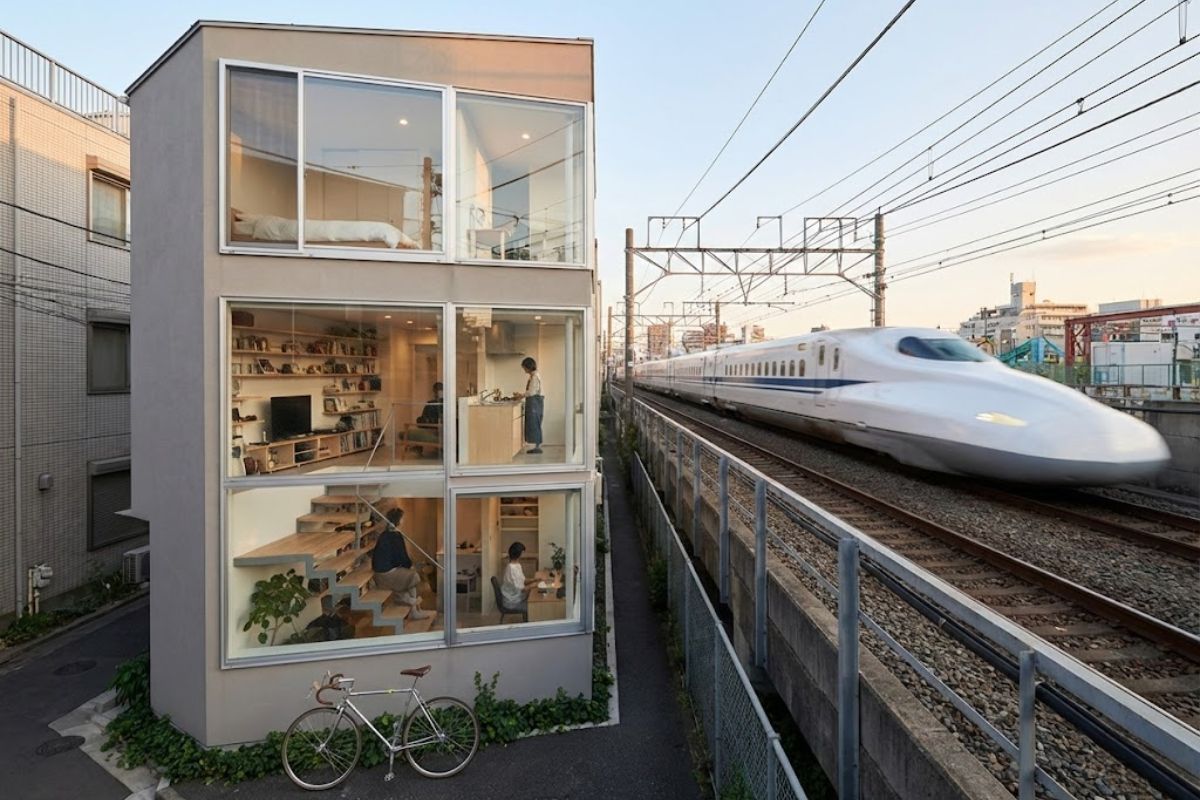
10 Minutes From Shinjuku, This House Was Born After Losing Two-Thirds of the Lot, Uses Interleaved Slabs Across Two Floors, a Central Pillar Like a Tree, and a Sculptural Staircase That Turns Into a Sofa, Closet, Office, and Viewing Point.
In Tokyo, a tiny house attached to the train tracks became a radical exercise in Japanese architecture. The house is 33 square meters, grows vertically, and turns stairs into living spaces, while trains pass by the windows every day.
The story begins with a loss of land. After the tracks needed to be elevated, the owner was asked to sell two-thirds of the lot where he lived for about 45 years. He decided to stay at the same address, rebuilding a new house on the remaining piece, an irregular plot with less than 30 square meters, where every centimeter needed to serve a purpose.
Where the House Is and Why This Location Changes Everything

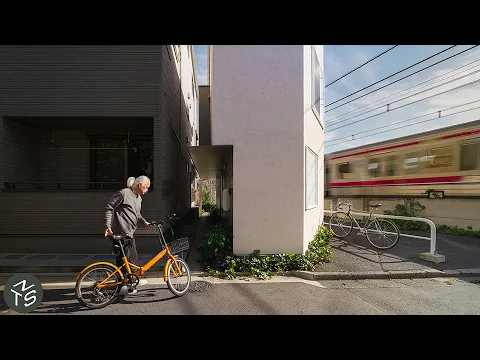
The house is located in a very convenient residential area of Tokyo, about 10 minutes by train from Shinjuku.
-
New CCR concrete paving technology promises roads up to 3x more durable, less maintenance, and cost reduction in Brazil.
-
Made from recycled plastic, plastic wood is gaining space in the construction industry because it does not rot, resists moisture, and reduces maintenance costs over the years.

-
Florianópolis will receive a million-dollar BRT that will begin construction in 2026 with nearly 400 million in funding from the federal government and the Inter-American Development Bank, and the map already shows the routes for the exclusive bus corridors.

-
Without a blueprint, without an engineer, and using scrap from the dump, a father spends 15 years building an 18-room castle for his daughter, featuring tram tracks, 13 fireplaces, and over 700 m², which may now be demolished.
This detail helps to understand why the owner insisted on staying there, even after losing most of the land.
The most striking point is the direct relationship with the railway line.
The facade faces the tracks, with windows framing trains passing in their routine, transforming an “urban problem” into part of the daily scenery of the house.
On clear days, from the large dining area window, it is also possible to see Mount Fuji.
How This House Was Born From a Brutal Cut in the Lot

Before the construction, there was a larger family house next to the tracks. The owner lived there with his family for approximately 45 years.

When the tracks needed to be elevated, the requirement to sell two-thirds of the land came.
Instead of moving out, he chose an extreme solution: to build a new house on the remaining land, maintaining the bond with the place, the neighborhood, and mobility.

This context explains the irregular shape of the lot and the compact scale that forced the house to grow upwards.
Who Designed the House and What Was the Central Idea

The house was designed by Takehiko Suzuki, founder of the Takehiko Suzuki Architects office in Tokyo.
The proposal was not simply to “fit” spaces into a small area, but rather to create a layered living experience, where circulation and permanence become the same thing.
The heart of the house is a sculptural staircase. It does not only serve as a connection between floors. It creates places, pauses, niches, and ways of being.
In some sections, the steps are slightly larger, forming platforms where one can sit, stop, place objects, look out the window, or simply be.
The Vertical Structure and the Pillar That Looks Like a Tree

In the middle of the building lies a thick pillar that resembles a tree. This element organizes the house and gives a sense of axis, as if the residence “grows” around it.
The house uses interleaved slabs within a two-story construction, creating levels that connect through small staircases, instead of dividing everything into traditional floors.
This system creates a continuous sequence of spaces, where the house unfolds at different heights, always guided by the steps.
Floor Plan and Distribution of Spaces by Levels
The logic of the house is simple, but extremely precise.
On the lower floor are the bathroom, the lavatory, and the laundry. The entrance and the bedroom are also located there.
The bedroom didn’t need to be wide, so it was placed in the narrowest part of the house, freeing larger areas for social spaces.
On the upper floor is the kitchen with an integrated dining area. Climbing a few more steps reveals an office that benefits from a protruding window.
Above that is the living room, with a custom-built sofa. The living room connects to a balcony.
At the top of the stairs is the attic, originally intended for storage but has become the place where the owner prefers to sleep.
Entrance: The First Shock of Light After the Dark Alley
Upon entering the house from a poorly lit alley, the feeling changes immediately.
You find yourself in a bright space thanks to the many windows. Natural light is treated as a building material.
The first steps at the entrance provide space for shoe storage. And it’s not just storage: the steps also serve as a bench for sitting and putting on shoes.
This sets the tone for the entire project. Nothing exists for a single purpose. Everything is designed to serve two or three functions at the same time.
Bathroom and Laundry: Details That Make a Small House Work

Two steps below the entrance is the laundry. There is a small bench beneath a small window, designed for the owner to cool off after a bath.
The bathroom furniture is made of birch plywood, chosen for its water resistance and durability, along with a shiny finish that helps enhance brightness in compact spaces.
This same material appears in other furniture around the house, creating visual continuity.
In the laundry, an integrated shelf can be accessed from both the laundry side and the bathroom side, a practical solution that reduces the need for additional furniture.
The floor is made of tiles, and the same tiles are repeated in the lavatory and bathroom. They are described as thermal, to avoid being too cold on bare feet.
The bathroom has a large window, providing daylight without the need for artificial lighting.
The sink and mirror were custom-made to fit the irregular shape. Above the toilet is a small birch plywood cabinet.
The electrical and plumbing installations were hidden in the space above this cabinet, preserving visual cleanliness.
The owner enjoys soaking in the bathtub, so the bathroom was placed in the widest part of the house.
The bathtub is also large considering the total size of the residence, a choice that shows how the project prioritized real comfort, not just minimalism.
Compact Bedroom That Turns Into a Closet and Storage at the Same Time
The bedroom is a few steps above the entrance and can be separated by a thick curtain, providing privacy without creating walls that would take up space.
It was designed to accommodate a compact futon.
Since the space is small, the floor uses small wood pieces, helping to give texture and scale to the environment. The area under the bedroom is entirely dedicated to storage.
The owner stores suitcases, seasonal clothes, and household items.
In practice, the bedroom also functions as a closet. Taking advantage of the ceiling beams, pipes were installed to hang clothes. There is a lower shelf for smaller items.
This shelving solution does not stop in the bedroom, it extends to the entrance, unifying storage and circulation.
Streamlined Kitchen with Materials That Can Withstand Daily Use

Between the dining area and the stairs, there is a waist-high cabinet that can be used from both the dining area and the stairs.
Both sides have sliding glass doors, allowing light to pass through and keeping the space airy.
Since the owner does not cook much, a simple kitchen was designed, containing only the essentials.
The countertop is made of stainless steel, chosen for easy maintenance. Wooden cabinets complement the rest of the furniture.
The kitchen walls are tiled with textured tiles that softly reflect light, enhancing the brightness that comes in through the dining room window.
Dining Area: The Train Window and Mount Fuji in the Background
The semicircular dining table was custom-made to facilitate movement in a narrow space. The shape reduces sharp corners and improves flow around the table.
Through the large window, you can see the trains passing by. The train is not a peripheral detail.
It becomes a constant presence, almost like a clock for the house.
On clear days, it is also possible to see Mount Fuji, adding a symbolic contrast between urban infrastructure and the distant natural landscape.
Tiny Office by the Protruding Window
The office is described as the smallest space in the house, but it was designed to be comfortable. It is next to a protruding window, created by extending the outer wall by 45 centimeters.
This small expansion becomes a huge gesture for the experience: it creates depth, light, and a point of focus.
The office is located above the entrance. It has a small desk for a computer and a perforated plywood panel on the wall for extra storage.
The owner has many clothes, hats, watches, and small items, and the wall allows him to display items openly, turning organization into decoration.
Living Room: The Favorite Place and the Custom Sofa
The living room is the owner’s favorite spot. He often sits on the rug, with his back against the central column, and listens to music.
The floor is covered with wool carpet, creating a cozy atmosphere.
He relaxes both on the sofa and on the rug. The sofa was custom-made to fit the space and is quite long, accommodating several guests.
The owner also often takes naps there. The fabric is light-colored and has a texture that makes dirt less visible, a practical decision for daily use.
The living room storage also serves as a support for the TV.
There is both open and closed storage, allowing him to hide what needs to be hidden and display what helps give the place its identity.
Balcony and Morning Routine: Sun, Photos, and Hanging Laundry
From the living room, there is access to a balcony. Every morning, the owner wakes up and goes to the balcony to enjoy the morning sun.
He also loves to take photos of Mount Fuji on clear mornings.
In addition to the experience, the balcony has a practical use: hanging laundry.
In a small house, the balcony becomes a functional extension of the routine, not a decorative luxury.
Attic That Was Meant for Storage but Became the Master Bedroom
At the top of the stairs is the attic.
It was originally designed as additional storage. But the owner found the space cozier and decided to sleep there.
As a result, the lower bedroom became primarily used as a closet and as an extra bedroom when his daughter comes to visit.
The attic floor is made of cork tiles, a soft and comfortable material even when kneeling, reinforcing the idea that the attic is not an improvised space; it’s true living space.
The Staircase as the Great Trick of the House
The most powerful detail of this house is how the staircase ceases to be circulation and transforms into furniture, a plaza, a bench, a corridor, and a lookout.
Wider steps become stopping points. Steps with niches hide storage. Steps at the entrance become a bench.
Steps connect levels as if they were branches. The logic is similar to a bird jumping from branch to branch: you find your favorite place to be.
In a small house, the proximity of the space to the body changes everything.
That’s why the question that guided the design is simple and profound: is a staircase just a staircase, or can it create a place to live?
Repeated Materials, Storage in Every Corner, and Light as a Priority
The house utilizes repetition of materials to visually unify the space and prevent a sense of fragmentation.
Birch plywood appears in furniture for its durability, finish, and moisture response. Tiles repeat in wet areas, aiding thermal comfort.
Storage has been integrated into every corner: under the bedroom, under floors, in tall cabinets, in shelves that cross spaces, in niches that accompany the staircase. This prevents a 33 m² house from becoming a cluttered mess.
And the windows are intentionally scattered.
They bring sunlight inside and reduce the need for artificial lighting during the day.
Simultaneously, they have been positioned to maintain privacy even with the railway line so close.
This house proves that a small house doesn’t need to be cramped; it needs to be smart.
It also proves that a staircase can be where life happens, not just the way to another floor.
Would you live in a house attached to the tracks, with trains passing by the window every day, if in exchange you had a 33 m² house that transforms into multiple places within one?










-

-

-

-

-

-

61 pessoas reagiram a isso.