





 Portuguese
  English
  Spanish
  4 min of reading
  0 comments


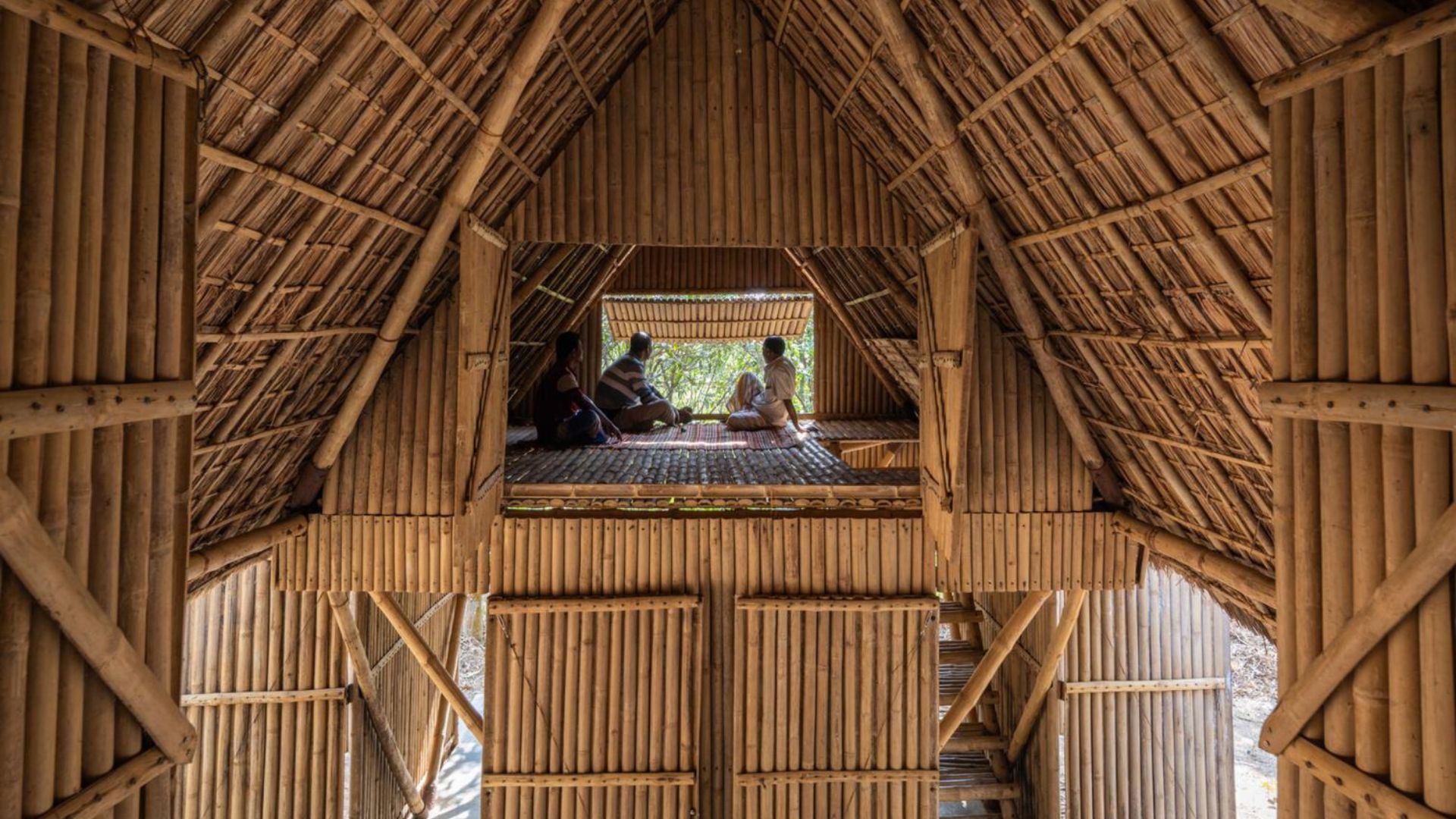
Modular Structure Created in Bangladesh Proposes Transportable Housing for Flood-Prone Areas, Using Bamboo and Manual Assembly. Project Khudi Bari Gained International Recognition for Presenting Adaptable Solution for Communities in Need of Moving Due to Rising Waters.
A house designed to be disassembled and transported, rather than remaining fixed on the ground, has been attracting international attention from Bangladesh, a country where floods and river erosion often alter the layout of banks and force residents to relocate.
Named Khudi Bari, a Bengali expression associated with the idea of “small house,” the system was developed by the office of Marina Tabassum Architects as a response to communities living in riverside areas prone to flooding and the gradual disappearance of land.
According to information released by the office and materials from the Aga Khan Award for Architecture, the project was conceived to allow manual assembly with simple tools and rapid disassembly, enabling the structure to be reinstalled at another location when necessary.
-
Friends have been building a small “town” for 30 years to grow old together, with compact houses, a common area, nature surrounding it, and a collective life project designed for friendship, coexistence, and simplicity.

-
This small town in Germany created its own currency 24 years ago, today it circulates millions per year, is accepted in over 300 stores, and the German government allowed all of this to happen under one condition.

-
Curitiba is shrinking and is expected to lose 97,000 residents by 2050, while inland cities in Paraná such as Sarandi, Araucária, and Toledo are experiencing accelerated growth that is changing the entire state’s map.

-
Tourists were poisoned on Everest in a million-dollar fraud scheme involving helicopters that diverted over $19 million and shocked international authorities.



In Bangladesh, a large portion of the rural population lives close to extensive and dynamic river systems, especially in the so-called chars, islands, and sandbanks formed by sediments, where erosion can destroy homes and force families to move multiple times.
In light of this context, the model proposes to treat mobility as part of architectural planning, and not as an emergency exception, structuring the house in reusable modules that reduce material loss when relocation is necessary.
Modular Bamboo Structure and Simplified Manual Assembly
The configuration of Khudi Bari utilizes structural bamboo combined with metal connectors, forming a lightweight and rigid set, described in the project documents as a spatial structure capable of efficiently distributing loads.
According to data presented by the office and by publications related to the Aga Khan Award, assembly can be completed in a few days by small groups, while disassembly tends to happen in a shorter timeframe, without the need for heavy machinery.

This performance is related to the elimination of common stages in conventional constructions, such as concrete curing and long drying periods, which, according to the project leaders, favors reconstruction in scenarios of sudden housing loss.
The plan provides for two overlapping levels, expanding the useful area and offering an alternative of temporary shelter in cases of flooding, in addition to promoting cross-ventilation, which is considered essential in warm and humid climates.
Local Materials, Reuse, and Adaptation to Floods
Bamboo was chosen for being widely available in the country and for its good strength-to-weight ratio, provided there is proper selection and preventive treatment against moisture and pests, as described in the project reports.
The sides can receive different types of closures, such as jute fabrics or reclaimed sheets, allowing adaptations based on material availability and families’ budgets, without compromising the integrity of the main structure.
The roof usually uses lightweight metal sheets, chosen for their durability and ease of removal, while elevating the house above the ground reduces direct contact with mud and moisture during flooding periods.

In addition, the modular organization allows for the replacement of damaged parts without requiring complete reconstruction, a strategy that, according to the designers, helps reduce waste and facilitate maintenance in areas prone to extreme events.
International Recognition and Architecture Award
The project has been circulating in international architecture exhibitions and events, including presentations linked to the Royal Academy of Arts in London, increasing the visibility of the proposal outside South Asia.
In 2025, Khudi Bari was included among the winners of the Aga Khan Award for Architecture, an award that highlighted the integration of local techniques and low-cost solutions aimed at vulnerable populations.
According to data released by the award, the estimated cost of a basic kit is around US$ 450, and more than seventy units had been built by early 2025, with monitoring to assess performance and durability.

For experts in resilient housing cited in institutional materials from the award, the system engages with current debates on climate adaptation by proposing alternatives that prioritize component reuse and speed of reinstallation.
The international recognition occurs amid increasing discussions about housing in flood-prone areas, a phenomenon affecting various regions worldwide and pressuring governments and organizations to seek solutions compatible with recurring risk contexts.
By transforming the house into a dismountable and transportable set, Khudi Bari fits into this global debate as an example of an approach based on local materials and simplified logistics, aimed at territories where prolonged permanence is not always possible.









Seja o primeiro a reagir!