





 Portuguese
  English
  Spanish
  6 min of reading
  2 comments


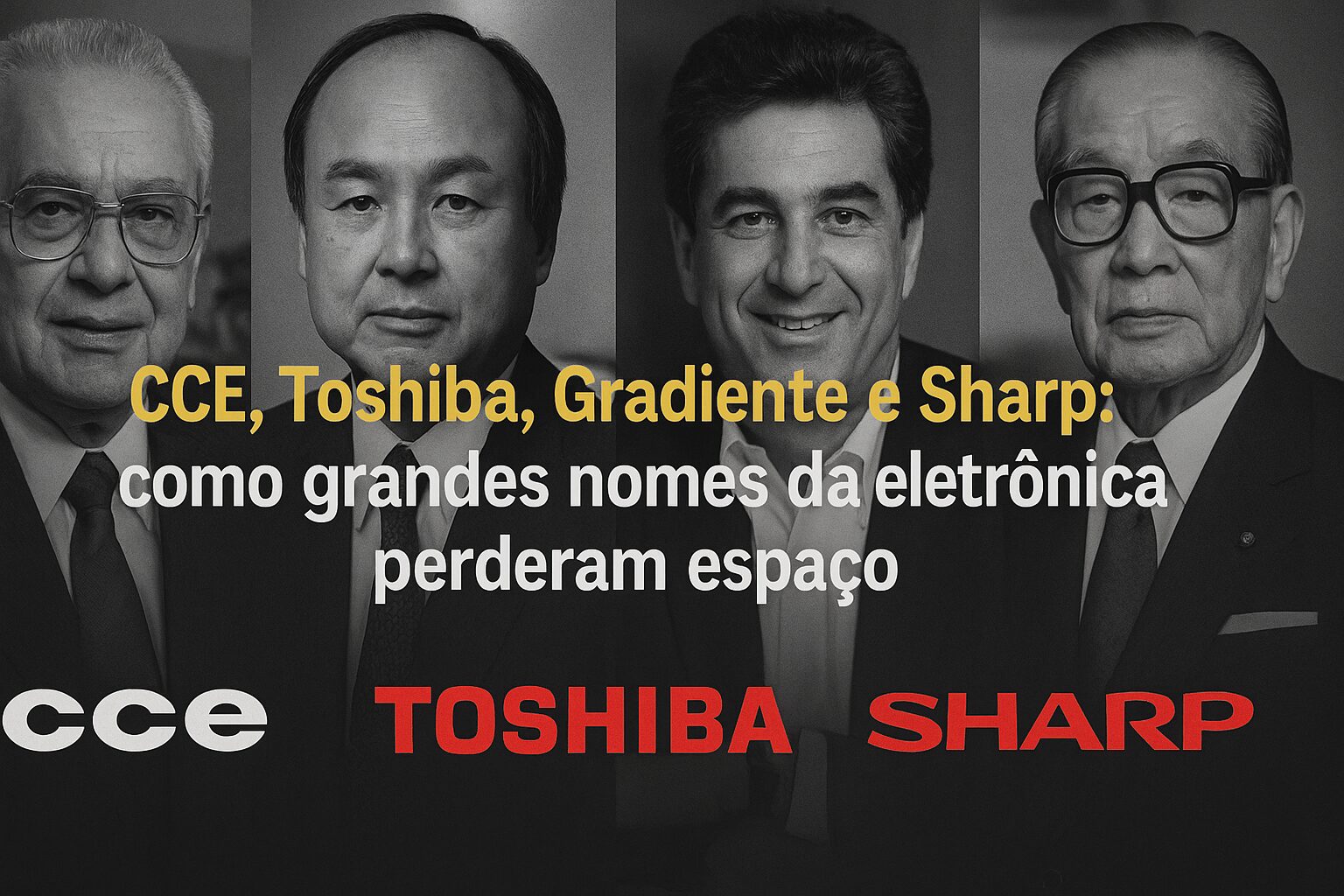


CCE, Toshiba, Gradiente and Sharp Marked Generations in Brazil and Worldwide with TVs, Radios, Audio Equipment and Video Games. But What Happened to These Famous Brands That Dominated the Market and Now Almost Disappeared from the Spotlight? Below, Understand the Origins, the Peak, and What Remains of Each of These Electronics Giants.
From the 1970s to the 1990s, the electronics market experienced a true consumption boom in Brazil, driven by import substitution policies, the growth of the middle class, and the strengthening of the Free Trade Zone of Manaus. In this scenario, brands like CCE, Toshiba, Gradiente, and Sharp gained prominence with products that were in practically every Brazilian home.
Each of these famous brands had its moment of glory, with innovative devices, competitive prices, and a strong appeal to consumers. However, all faced crises — and some completely disappeared from retail. Understand what happened to CCE, Toshiba, Gradiente, and Sharp.
CCE: From Popularity to Difficulties
CCE (Comércio de Componentes Eletrônicos) was founded in 1964 by Isaac Sverner. It started by importing electronic parts but soon transitioned to manufacturing its own products. Its differential was clear: to offer more accessible alternatives for a market that was still very elitist. Radios, audio devices, and later TVs and computers from CCE reached the shelves at lower prices than the competition.
-
Brazil is chosen as a global laboratory against plastic waste in a project that could last up to 7 years with tens of millions of dollars in investment to prove that the circular economy works on a continental scale.

-
A new study suggests that the Strait of Gibraltar may disappear because the rocks beneath it are triggering a subduction process that could reshape the entire Atlantic Ocean in the next 20 million years.
-
There is a little-known function that allows you to earn a salary in dollars working from home without knowing anything about programming, and Brazilians are already making up to R$ 35,000 per month organizing inventories and routes for American companies.

-
China has deployed over 1,400 fishing boats in formation, creating a barrier of 320 kilometers at sea, and the whole world wants to know if this is fishing, military exercise, or a message of war.


In the 1980s, CCE entered the video game market with models compatible with the Atari 2600. In the 1990s and 2000s, it focused on popular computers and appliances.
Although it did not have the same technical reputation as brands like Gradiente or Toshiba, CCE became one of the most recognized brands in Brazil — even if it was the target of jokes, like the saying “CCE: Comprei, Chorei, Entreguei.”
What Happened to CCE?
In the 2010s, CCE was acquired by Lenovo, which wanted to expand its presence in the national market. In 2012, the Chinese giant took over the brand butreturned control to the Sverner family in 2015 after disappointing results.
Since then, CCE has left the windows of major retail chains and operates with a limited presence, especially in the educational and B2B sectors. Although its production has decreased, the brand still exists — but very far from the presence it once had in the past.
Toshiba: The Japanese Giant That Became a Shadow
Toshiba was founded in 1939 in Japan, resulting from the merger of two technology companies. It innovated in various areas: it launched the first commercial notebook (T1100, in 1985), the first color video phone, and was a pioneer in flash memory technology.
In Brazil, it arrived in 1968 but gained strength in 1977 by forming a joint venture with SEMP, giving rise to SEMP Toshiba. This alliance yielded memorable products, such as TVs with built-in VCRs and the famous slogan: “Our Japanese are more creative than the Japanese of others.”
What Happened to Toshiba?
The decline began with internal problems and poor strategic decisions. In 2015, the company was involved inan accounting scandal after revelations of frauds that inflated artificial profits for years. Shortly thereafter, it suffered billion-dollar losses due to the bankruptcy of its subsidiary Westinghouse in the nuclear energy sector in the US.
Toshiba sold several divisions, including its notebook division (Dynabook) and its television division (sold to Hisense). The partnership with SEMP was terminated, and the Japanese company left the consumer market in Brazil.
How is Toshiba Currently?
Despite many thinking it was the end of Toshiba, the company still exists. Today, it operates in sectors such as:
- Energy and nuclear infrastructure
- Industrial solutions
- Rail and digital technology
In 2023, it was privatized by a Japanese consortium and is attempting to recover away from the consumer spotlight.
Gradiente: The Brazilian Pioneer That Still Resists
Gradiente – A National Technology Empire
Gradiente was founded in 1964 in São Paulo by Luis Alberto Salvatore and Nelson Bastos. It started with radios and amplifiers and soon began producing sophisticated sound systems.
In the 1970s, it stood out by popularizing the “sound system” concept and acquired brands like Garrard and Polyvox. In 1983, it launched the Atari 2600 in Brazil with an official license and later made history by founding Playtronic, in partnership with Estrela, bringing Super Nintendo and Nintendo 64 officially to the country.
What Happened to Gradiente?
After ups and downs, the company entered judicial recovery in 2007. Strong foreign competition, market opening in the 1990s, and accumulated debts brought down the empire.
In 2012, Gradiente returned as IGB Eletrônica, betting on cell phones, tablets, and nostalgic reissues, such as “My First Gradiente.” However, it could not regain the lost space.
How is Gradiente Currently?
The brand still exists and operates with a focus on niches, such as products for the elderly and nostalgic branding initiatives. IGB also became known for legal disputes with Apple over the use of the name “iPhone” in Brazil.
Gradiente is, of the four analyzed brands, the only 100% national one still active in the electronics sector — even if with significantly reduced operations.
Sharp: From the Japanese Revolution to the End of Operations in Brazil
Sharp was born in Japan in 1912, and its name comes from the Ever-Sharp pencil, created in 1915. It was responsible for technological advances in TVs, radios, calculators, cell phones, monitors, purifiers, and solar cells.
In Brazil, Sharp arrived in 1972, operated by the Machline Group. It stood out in the 1980s with cutting-edge televisions, portable radios, and sound systems, always with a strong appeal to the middle class.
It also produced electronic calculators in the Free Trade Zone of Manaus and gained fame for its durability and bold design.
What Happened to Sharp?
Sharp Brazil went into crisis in the early 1990s, following the death of Matias Machline, the businessman who led the local operation. The company faced financial difficulties and filed for bankruptcy in 2002.
The brand returned to the country in 2011, with corporate operations focused on multifunction printers, monitors, and digital solutions, aimed at businesses and governments.
How is Sharp Currently?
Globally, Sharp became part of Foxconn (the same company that manufactures iPhones for Apple), after being acquired in 2016. Its consumer operation has grown again in Asian and European countries.
In Brazil, Sharp no longer operates directly in the electronics retail market but maintains an institutional presence through licensed partners.
What Remains of CCE, Toshiba, Gradiente, and Sharp?
The famous brands that shaped electronic consumption in Brazil in the 70s, 80s, and 90s still hold symbolic value — but few maintain relevant operations.
| Brand | Current Situation |
|---|---|
| CCE | Still exists, under the control of the founding family, with limited operations. |
| Toshiba | Operates globally in industrial and energy sectors; no longer active in retail. |
| Gradiente | Survives as IGB Eletrônica, focusing on niches and nostalgia. |
| Sharp | Operates globally in B2B under Foxconn’s control; discreet presence in Brazil. |
The End of an Era — and the Memory of Brands That Marked Generations
What happened to CCE, Toshiba, Gradiente, and Sharp reflects the transformations in the global electronics market: the entry of Asian competition, changes in consumer behavior, and technological acceleration.
These famous brands were synonymous with innovation, status, and modernity. They were in homes, offices, schools — and are part of the collective memory of millions of Brazilians.
Today, even out of the spotlight, these brands leave a legacy of innovation and Brazilian identity, as well as lessons on adaptation, management, and the importance of investing in technology and constant renewal.





Todas as tecnologias fazem parte do conceito de que nada é estático,sempre inovando e descobrindo novas formas de produzir sempre com melhor qualidade e desempenho. Pelos menos é o que deveria acontecer. Hoje existem produtos atraentes pelo preço e design, porém, quase todos descartáveis .
Isso traduz em produtos mais barato porém uma enxurrada de lixos em todo o planeta .Isso colocou por terra o direto de milhões de pessoas a terem para si produtos de alta qualidade como :carro,tv,geladeira, rádio e milhares de outros produtos duradouros.
Entoa o grande lamento para quem pode comprar e ter qualidade em mãos
Saudade triste de um passado alegre !