





 Portuguese
  English
  Spanish
  7 min of reading
  0 comments


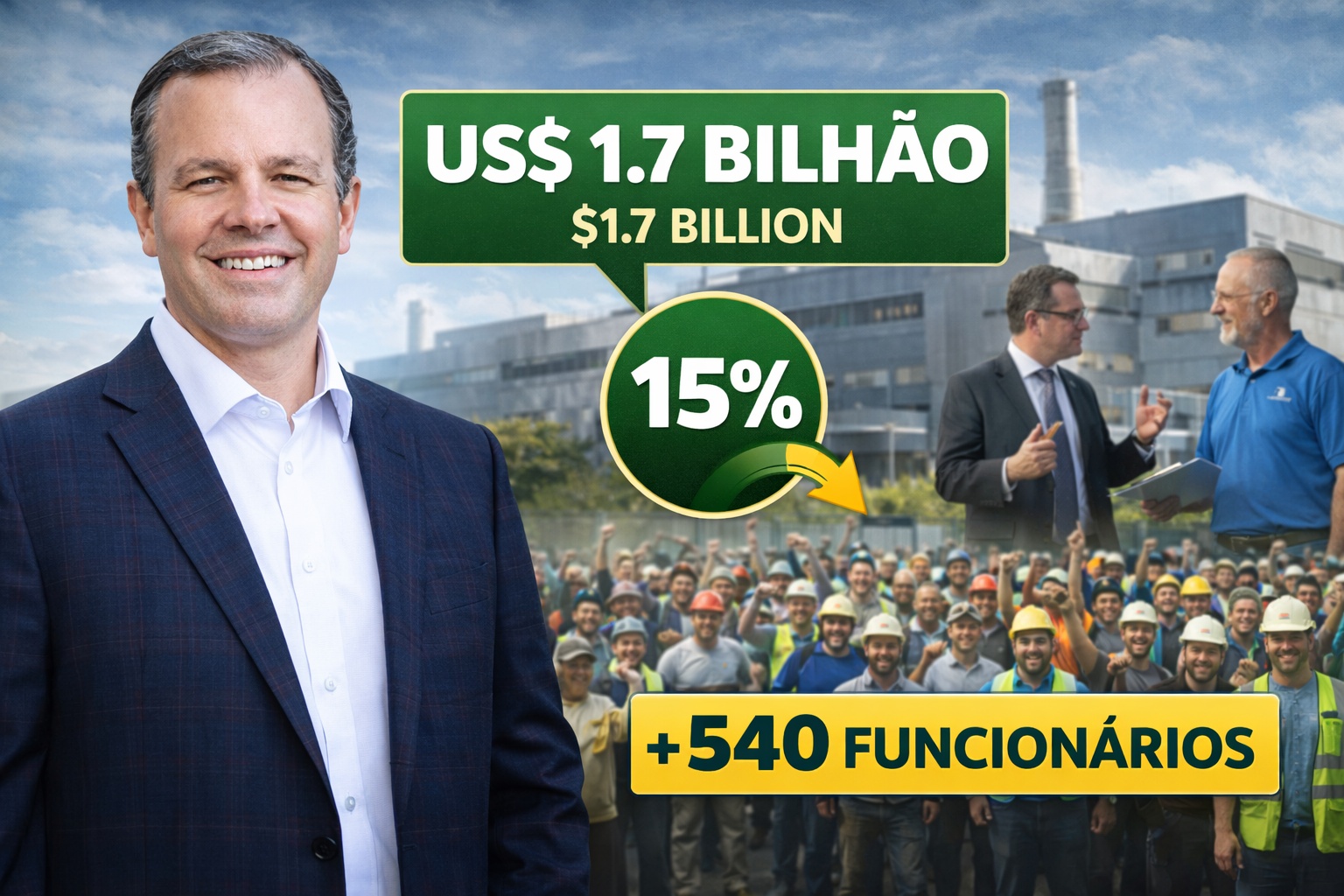
After Selling Fibrebond for US$ 1.7 Billion to Eaton, Graham Walker Allocated US$ 240 Million, 15% of the Value, to the 540 Employees, Changing the Lives of Workers Who Did Not Own Stocks in the Company.
On March 11, 2025, Graham Walker gathered the employees of Fibrebond in small groups across the 254-acre campus in Minden, Louisiana. He gave each one a sealed envelope. He asked them not to open it in front of coworkers. Lesia Key, 51, has worked at the company since 1995. She started earning US$ 5.35 an hour. She became the supervisor responsible for 18 people and the facilities across the entire campus. When she opened the envelope, she collapsed.
“Before, we lived paycheck to paycheck,” she told the Wall Street Journal. “Now I can live.”
What was in the envelope was the result of a decision made months earlier by Walker: when the energy management giant Eaton Corporation sat down to negotiate the purchase of Fibrebond for US$ 1.7 billion, he had one requirement that was non-negotiable. Fifteen percent of the sale price — US$ 240 million — would go directly to the 540 full-time employees of the factory. No exceptions. Even if none of them owned a single share of the company.
-
Friends have been building a small “town” for 30 years to grow old together, with compact houses, a common area, nature surrounding it, and a collective life project designed for friendship, coexistence, and simplicity.

-
This small town in Germany created its own currency 24 years ago, today it circulates millions per year, is accepted in over 300 stores, and the German government allowed all of this to happen under one condition.

-
Curitiba is shrinking and is expected to lose 97,000 residents by 2050, while inland cities in Paraná such as Sarandi, Araucária, and Toledo are experiencing accelerated growth that is changing the entire state’s map.

-
Tourists were poisoned on Everest in a million-dollar fraud scheme involving helicopters that diverted over $19 million and shocked international authorities.

“Close to a quarter of a billion dollars in the hands of employees seemed fair,” Walker told the Journal. Eaton agreed.
The Son Who Returned to His Father’s Factory
To understand why a CEO does this, one must start before Graham Walker existed as CEO. Claud Walker founded Fibrebond in 1982 with 12 employees in an old sawmill in Minden, Louisiana, bought after recognizing that the wireless telecommunications industry would need physical structures to protect its equipment.
The first products were fiberglass shelters for microwave towers. The first clients were Southwestern Bell Mobile Systems and Quest Microwave. By 1984, the company had expanded to a 180-acre site in Minden.
The cellular boom of the 1990s propelled Fibrebond’s growth. At some point during the decade, the company reached nearly 900 employees. This lasted until the fire.
Destruction and Reconstruction
In 1998, a fire destroyed the entire manufacturing plant. Production halted. Most companies in the Walkers’ position would have cut payroll the next day. The Walkers did not cut back. They continued to pay everyone while they rebuilt from scratch, a decision that employees who lived through that period never forgot. Within a year, a new factory was operating with even more advanced equipment.
Shortly thereafter, the dot-com bubble burst. Fibrebond’s telecom clients went bankrupt or shrank. The company’s customer base shrank from dozens to just three. The workforce, which had neared 900, was cut down to 320. It was the second major crisis in less than two years.
Graham Walker joined the company in 2004. A History graduate from Sewanee (University of the South) with an MBA in Finance from Louisiana State University, he had previously worked in corporate investment banking. He became CFO in 2006, then president and CEO in 2015 and found a company with debts to pay, employees who survived two crises in a row, and no certainty about where to go next.
His bet was on data centers.
The US$ 150 Million Turnaround and Creation of Fibrebond Power
In 2014, Graham created the Fibrebond Power division and began manufacturing custom-engineered electrical modules for data centers, the cabinets where power distribution systems for cloud computing facilities are located. In 2015, he merged the company with a manufacturer of generator modules in Illinois. And in 2020, he invested US$ 150 million in the expansion of the Minden campus.
The timing was spot on. The demand for data center infrastructure exploded along with cloud computing and later with AI. Fibrebond entered at just the right time with the right product. Sales grew nearly 400% in the next five years.


In April 2024, the Speaker of the U.S. House of Representatives, Mike Johnson — a congressman from Louisiana — visited the Minden campus in person to announce a US$ 150 million expansion. At that point, the factory was the largest employer in Webster Parish and the economic engine of a town that had been losing jobs and population for decades.
When Eaton came in to negotiate the purchase in 2025, Fibrebond had 51,000 modules installed in projects across the country, was the national leader in complex electrical modules for data centers, and was valued at US$ 1.7 billion. The Walker family had built all of this without any external capital — no private equity, no financial partners, no IPO.
And Graham Walker knew exactly who had helped build it.
The Non-Negotiable Clause: 15% of the Value to the 540 Employees
The incentive model at Fibrebond never differentiated much between those at the top and those on the factory floor. Bonuses were collective — based on safety metrics and the performance of the team as a whole, from the CEO to the front desk security. It was not a philosophy stated in the annual report. It was the way the company operated.

When Walker went to the negotiating table with Eaton, he applied the same principle to the sale. The condition was simple: 15% of the purchase price, held for the employees, paid in annual installments over five years. Those who stayed would receive everything. Those who left before the term would only receive a proportional amount of what had already been paid. Employees over 65 years old were exempt from the stay requirement.
The logic behind the timeframe was practical. “I think we wouldn’t have many employees on the second day,” Walker told the Journal, explaining why he structured the payments as retention incentives rather than immediate bonuses.
He wanted to ensure that Eaton found an intact operation and that the employees who had survived the 1998 fire, the cutbacks from the dot-com crisis, and years of frozen salaries had time and stability to use the money wisely.
Guaranteed Retirement
Eaton agreed. According to a company spokesperson, the deal “honors their commitments to the employees and the community.”
When the envelopes were opened, some employees thought it was a joke. Others called their children still on campus. Others went home unable to speak.
Hong “TT” Blackwell, 67, a logistics assistant with decades at the company, resigned immediately after receiving the bonus — several hundred thousand dollars. “I don’t have to worry anymore. My retirement is guaranteed and secure,” she told the Journal.
Lesia Key used part of her payment to pay off her mortgage. With the rest, she opened a clothing boutique in the neighboring town.
One employee took the entire extended family to Cancun, Mexico. Others paid off credit card debts, bought cars outright, paid for their children’s college or bolstered their retirement savings.
The mayor of Minden, Nick Cox, told the Journal that local retailers noticed a significant increase in sales. “There’s a lot of buzz about how much is being spent.”
Why Walker Did This
The most honest answer came in a sentence he told the Shreveport-Bossier Advocate, the local newspaper, on the day he left the company for the last time, two days after Christmas in 2025, making the rounds across the campus to say goodbye to each employee in person.
“We don’t usually see good things around here.”
Minden is a town that has lost jobs and residents for decades. When International Paper closed its local plant in 2012, 200 jobs vanished in one stroke. Fibrebond bought that facility in 2014 to open its power division — bringing back some of those jobs to the community that had lost them.

Walker never hid that he saw the company as part of something bigger than the bottom line. Fibrebond sponsored youth baseball teams, donated to St. Jude Children’s Research Hospital, and supported churches. Claud Walker, the founder, had built the company with that DNA and Graham Walker had preserved and expanded that culture during his ten years at the helm.
Why He Decided to Share US$ 240 Million with People Who Were Not Shareholders
The gesture of sharing US$ 240 million with people who were not technically shareholders was not a whim. It was the natural logic of someone who, in 1998, paid salaries while the plant was destroyed. And of someone who, in 2025, knew that without those same people who stayed during the tough years because they had few alternatives in Minden — there would be no billion to sell.
In the letter Walker wrote to employees after the sale closed in April 2025, he described what happened in the two-day collective meeting where the envelopes were distributed.
“Forty-three years of memories, failures, successes, and opportunities turned into tears, hugs, and deep joy. Our family fulfilled a commitment that we would win together.”
Walker left the company on December 31, 2025. He said he hoped, at 80 years old, to receive an email from someone telling him what that money had meant in that person’s life.
A photographer from Minden was hired to capture the moment each employee opened the envelope. Walker kept the photos.
“I have those photographs, and it’s something I will always know how it felt,” he said. “I will always remember.”










-

-

-

-

-

-

41 pessoas reagiram a isso.