





 Portuguese
  English
  Spanish
  4 min of reading
  4 comments


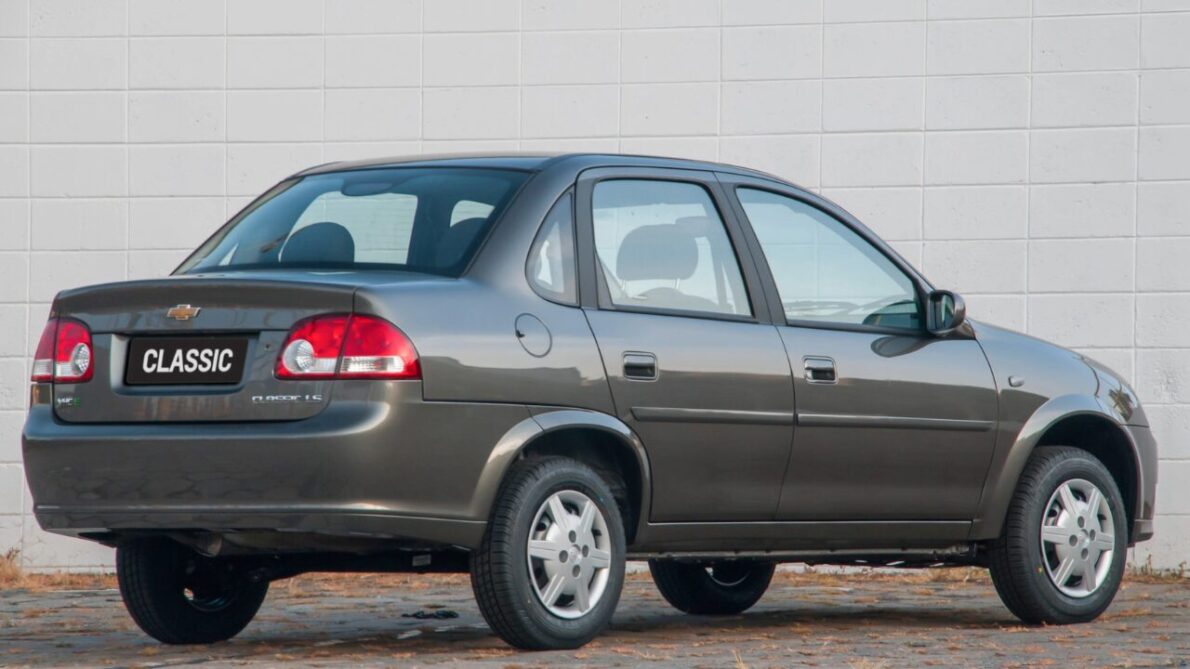


Chevrolet Classic: The Evolution Of The Corsa Into A Compact And Economical Sedan, Maintaining Simplicity And Functionality.
The Chevrolet Classic, one of the most popular models of Chevrolet in Brazil, is remembered by many as a car that combined simplicity and efficiency. Although it was launched as an update to the Corsa Classic, the model quickly distinguished itself by its proposal to be an accessible and practical sedan, winning a loyal consumer base over the years. With a design that reflected economy and functionality, the Classic became a viable option for those seeking a reliable vehicle without giving up on efficiency.
A Car With Aesthetic And Functionality
Although the Chevrolet Classic is not a revolution in terms of design, it managed to preserve the simplicity that has always characterized the model.
The lines of the car remained quite similar to the Corsa Classic, with some updates at the ends.
-
OMODA & JAECOO grows in Europe in 2026 with an integrated strategy of sales, innovation, local production, and technological advancement in the United Kingdom, Italy, and Spain.

-
OMODA & JAECOO expands after-sales service in Brazil with competitive maintenance, a 7-year warranty, and high availability of parts for technological SUVs.

-
OMODA & JAECOO appoints Alessandra Souza as executive marketing director in Brazil and accelerates brand expansion with a focus on innovation, networking, and hybrid portfolio.

-
Jaecoo 7 with super hybrid SHS system exceeds 1,200 km of combined range with a 1.5 turbo engine, high-density battery, and intelligent energy management.

At the front, the round headlights were replaced by pieces similar to those of the Corsa C, with a new bumper that complements the look.
At the rear, the horizontal taillights began to invade the trunk lid, a detail inspired by the Chevrolet Sail, a model aimed at the Chinese market.
This design approach aimed, above all, to keep costs low, one of the most appreciated features of the Classic.
The car was the cheapest sedan in the country at the time, and this accessibility made it a sales success.
However, this simplicity in design also has its drawbacks, such as the lack of more modern elements that could attract more demanding consumers.
The Chevrolet Classic was designed to be economical, both in purchase and maintenance.
Despite being launched in 2010, it retained the same GM4200 platform used in various other compact Chevrolet cars since 1994.
The reason for this choice was, again, cost reduction, allowing the Classic to remain an affordable option in the market.
The engine chosen for the Classic was the 1.0 aspirated Flex from the VHC-E line, capable of generating up to 78 horsepower and 9.7 kgfm of torque.
This configuration, although simple, met the car’s proposal of being an entry-level model aimed at consumers looking for economy and practicality.
The five-speed manual transmission also contributed to keeping the price affordable and maintenance costs low.
More Details About The Chevrolet Classic
Inside, the changes compared to the Corsa Classic were minimal. The instrument panel received new graphics, and the seats got a different pattern, but the overall layout remained the same.
The “T” shaped panel with horizontal air vents and the center console with ventilation controls and space for a 1DIN radio are legacies from the Corsa B, as well as the three-spoke steering wheel.
This lack of updates in the interior reflects the Classic’s philosophy of being a functional car, without luxuries or excesses.
For consumers who prioritize economy, this approach can be seen as an advantage, as the car offers exactly what is necessary for day-to-day use, without superfluous items.
The Chevrolet Classic has always been known for its simplicity, and this is reflected in its list of standard equipment.
The car comes equipped with manual windows, rear window defroster, sound preparation, and manually adjustable mirrors.
There are no items like air conditioning or power steering as standard, but Chevrolet offered optional packages for those who wanted a bit more comfort.
The Comfort kit, for example, added power steering, power windows and locks, while the Style kit included alloy wheels and headlights with black masks.
These packages allowed the Classic to cater to a slightly more demanding audience without compromising its proposal to be an affordable car.
Advantages And Disadvantages Of The Chevrolet Classic
The Chevrolet Classic is a car that stands out for its simple and cheap maintenance.
Its parts are widely available on the market, and maintenance tends to be easy to carry out, making it a popular choice among drivers looking for economy in their daily lives.
In addition, the Classic has an attractive resale value, making it easy to sell when it’s time to change vehicles, which adds another positive point to its list of qualities.
On the other hand, the performance of the Chevrolet Classic is modest. Despite improvements to the VHC-E engine, the car is not known for its agility, especially in situations requiring quick accelerations or overtaking.
Additionally, the Classic is essentially a basic car, with a limited list of standard equipment.
For those used to more modern and well-equipped cars, this simplicity can be a weak point.
Another factor to consider is that the Classic is based on an old project, which implies that it does not offer the same levels of comfort, safety, and interior space as more modern models.
For those looking for a family car, the Classic may not be the best option.
Similar Vehicles In The Market
The Chevrolet Classic faced competition from models such as the Fiat Siena, Volkswagen Voyage, and Ford Fiesta Sedan.
All these cars offer similar features, but each with its particularities.
The Classic, however, remained competitive thanks to its combination of simplicity, economy, and affordable pricing.









Gostaria de saber o ano o valor é completo qual cidade e estado
Sou frente carro, tive 2 e me arrependo ter mudado. Hoje ele está muito caro
Vendi o meu me arrependi, um carro que não dava mecânica, excelente