





 Português
  Inglês
  Espanhol
  3 min de leitura
  0 comentários


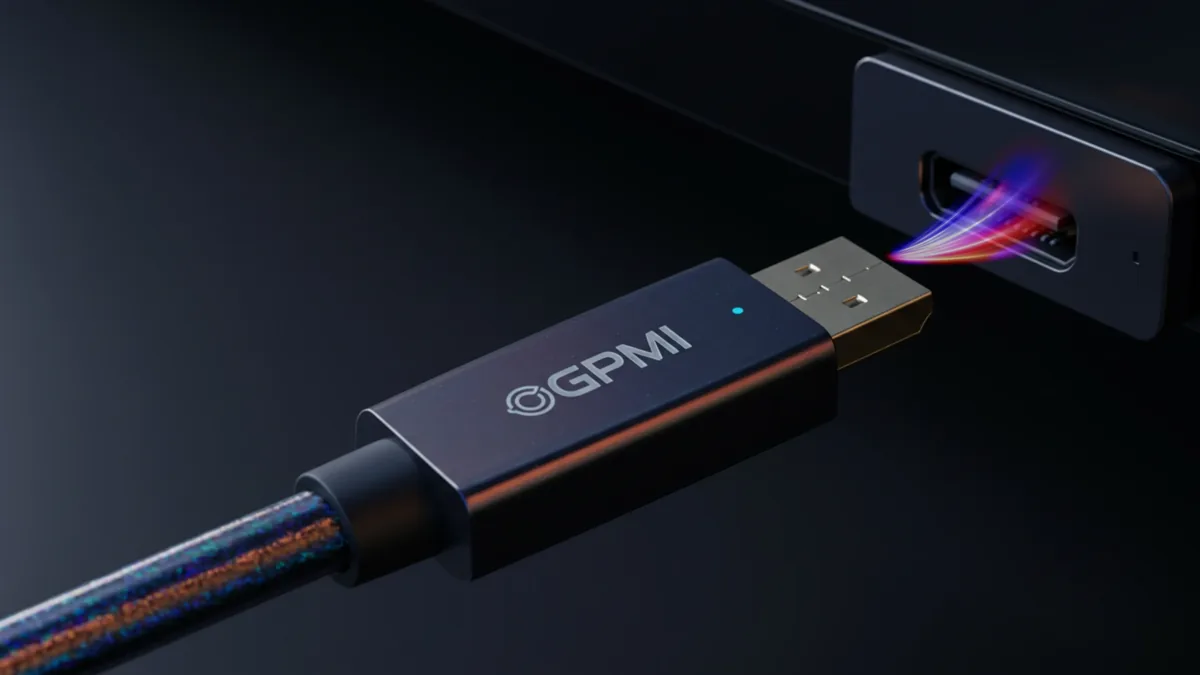
With Speeds of Up to 192 Gb/s and Support for Up to 480W of Power, GPMI Could Become the Main Alternative to HDMI and DisplayPort. Chinese Technology Aims to Unify Video, Data, and Power in a Single Cable.
A consortium formed by major Chinese companies, including Huawei, TCL, and Hisense, has officially announced the GPMI (General Purpose Media Interface), a new video transmission technology that promises to revolutionize the audiovisual sector. With performance superior to HDMI 2.1 and DisplayPort 2.1, GPMI emerges as a powerful and efficient alternative, focusing on versatility and sustainability.
GPMI Can Transform Connections with USB-C and USB-B
The great innovation of GPMI lies in its transmission capability: up to 192 Gbps of data and 480W of power, significantly surpassing current standards. The technology can be used through USB-C and USB-B ports, eliminating proprietary connectors and facilitating adoption in existing devices.
ARTIGO CONTINUA ABAIXOVeja também
A bright yellow mushroom imported from Asia escaped from a cultivation farm in the United States in 2010 and is now aggressively spreading across 25 states, destroying entire communities of native fungi in American forests.

Buried under China, a colossal machine weighing 20,000 tons began operating as the largest neutrino detector on the planet and, in just 59 days, surpassed results that science took half a century to achieve.

Iran enters the center of a climate alert after the war emitted 5.6 million tons of CO2 in two weeks, surpassing the annual pollution of entire countries.

Lunar exploration may change after a Chinese probe finds a “cavity” of radiation that reduces the impact on astronauts by up to 20% at certain times on the Moon.
Even using the popular USB-C, GPMI is already capable of offering 96 Gbps and 240W of power, placing it ahead of all current commercial video standards. In the less popular but more robust USB-B format, it reaches its maximum potential.
Moreover, GPMI is a bidirectional interface, meaning it allows for both data and power transmission and reception, ideal for modern applications such as set-top boxes, monitors, electric cars, and even industrial machines.
Comparison Between Video Technologies
To better understand the advancement brought by GPMI, check out the comparison with the main current video transmission standards:
- HDMI 2.1 (TMDS): 18 Gbps | no power
- HDMI 2.1 (FRL): 48 Gbps | no power
- DisplayPort 2.1 (UHBR20): 80 Gbps | up to 240W
- GPMI USB-C: 96 Gbps | up to 240W
- GPMI USB-B: 192 Gbps | up to 480W
In addition to the impressive speed, the new video transmission technology supports 8K resolution, high refresh rates, and compatibility with HDMI CEC, which means it allows control of multiple devices with the same TV remote control.
When Will the New Technology Arrive on the Market?
The companies involved in the development of GPMI announced that the launch will occur in phases. The first stage will include home entertainment products such as televisions and media boxes.
Subsequently, the technology is expected to reach the automotive and transportation sectors, with applications in electric cars and navigation systems. Finally, the expectation is that GPMI will be used in industrial environments where there is a demand for large volumes of data and power in real time.
In one of the presented examples, the companies demonstrated how a single GPMI cable could replace three different connections: HDMI for video, Wi-Fi for internet, and electrical power from the socket — all in one wire.
GPMI vs HDMI and DisplayPort: Which is the Most Advanced Video Input?
Today, the DisplayPort 2.1 connection is considered the most advanced commercially, supporting 80 Gbps, 32 audio channels, extended color depth, and 8K resolution at 85 Hz without compression. However, the arrival of GPMI could rapidly change this scenario.
The main advantage of this Chinese technology is its ability to offer much more in terms of bandwidth, power, and simplicity. If it delivers on its promises, GPMI could replace HDMI and DisplayPort in virtually all modern devices — and with just one USB port.







-

-

2 pessoas reagiram a isso.