





 Português
  Inglês
  Espanhol
  7 min de leitura
  3 comentários


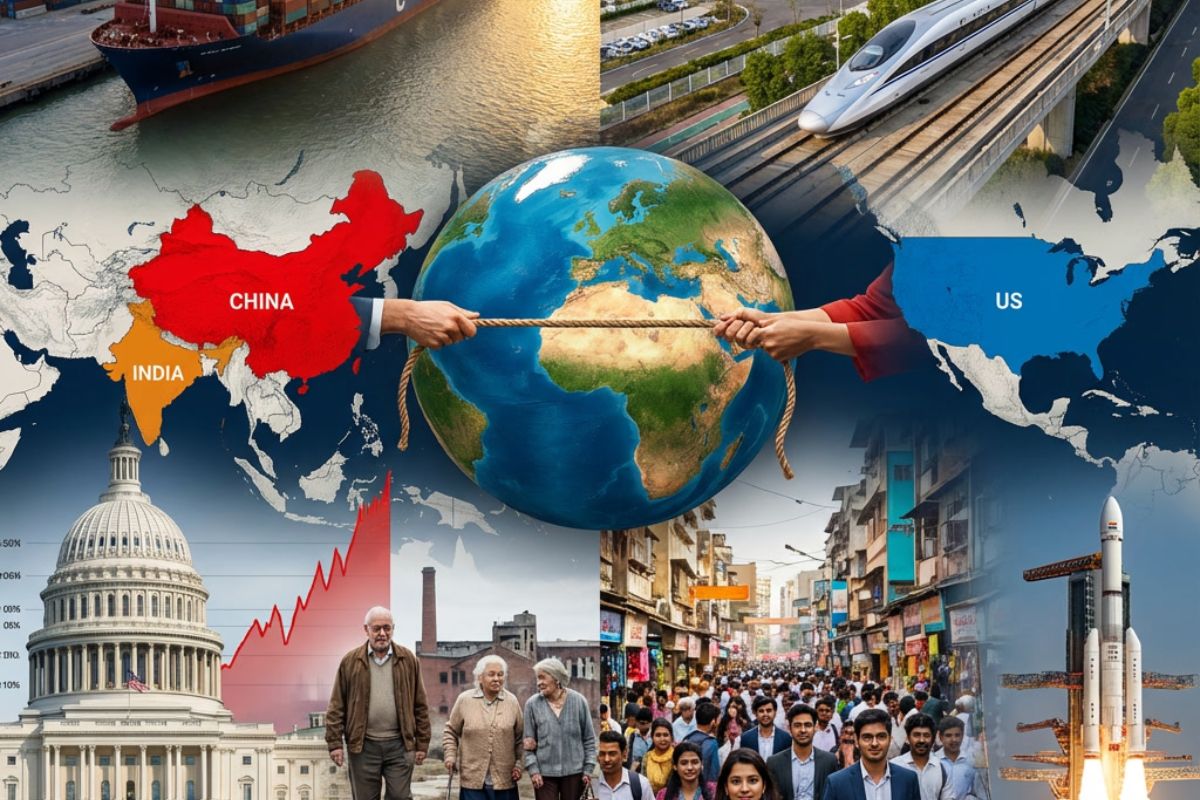


With High GDP, Record Trade Surpluses, and Leadership in Green Technology, China Pressures the United States in 2024 and 2025, Accumulates Reserves, Expands Influence in the Global South, and Faces Growing Debt, Aging, and India’s Demographic Competition in the New Multipolar Economic Order of the 21st Century in Dispute.
For over a century, the United States has held the position of the largest economy on the planet, but China, which has pursued this leadership for two decades, has closed the gap and is now the main challenger. In 2024, the nominal GDP of the U.S. is estimated at about 29 trillion dollars, compared to approximately 18 trillion dollars for the Chinese economy, which still represents a third less in goods and services bought or sold, but with a gradual convergence trajectory and increasing imbalances in other structural fronts.
In 2025, while the trade war initiated by Donald Trump with tariffs between 10% and 50% on Chinese products continues to influence global supply chains, China intensifies economic diplomacy. The Foreign Minister travels to Global South and African countries to compensate for barriers in the United States, and in September 2025 Xi Jinping hosts Narendra Modi in Beijing, seeking to consolidate the country as the voice of the Global South and a pillar of a new more multipolar global economic order, in which India and other emerging economies gain ground.
United States and China Compete for GDP, Industrial Production, and Structural Power

By the strict criterion of nominal GDP, the United States remains ahead of China, but the picture changes when the focus shifts to global goods production.
-
Brazilian city gains industrial hub for 85 companies that is equivalent to 55 football fields.

-
Peugeot and Citroën factory in Argentina cuts production by half and opens a layoff program for more than 2,000 employees after Brazil drastically reduced purchases of Argentine vehicles.

-
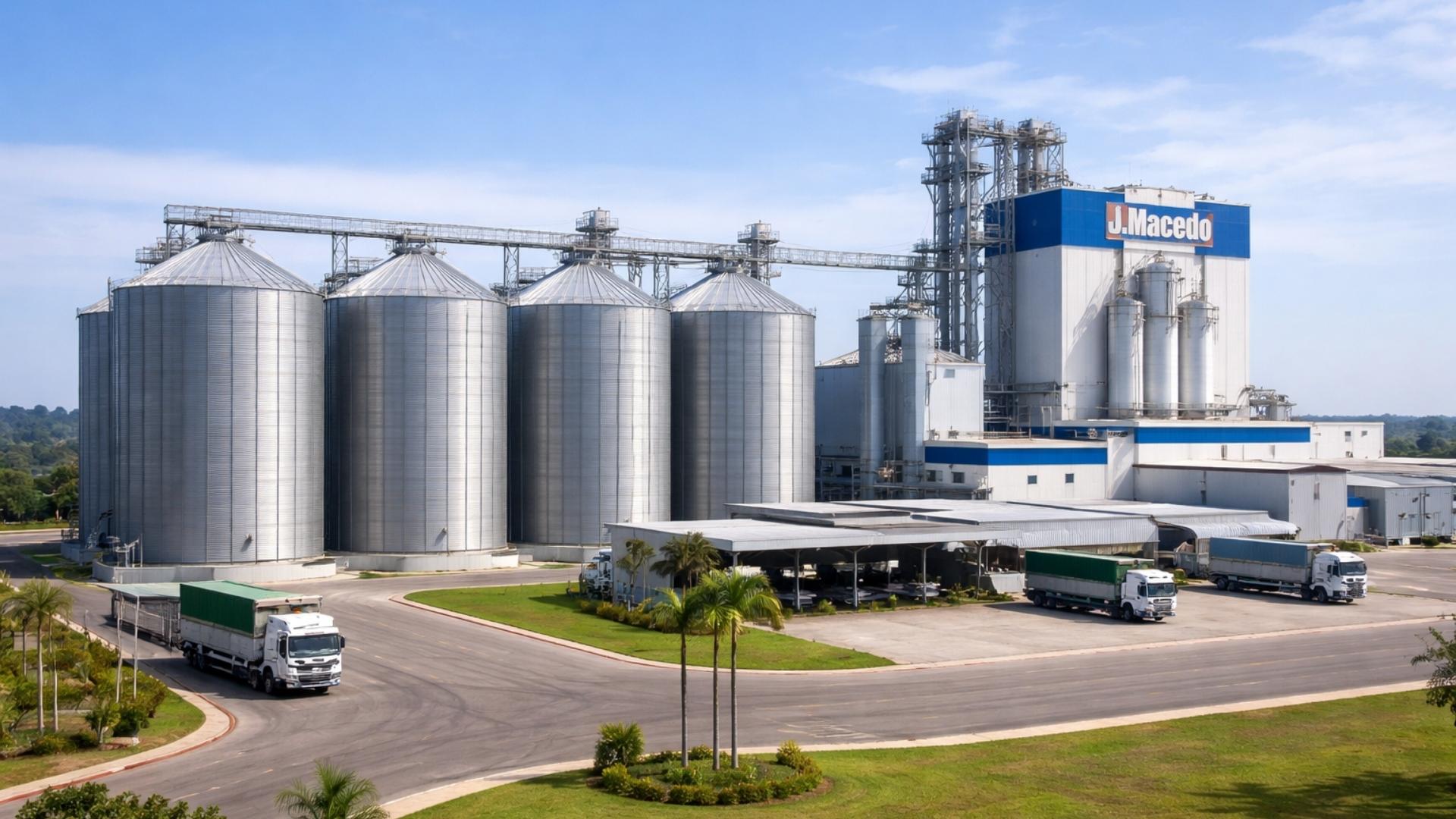
A Brazilian city gains a factory worth R$ 300 million with the capacity to process 200 thousand tons of wheat per year, a mill of 660 tons/day, silos for 42 thousand tons, and an industrial area of 276 thousand m².
-
Havan will leave the shopping mall in Blumenau to inaugurate something that the chain has never done before: a megastore in half-timbered style in the Historic Center of the city, which is expected to be completed in May and change the landscape of local retail.


The Chinese economy accounts for about 27.7 percent of goods produced in the world, compared to 17.3 percent for the United States, with Japan, Germany, and India trailing far behind in this industrial hierarchy.
This difference translates into manufacturing weight, productive infrastructure, and the capacity to scale technologies on a large scale.
China has become number one when it comes to the quantity of goods produced, while the United States maintains a significant advantage in finance, financial innovation, and depth of capital market.
In practice, the competition for global economic leadership is no longer just a GDP race and now involves control over production chains, critical infrastructure, and financial power.
According to experts, the current landscape leads to a dual diagnosis.
In the productive and energy sectors, the axis shifts toward China, which accumulates manufacturing capacity and applied technology.
In the financial realm, the assessment is that the United States maintains a commanding position due to having a global reserve currency, developed capital markets, and a banking system with greater international influence.
Surpluses, Reserves, and Diplomacy Extend China’s Reach

China is also notable for its external surpluses.
The country ranks at the top of trade balance rankings, with a surplus near 989.5 billion dollars and a positive result with about 150 partners.
Germany, Russia, the Netherlands, and Ireland follow, with much smaller figures, reinforcing China’s position as a major net supplier of goods to the rest of the world.
This surplus translates into robust international reserves.
With over 3 trillion dollars in foreign currency reserves, China possesses the largest currency buffer on the planet, which provides some protection against external shocks and enhances its ability to finance strategic projects, both internally and in initiatives for integration with other countries.
Diplomacy accompanies the numbers.
In 2025, visits to markets in the Global South and Africa are used to reorient trade flows and reduce dependence on Western buyers, especially from the United States.
The meeting of Xi Jinping with Narendra Modi in Beijing signals an effort to structure Asian partnerships that are not limited to the logic of rivalry but that recognize China as a mediator of the Global South’s interests in negotiations with the Global North.
State Capitalism, Growing Debt, and Internal Risks of the Chinese Economy

The Chinese state capitalism model is one of the central elements of the long-term strategy.
The Chinese government subsidizes expensive technologies with billions in public resources, chooses national champions, and maintains consistent support for business groups considered strategic.
This approach has allowed for the rapid construction of industrial capacities in sectors that require substantial investments and long payback horizons.
The other side of this model is the accumulation of liabilities.
The public debt of China hovers around 90 percent of GDP, placing the country among the most indebted in the world.
The combination of high indebtedness with recurring subsidies and state-owned or semi-state-owned enterprises reduces maneuverability in scenarios of slowdown.
Additionally, China’s economic growth is far from the double digits observed at the peak of expansion.
About a decade ago, the economy could no longer sustain such high annual rates and now advances at around 4 to 5 percent per year.
Experts mention economic policy errors, misallocation of capital in some sectors, real estate bubbles, and the impact of an aging population as factors weighing on the medium and long-term trajectory of China.
Green Technology and Energy Transition Strengthen China’s Advantage
If debt raises alarms, green technology is one area where China appears to be better positioned for the future.
The country produces about 80 percent of the world’s solar panels, 70 percent of wind turbines, and 60 percent of electric vehicles, indices that highlight the centrality of the Chinese industry in the transition to a low-carbon economy.
Meanwhile, the situation is distinct in the United States.
The Trump administration opted to withdraw the country from the Paris Agreement, reduce subsidies for wind farms, and bet on fossil fuels like coal and oil, under the banner of expanding exploration and exports of hydrocarbons.
For analysts, encouraging oil and closing markets for clean exports tends to undermine U.S. competitiveness in segments that should lead economic growth in the coming decades.
In the view of these specialists, technologies such as solar photovoltaic, wind, battery storage, and electric vehicles clearly indicate the direction of the global economy.
In energy terms, the bet falls much more on the future of China than that of the United States.
In the financial realm, however, the reading is the opposite: the U.S. remains the global reference in currency, credit, and market structure.
Digital Surveillance, Business Distrust, and Limits of the Chinese Model
The technological advancement of China is not limited to energy and industry, but also manifests in internal monitoring digital systems.
The government’s surveillance apparatus tracks citizens and companies, fueling fears among foreign groups regarding the protection of industrial secrets, sensitive data, and individual freedoms.
Many international companies show reluctance to invest in China precisely because of this surveillance environment and the dominant role of the state in the economy.
The perception of regulatory risk, lack of predictability, and the possibility of government access to strategic information weighs on the decision to relocate production chains or diversify investments to other countries.
Alongside this, the accelerated aging of the population reduces the available workforce and pressures pension and health systems.
The most populous country in recent decades is now facing a scenario of lower demographic dynamism, contrasting with emerging markets with younger and growing populations, like India.
Young India, Diplomatic Neutrality, and Multipolarity Under Construction
India emerges in this scenario as a potential beneficiary of some of the pressures currently weighing on China.
The country has surpassed China’s population mark, possesses a young demographic profile, and operates as a democracy with a greater degree of political pluralism, albeit with relevant internal challenges.
In foreign policy, multipolarity works for India, which has historically maintained a stance of neutrality since 1947, avoiding rigid alignment with rival blocs.
In an environment where bloc domination is seen as harmful, India’s strategy is to negotiate with different poles of power, extracting economic and technological advantages without committing exclusively to either the United States or China.
This repositioning opens space for production chains reoriented by the quest for geopolitical security and lower regulatory risk to find an alternative in India, especially in sectors that require abundant labor and expanding domestic markets.
At the same time, the country still needs to consolidate infrastructure, education, and industrial capacity to compete with the scale already reached by China.
A 21st Century Without a Single Hegemon in the Global Economy
Given this set of factors, the initial question remains open: will China lead the new global order or will the world continue without a single economic hegemon?
The picture that emerges is of a more distributed order, in which the United States, China, India, and other emerging economies share portions of economic, technological, and financial power.
There are many signs that countries like India may gain ground as China’s growth slows down and the cost of maintaining high debts, an aging population, and a restrictive surveillance apparatus becomes heavier.
In parallel, the United States faces the challenge of reconciling financial leadership with relative delay in key segments of the energy transition, while the Global South seeks to amplify its voice in multilateral forums.
The likely outcome is an increasingly multipolar economic order, with disputes over value chains, green technology, diplomatic influence, and access to markets.
Instead of a simple exchange of hegemony, the scenario suggests a redistribution of power, in which no single actor is able to dominate all axes of power simultaneously.
In your view, does China still have the strength to dethrone the United States as the leading economic power, or has the rise of India and multipolarity made a 21st century without a single leader in the world economy inevitable?









Sim. Nós observamos na história da humanidade que essas dominações hegemônicas são evidentes no cenário mundial. Retroceder um pouco no tempo, temos a Mesopotâmia, em seguida, Egito, Babilônia, o império Medo-Persa, Grécia, Roma, a qual sucumbi em 1453, tomada pelos Turcos Otomanos, e assim vai, de um país para o outro o domínio mundial, seja pela força, seja pela estratégia econômica.
A partir desse pressuposto simples, observamos que a China vai superar economicamente os Estados Unidos.
Esse é um perfil de quem só olha por cima, e não profundamente, para a China alcançar os EUA. Ela tem que fazer muito mais do que tentar. Se os EUA cortarem algumas coisas, ela desmonta.
Trump vai renunciar…