





 Portuguese
  English
  Spanish
  4 min of reading
  0 comments


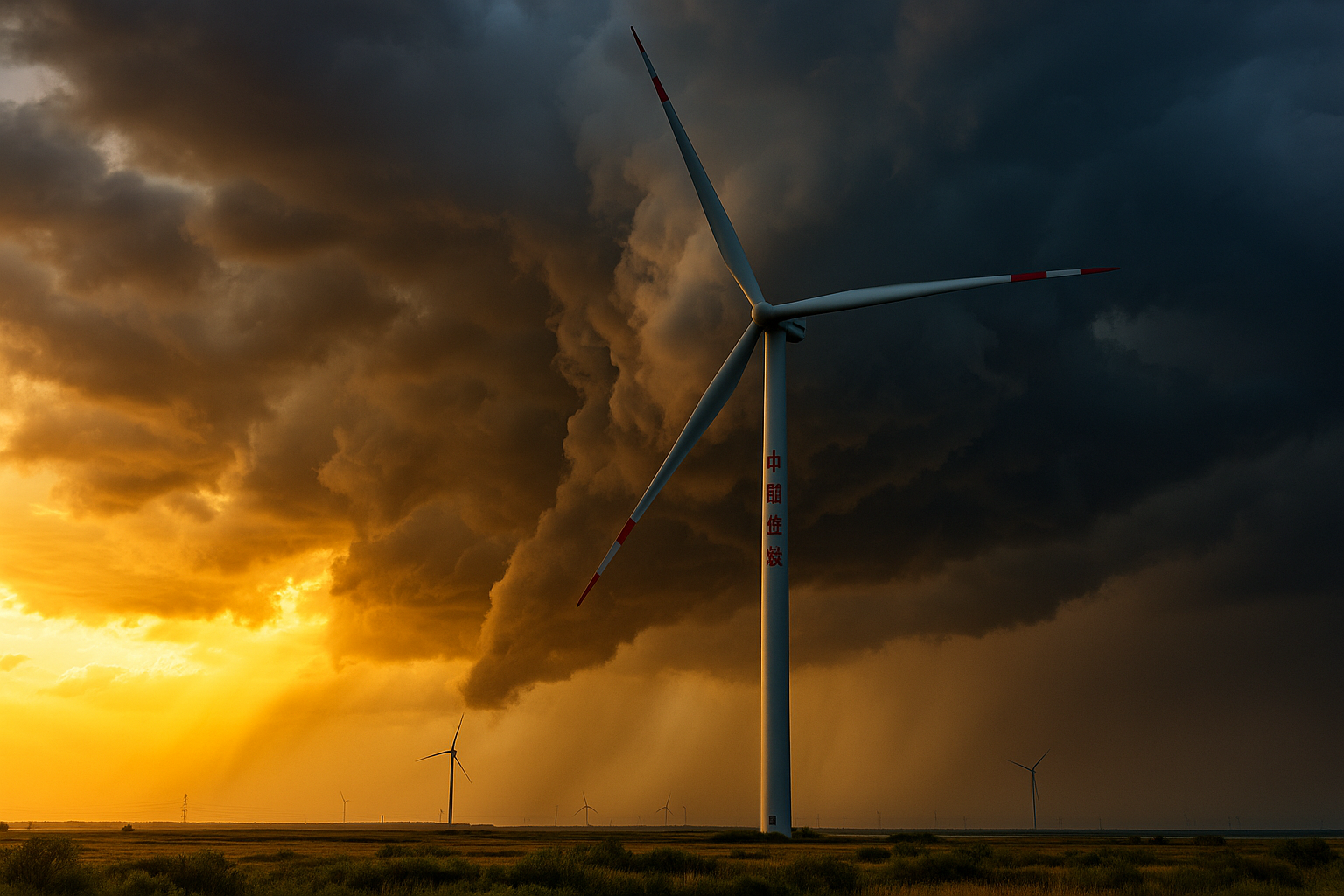
China, The Asian Giant, Holds Over 65% Of The World’s Wind Energy Capacity And Houses Four Of The Five Largest Global Wind Turbine Manufacturers
The star of the moment is the turbine SI-270150, with an impressive capacity of 15 megawatts. Just to give you an idea of what that represents: its blades measure 131 meters each, forming a rotor of 270 meters in diameter. That’s larger than three football fields lined up! For comparison, the One Tower, the tallest building in Brazil, is 290 meters tall. The Sany turbine is only 20 meters shorter — and we’re not talking about a building, but a rotating structure!
The first unit was connected to the grid in October 2023 and became fully operational on November 16. Since then, it has the capacity to generate about 56 million kWh per year, enough to supply tens of thousands of Chinese households.
-
Renewable energy advances over protected areas in Brazil, and a survey by the Energy Transition Observatory reveals silent impacts that challenge environmental conservation and pressure sensitive traditional territories.

-
Rio Grande do Sul accelerates energy transition: State invests in renewable technologies and consolidates decarbonization strategies and pathways to attract billions in new industrial investments.

-
With 160,000 m² of collectors, an area larger than 20 football fields, Silkeborg, in Denmark, hosts a solar thermal plant that heats 19,500 homes and could become the largest solar heating plant in the world.

-
A study reveals the expansion of renewable energy procurement in Brazil and shows how companies are taking advantage of opportunities to reduce expenses, ensure energy efficiency, and strengthen strategic environmental commitments.

Movement Of The Enormous Blades May Be Interfering With Air Circulation In The Region
When it comes to wind energy, the environmental impact is generally considered minimal. However, in the case of this giant turbine, something curious began to happen. Chinese scientists noticed changes in local wind patterns and temperature distribution around the installation. Located in Tongyu, in Jilin province, the turbine is in a test park, where its effects are being carefully observed.

The suspicion is that the movement of the enormous blades may be interfering with the air circulation in the region. According to previous research, this type of interference can alter the thermal balance of neighboring areas, raising questions about the sustainability of such large turbines in the long run.
Powerful Turbine From China: A Rigorous Testing Phase
Before being launched for commercial use, the SI-270150 turbine will undergo a battery of tests that includes more than 2,000 simulations under real conditions. Sany expects the equipment’s lifespan to range between 25 and 30 years, which places it among the most durable on the market.
According to the company itself, the focus now is to understand the project’s performance in different climatic and operational scenarios. This includes measuring noise levels, efficiency at low wind speeds, and, of course, the impacts it is generating on the surrounding environment.
Race With Europe: Who Will Go Further?
While China continues to invest heavily in ever-larger and more powerful models, Europeans are facing obstacles in keeping pace. The logistics of transporting gigantic components, combined with difficulties in obtaining environmental and urban permits, make it unfeasible to install such large onshore turbines in many Western European countries.
Currently, China holds over 65% of the world’s wind capacity and houses four of the five largest global wind turbine manufacturers. In addition to Sany, another Chinese company, Mingyang Smart Energy, recently installed the world’s largest offshore wind turbine, with a capacity of 20 MW. In comparison, European wind farms are still using models with capacities between 6 and 12 MW, as shown in this report by WindEurope.
China’s Bet On Gigantic Turbines
China’s bet on gigantic turbines like the SI-270150 is not just a matter of ostentation. It is a strategy to reduce costs per megawatt and increase productivity in areas with less wind. According to experts from Tsinghua University, “scalability may be the key to economically viable energy transition in countries with large land areas.”
Additionally, China is accelerating the construction of wind farms in inland regions, connecting them to smart grids that optimize energy distribution. This could completely change the global landscape in the coming years, as pointed out in a report by the International Energy Agency.
A Future Of Giant Blades (And Different Climates?)
It is still early to say whether the impacts on the microclimate will prove to be an environmental issue or just a transient phenomenon. But the fact that a single turbine can alter wind dynamics in a region already raises important discussions about the limits of engineering and the environmental consequences of technological advancement.
With rigorous testing, data being collected, and the world watching China’s decisions, the future of onshore wind energy is being shaped now — and it is made of blades the size of a building.
What do you think about such large turbines changing even the climate? Leave your comment below or share this content with someone interested in clean energy and cutting-edge technology!







Seja o primeiro a reagir!